answer.
Ask question
Login Signup
Ask question
All categories
  • English
  • Mathematics
  • Social Studies
  • Business
  • History
  • Health
  • Geography
  • Biology
  • Physics
  • Chemistry
  • Computers and Technology
  • Arts
  • World Languages
  • Spanish
  • French
  • German
  • Advanced Placement (AP)
  • SAT
  • Medicine
  • Law
  • Engineering
Wittaler [7]
2 years ago
3

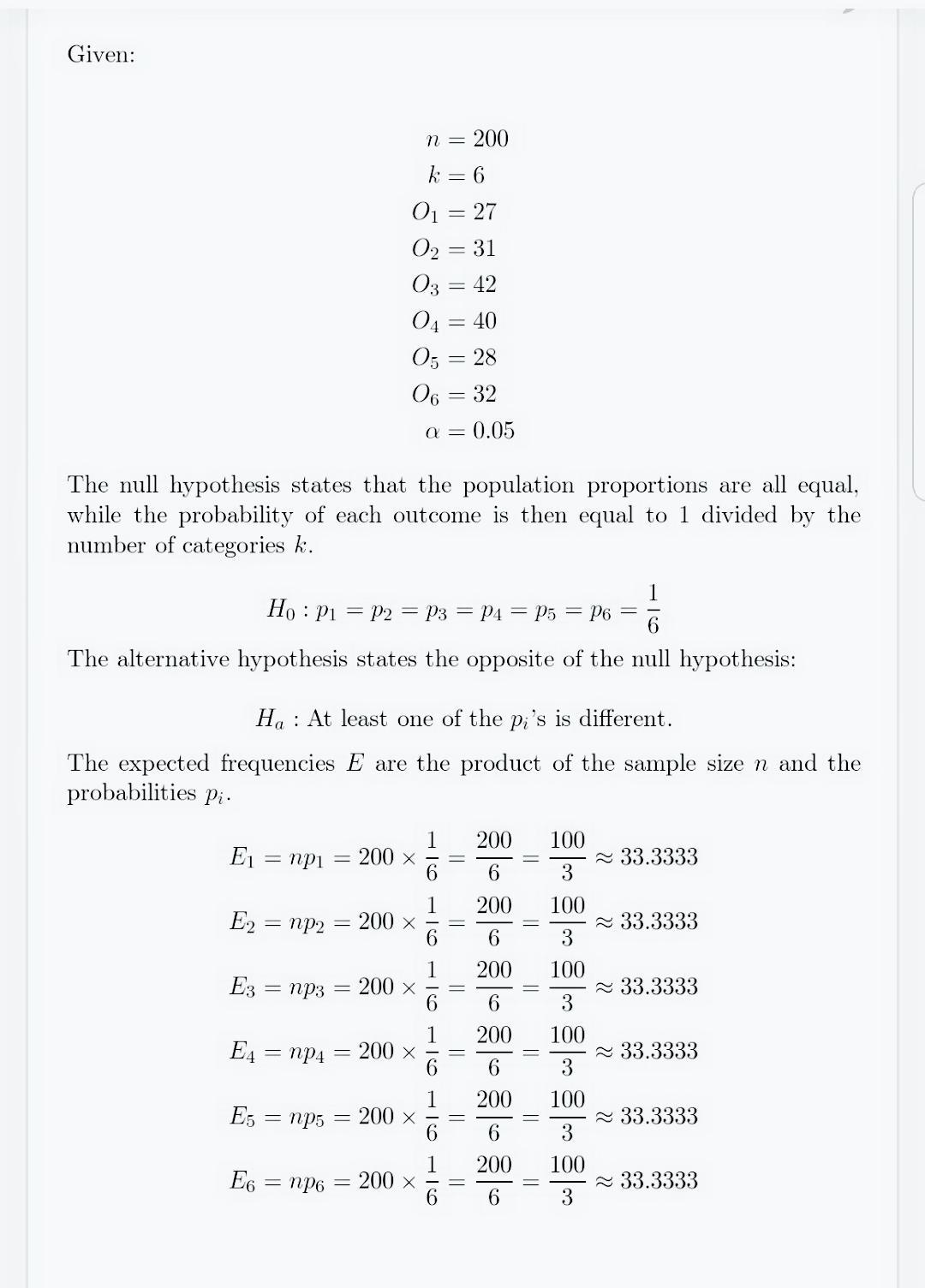
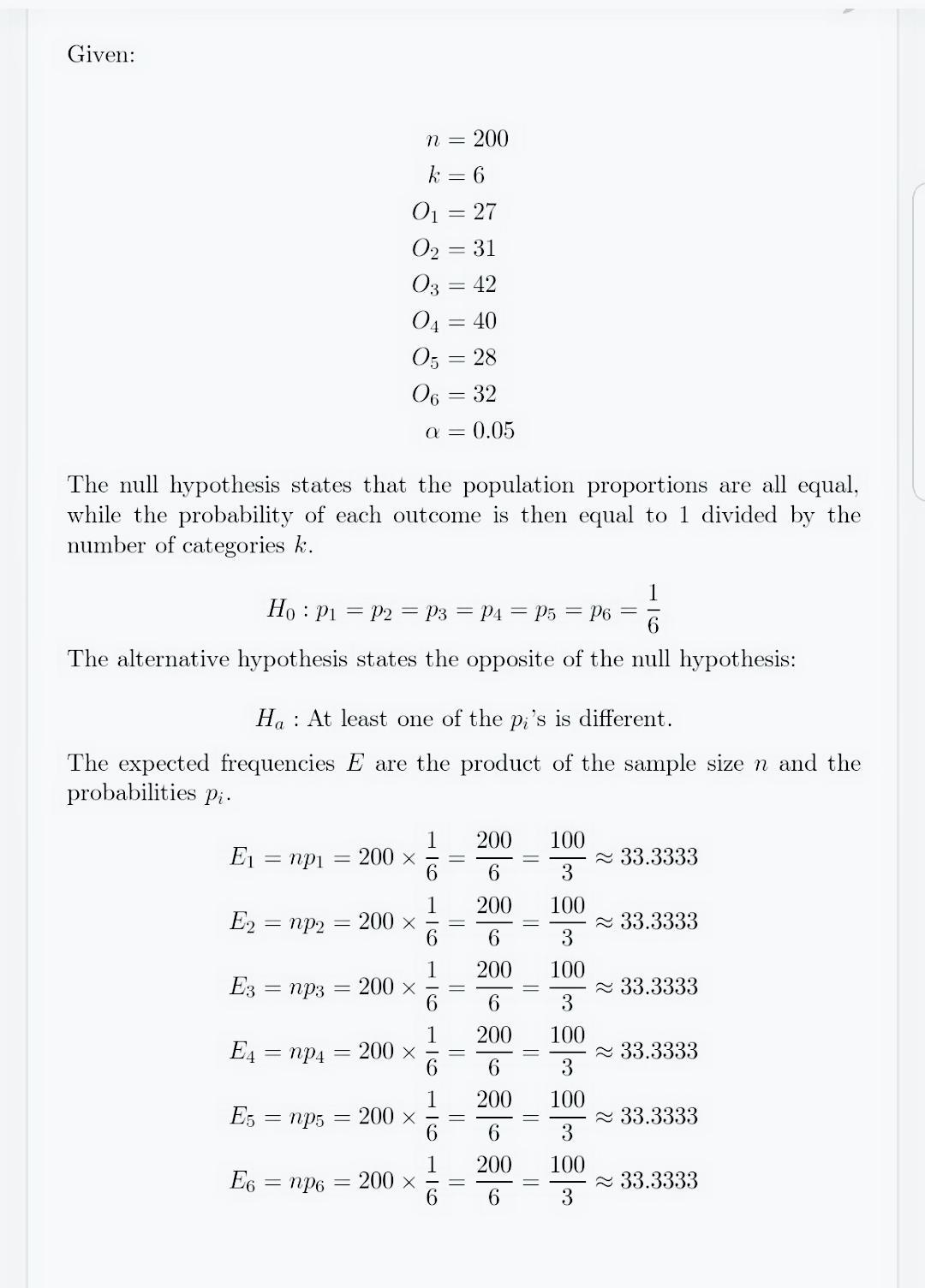
Conduct the hypothesis test and provide the test statistic and the critical​ value, and state the conclusion. A person drilled a

hole in a die and filled it with a lead​ weight, then proceeded to roll it times. Here are the observed frequencies for the outcomes of​ 1, 2,​ 3, 4,​ 5, and​ 6, respectively: ​, ​, ​, ​, ​, . Use a significance level to test the claim that the outcomes are not equally likely. Does it appear that the loaded die behaves differently than a fair​ die?

Mathematics
1 answer:
zhenek [66]2 years ago
4 0

Answer: There is no sufficient evidence to support the claim that loaded die behaves differently than a fair die

Step-by-step explanation:

Find explanations in the attached file

You might be interested in
In the figure the horizontal lines are parallel and ab=bc=cd if lm =5 find jm
Leviafan [203]
Answer is c or 10

thanks!
7 0
2 years ago
Read 2 more answers
There are 28.35 grams in an ounce and 2.21 pounds in a kilogram. Miriam converted 7 kilograms to ounces, but her answer is not c
sergejj [24]

Answer: OPTION C.

Step-by-step explanation:

For this exercise it is important to remember the following:

1\ kilogram=1,000\ grams

Knowing this and based on the information provided in the exercise, you can make the conversion from kilograms to ounces. This is:

(7\ Kg)(\frac{1,000\ gr}{1\ Kg})(\frac{1\ oz}{28.35\ gr})=246.913\ oz

According to the exercise, Miriam's procedure was:

 (7\ Kg)(\frac{1,000\ gr}{1\ Kg})(\frac{28.35\ gr}{1\ oz})= 198,450\ oz

So you can identify that she made a mistake.

Notice that:

1. Miriaim multiplied correctly.

2. Butt the third fraction should be \frac{1\ oz}{28.35\ gr} and not \frac{28.35\ gr}{1\ oz}.

5 0
2 years ago
Read 2 more answers
What is the volume of the prism? 1080 cm 2700 cm 3240 cm 6480 cm
makkiz [27]

Answer:

Volume of prism = 3,240 cm³

Step-by-step explanation:

GIven.

Hexagonal prism.

Side of base(b) = 12cm

Height of prism = 9cm

Height of base (h)= 10cm

Find:

The volume of the prism.

Computation:

Area of base of hexagonal prism = n/2[bh]

Area of base of hexagonal prism = 6/2[(12)(10)]

Area of base of hexagonal prism = 360 cm²

The volume of prism = Area of base of hexagonal prism × Height of prism

The volume of prism = 360 × 9

Volume of prism = 3,240 cm³

3 0
2 years ago
Which graph shows a dilation? On a coordinate plane, 2 quadrilaterals are shown. The larger quadrilateral has points (negative 4
gayaneshka [121]

Answer:

On a coordinate plane, 2 quadrilaterals are shown. The larger quadrilateral has points (negative 5, 3), (1, 3), (4, 0), (negative 2, 0). The smaller quadrilateral has points (negative 1, 0), (negative 2, 1), (0, 1), and (1, 0).      

Step-by-step explanation:

<u>Larger quadrilateral</u>

Length of the top and bottom segments are 6 units.

Length of the left and right sides:

d = √[(-5 - (-2))² + (3 - 0)²] = √[3² + 3²] = √(2*3²) = 3√2 units

From point (-5, 3) to point (-2, 0) the slope is:

m = (3 - 0)/(-5 - (-2)) = -1

<u>Smaller quadrilateral</u>

Length of the top and bottom segments are 2 units.

Length of the left and right sides:

d = √[(-2 - (-1))² + (1 - 0)²] = √[1² + 1²] = √2 units

From point (-2, 1) to point (-1, 0) the slope is:

m = (1 - 0)/(-2 - (-1)) = -1

If you dilate the smaller quadrilateral by a factor of 3, you get the larger quadrilateral (they have the same slope, and 3 times length of the smaller quadrilateral is equal to the length of the larger quadrilateral).

5 0
2 years ago
Read 2 more answers
A calculator has 50 keys in five colors:gray,black,blue,yellow,and green.There are 6 gray keys for every 7 blue keys.write the p
Akimi4 [234]
A ratio is written in the form a : b. In this case, there are 6 gray keys for every 7 blue keys. So the ratio for gray to blue keys would be 6:7. 
Since 6 and 7 don't have common factors, the ratio 6:7 cannot be simplified further. 
So the ratio for gray to blue keys is 6:7.

7 0
2 years ago
Other questions:
  • Lillie jogs 1/2 mile in 1/10 hour what is Lilli's rate in miles per hour
    5·2 answers
  • Graph the image of the given triangle under a dilation with a scale factor of 12 and center of dilation ​ (0, 0)
    12·1 answer
  • The graph shows a vertical translation of y = RootIndex 3 StartRoot x EndRoot.
    9·2 answers
  • A normal distribution curve, where x = 70 and σ = 15, was created by a teacher using her students’ grades. What information abou
    6·2 answers
  • Three kids play tennis at the same tennis courts. Mark plays every fourth day, David plays every seventh day and Bryan plays eve
    15·2 answers
  • I'll mark you as brainliest if you give me the correct answer!!!
    14·1 answer
  • . Steve drove for 812 hours at 72 miles per hour. How much distance did he travel?
    5·2 answers
  • Given f(x) = 70 + 11x, find x when f(x) =158
    15·1 answer
  • Which rule represents the translation from the pre-image, ΔABC, to the image, ΔA'B'C'?
    15·1 answer
  • Can all linear functions be modeled by an arithmetic sequence? if not, provide a counterexample
    12·1 answer
Add answer
Login
Not registered? Fast signup
Signup
Login Signup
Ask question!