answer.
Ask question
Login Signup
Ask question
All categories
  • English
  • Mathematics
  • Social Studies
  • Business
  • History
  • Health
  • Geography
  • Biology
  • Physics
  • Chemistry
  • Computers and Technology
  • Arts
  • World Languages
  • Spanish
  • French
  • German
  • Advanced Placement (AP)
  • SAT
  • Medicine
  • Law
  • Engineering
rjkz [21]
2 years ago
4

A rigid container is partly filled with a liquid at 1520 kPa. The volume of the liquid is 1.232 litres. At a pressure

Engineering
1 answer:
never [62]2 years ago
6 0

Answer:

Bulk modulus: ß = - ∆p/(∆V/V)

∆p = (3039 - 1520)x10³ = 1519 kPa

∆V = 1231 - 1232 = -1 m³

V = 1232 m³

ß = - 1519/(-1/1232) = 1.87x10^6 kPa = 1.87 GPa

Explanation:

You might be interested in
The volume of a cylinder is to be determined from measurements of the diameter and length. If the length and diameter are measur
sveta [45]

Answer: The uncertainty in the measurements is 4%

Explanation: uncertainty is the doubt or level of not being sure about an outcome or a result.

Because the volume of the cylinder is gotten by measuring length and diameter of the cylinder, using a micrometer that has a 0.5% uncertainty, this will cause the measurements of each value to have a 0.5% uncertainty.

Therefore, since the length has 0.5% uncertainty and the diameter has 0.5% uncertainty too.

The uncertainty in the measurement will be.

0.5% + 0.5% = 1%

Since we are told that this measurement was carried out in four different locations, that means the uncertainty will become;

1% × 4 = 4%

As the number of locations increases, the uncertainty in the measurement will increase as well.

5 0
2 years ago
A sample of normally consolidated clay was subjected to a CU triaxial compression test that was carried out until the specimen f
QveST [7]

Answer:

Check the explanation

Explanation:

Given

1) CU traixial compression test

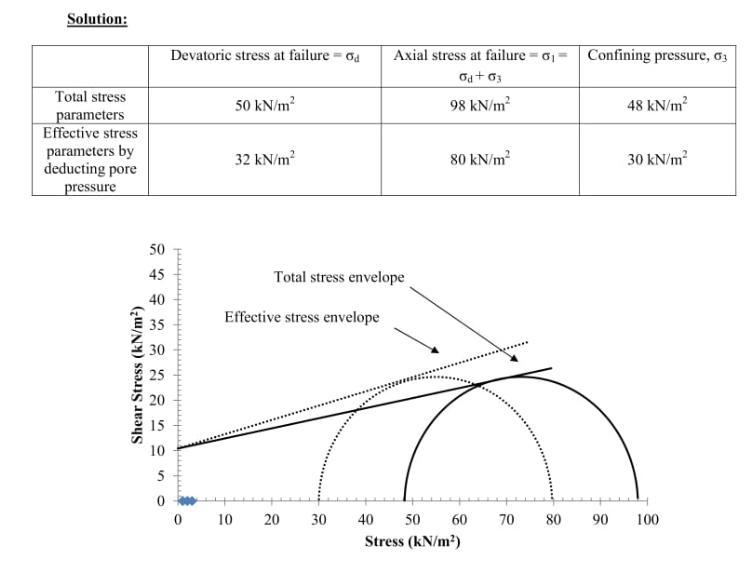
2) Devatoric stress at failure  = бd = 50 kN/m^2

3) Confining pressure at failure  = бd = 48 kN/m^2

4) Pore pressure at failure  = u = 18 kN/m^2

5) Unconfined compression stress  = q = 20 kN/m^2

6) Undrained cohesion  = q/2 = 20 kN/m^2

To find:

1) Effective and total stress strength failure envelope

Kindly check the attached image below .

7 0
2 years ago
A spring-loaded toy gun is used to shoot a ball of mass m = 1.50 kg straight up in the air. The spring has spring constant k = 6
adell [148]

Answer:

1) a) Mechanical energy is conserved because no dissipative forces perform work on the ball.

2) The muzzle velocity of the ball is approximately 5.272 meters per second.

3) The maximum height of the ball is 1.417 meters.

Explanation:

1) Which of the following statements are true?

a) Mechanical energy is conserved because no dissipative forces perform work on the ball.

True, statement indicates that there is no air resistence and no friction between ball and the inside of the gun because the first never touches the latter one.

b) The forces of gravity and the spring have potential energies associated with them.

False, force of gravity do work on the ball and spring receives a potential energy at being deformated by the ball.

c) No conservative forces act in this problem after the ball is released from the spring gun.

False, the absence of no conservative forces is guaranteed for the entire system according to the statement of the problem.

2) According to the statement, we understand that spring is deformed and once released and just after reaching its equilibrium position, the muzzle velocity is reached. As spring deformation is too small in comparison with height, we can neglect changes in gravitational potential energy. By Principle of Energy Conservation, we describe the motion of the ball by the following expression:

U_{k, 1}+K_{1}=U_{k,2}+K_{2} (Eq. 1)

Where:

U_{k,1}, U_{k,2} - Initial and final elastic potential energies of spring, measured in joules.

K_{1}, K_{2} - Initial and final translational kinetic energies of the ball, measured in joules.

After using definitions of elastic potential and translational kinetic energies, we expand the equation above as:

\frac{1}{2}\cdot m\cdot (v_{2}^{2}-v_{1}^{2}) = \frac{1}{2}\cdot k\cdot (x_{1}^{2}-x_{2}^{2})

And the final velocity is cleared:

m\cdot (v_{2}^{2}-v_{1}^{2}) = k\cdot (x_{1}^{2}-x_{2}^{2})

v_{2}^{2}-v_{1}^{2} =\frac{k}{m}\cdot (x_{1}^{2}-x_{2}^{2})

v_{2}^{2} =v_{1}^{2}+\frac{k}{m}\cdot (x_{1}^{2}-x_{2}^{2})

v_{2} = \sqrt{v_{1}^{2}+\frac{k}{m}\cdot (x_{1}^{2}-x_{2}^{2}) } (Eq. 2)

Where:

v_{1}, v_{2} - Initial and final velocities of the ball, measured in meters per second.

k - Spring constant, measured in newtons per meter.

m - Mass of the ball, measured in kilograms.

x_{1}, x_{2} - Initial and final position of spring, measured in meters.

If we know that v_{1} = 0\,\frac{m}{s}, k = 667\,\frac{N}{m}, m = 1.50\,kg, x_{1} = -0.25\,m and x_{2} = 0\,cm, the muzzle velocity of the ball is:

v_{2} =\sqrt{\left(0\,\frac{m}{s} \right)^{2}+\left(\frac{667\,\frac{N}{m} }{1.50\,kg} \right)\cdot [(-0.25\,m)^{2}-(0\,m)^{2}]}

v_{2}\approx 5.272\,\frac{m}{s}

The muzzle velocity of the ball is approximately 5.272 meters per second.

3) After leaving the toy gun, the ball is solely decelerated by gravity. We construct this model by Principle of Energy Conservation:

U_{g,2}+K_{2} = U_{g,3}+K_{3} (Eq. 3)

Where:

U_{g,2}, U_{g,3} - Initial and gravitational potential energies of the ball, measured in joules.

K_{2}, K_{3} - Initial and final translational kinetic energies of the ball, measured in joules.

After applying definitions of gravitational potential and translational kinetic energies, we expand the equation above and solve the resulting for the final height:

m\cdot g \cdot (h_{3}-h_{2}) = \frac{1}{2}\cdot m \cdot (v_{2}^{2}-v_{3}^{2})

h_{3}-h_{2}=\frac{v_{2}^{2}-v_{3}^{2}}{2\cdot g}

h_{3} = h_{2} +\frac{v_{2}^{2}-v_{3}^{2}}{2\cdot g} (Eq. 4)

h_{2}, h_{3} - Initial and final heights of the ball, measured in meters.

v_{2}, v_{3} - Initial and final velocities of the ball, measured in meters per second.

g - Gravitational acceleration, measured in meters per square second.

If we get that v_{2} = 5.272\,\frac{m}{s}, v_{3} = 0\,\frac{m}{s}, h_{2} = 0\,m and g = 9.807\,\frac{m}{s^{2}}, the maximum height of the ball is:

h_{3} = 0\,m+\frac{\left(5.272\,\frac{m}{s} \right)^{2}-\left(0\,\frac{m}{s} \right)^{2}}{2\cdot \left(9.807\,\frac{m}{s^{2}} \right)}

h_{3} = 1.417\,m

The maximum height of the ball is 1.417 meters.

5 0
2 years ago
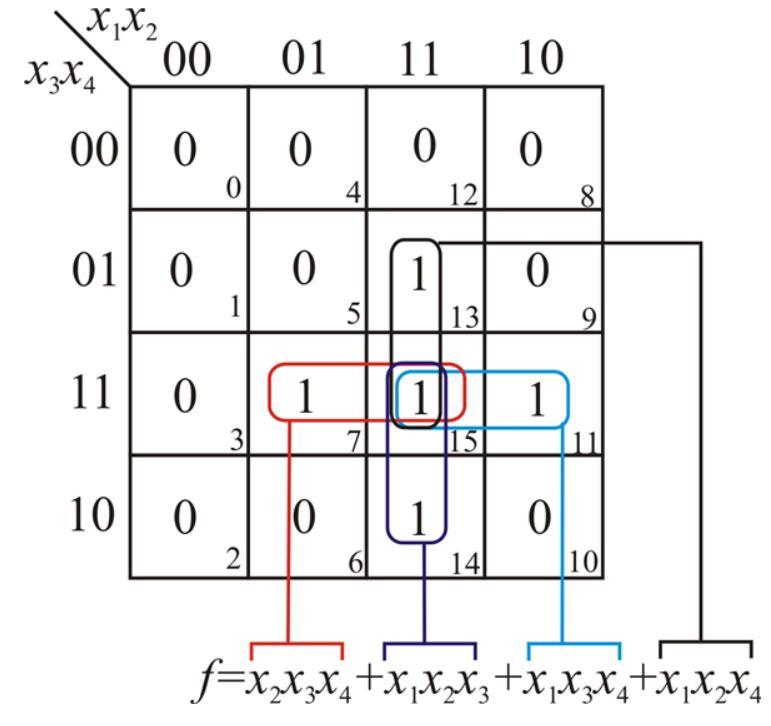
A four-variable logic function that is equal to 1 if any three or all four of its variables are equal to 1 is called a majority
gulaghasi [49]

Answer:

1. Assumption

2.Truth Table

3.K-Map

4.Mapping and Final Expression

5 0
2 years ago
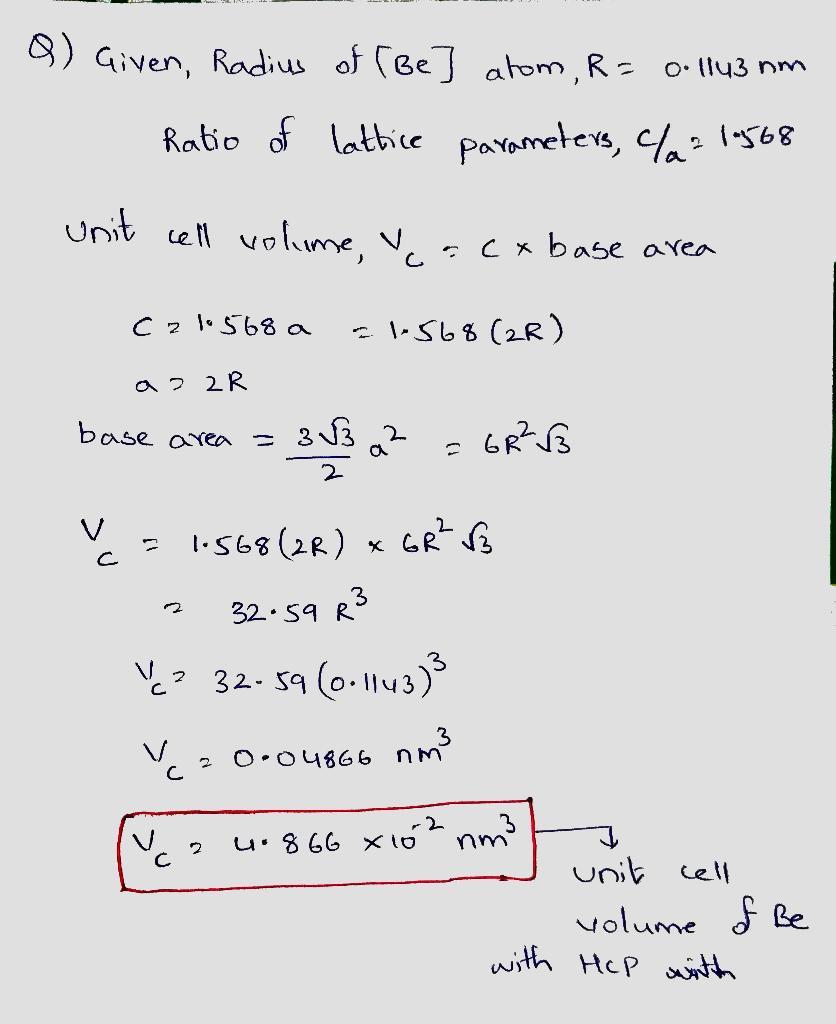
Beryllium (Be) has an HCP unit cell for which the ratio of the lattice parameters c/a is 1.568. If the radius of the Be atom is
sweet-ann [11.9K]

Answer:

Unit cell volume will be

4.866*10^{-2}nm^{3}

8 0
2 years ago
Other questions:
  • What is the damped natural frequency (in rad/s) of a second order system whose undamped natural frequency is 25 rad/s and has a
    15·1 answer
  • For a two-source network, if current produced by one source is in one direction, while the current produced by the other source
    14·1 answer
  • A pin fin of uniform cross-sectional area is fabricated of an aluminum alloy (k = 160W m-1 K-1 ). The fin diameter is D = 4 mm,
    15·1 answer
  • A zener diode exhibits a constant voltage of 5.6 V for currents greater than five times the knee current. IZK is specified to be
    10·1 answer
  • A gas stream flowing at 1000 cfm with a particulate loading of 400 gr/ft3 discharges from a certain industrial plant through an
    8·1 answer
  • Air is contained in a cylinder device fitted with a piston-cylinder. The piston initially rests on a set of stops, and a pressur
    14·1 answer
  • A 30-ft tall drop tower is being used to study the shape of water droplets as they fall through air. A camera is to be carried b
    13·1 answer
  • A hydraulic cylinder is to be used to move a workpiece in a manufacturing operation through a distance of 50 mm in 10 s. A force
    9·1 answer
  • . A belt drive is desired to couple the motor with a mixer for processing corn syrup. The 25-hp electric motor is rated at 950 r
    13·1 answer
  • Toeboards are usually ___ inches high and used on landings and balconies.
    8·1 answer
Add answer
Login
Not registered? Fast signup
Signup
Login Signup
Ask question!