answer.
Ask question
Login Signup
Ask question
All categories
  • English
  • Mathematics
  • Social Studies
  • Business
  • History
  • Health
  • Geography
  • Biology
  • Physics
  • Chemistry
  • Computers and Technology
  • Arts
  • World Languages
  • Spanish
  • French
  • German
  • Advanced Placement (AP)
  • SAT
  • Medicine
  • Law
  • Engineering
jonny [76]
2 years ago
8

Classify these compounds as acid, base, salt, or other.? 1. ch3oh 3. hno3 5. nabr

Chemistry
2 answers:
Nesterboy [21]2 years ago
7 0

Explanation:

Acids are the species which upon dissociation in water gives hydrogen ions (H^{+}).

For example, HNO_{3} is acidic in nature because upon dissociation it releases H^{+} ions as follows.

            HNO_{3} \rightarrow H^{+} + NO^{-}_{3}

Whereas bases are the species which upon dissociation in water gives hydroxide ions (OH^{-}).

For example, NaOH is basic in nature as it releases OH^{-} ions.

Salts are the substances formed by combination of two or more different oppositely charged ions.

For example, NaCl is a salt.

Therefore, we classify the given compounds as acid, base, salt, or other as follows.

  • CH_{3}OH - Other
  • HNO_{3} - Acid
  • NaBr - Salt

ELEN [110]2 years ago
5 0
<span> </span><span>1. Alcohol(other) 
3. Acid 
5. Salt 

</span>
You might be interested in
Which of the following statements is a true statement concerning a reaction that has reached a state of equilibrium?
Inga [223]

Answer: A system has reached equilibrium when the concentrations of reactants and products remain constant.

Explanation:

The reactions which do not go on completion and in which the reactant forms product and the products goes back to the reactants simultaneously are known as equilibrium reactions.

The equilibrium is dynamic in nature and the reactions are continuous in nature. Rate of forward reaction is equal to the rate of backward reaction.

Equilibrium state is the state when reactants and products are present but the concentrations does not change with time, that is the concentration remains constant.

8 0
2 years ago
Use the chemical reaction to answer the question. ​CaCO3→CO2​+CaO A scientist heats 30 grams of calcium carbonate (CaCO3) in the
saul85 [17]
1.) A
2.)B


Explanation:
5 0
2 years ago
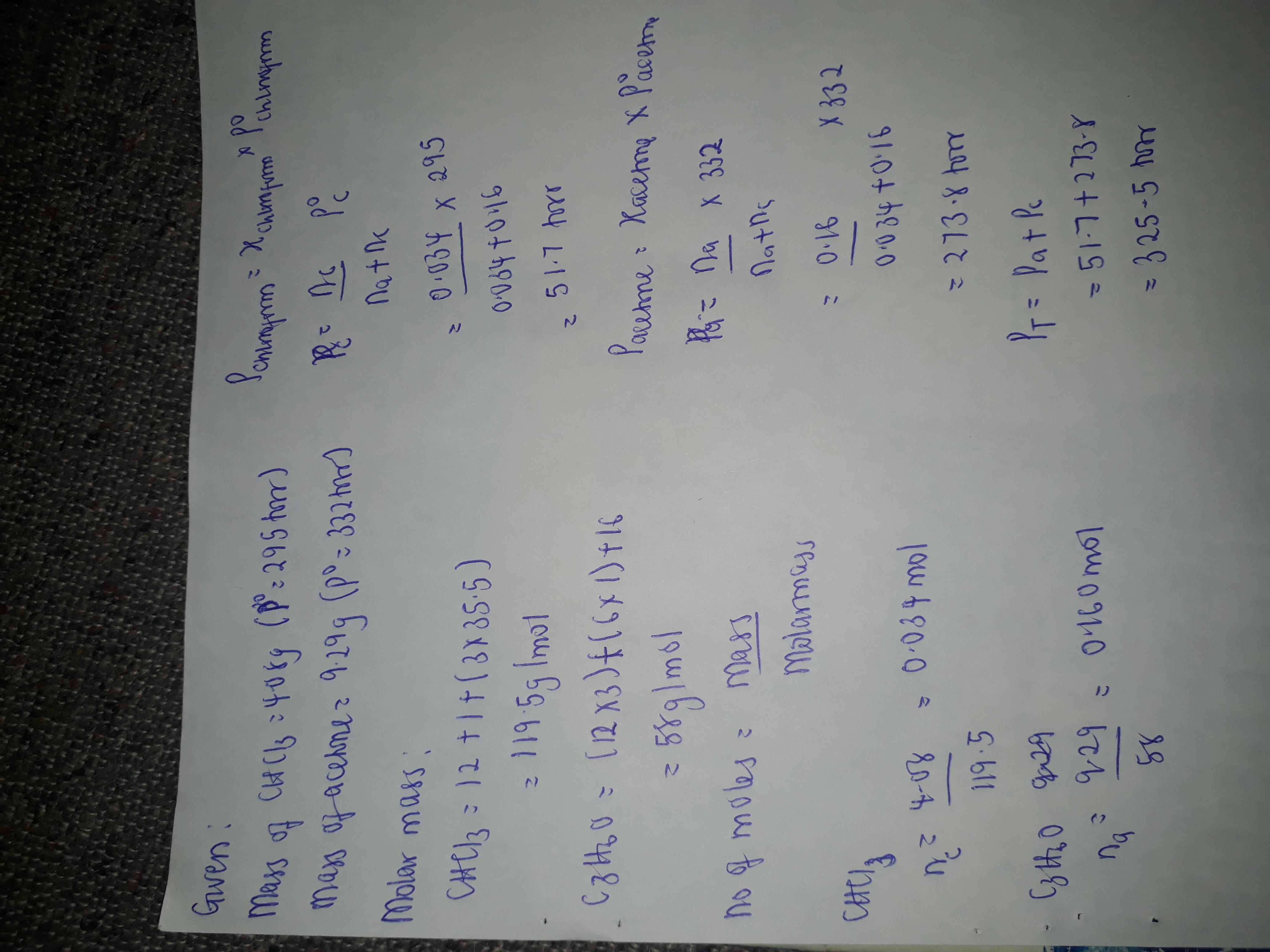
A solution contains 4.08 g of chloroform (CHCl3) and 9.29 g of acetone (CH3COCH3). The vapor pressures at 35 ∘C of pure chlorofo
Sergeeva-Olga [200]

Explanation:

Below is an attachment containing the solution.

8 0
2 years ago
Read 2 more answers
When the concentration of solute in a solid solution exceeds its solubility limit, a new solid solution or phase forms that has
soldi70 [24.7K]
Answer is: true.
Solid solution <span>is a </span>solid state solution<span> of one or more </span>solutes<span> in a </span>solvent or <span>mixture of two </span>crystalline<span> solids that coexist as</span> crystal lattice. <span>Examples of solid solutions are metal </span>alloys (<span>mixture of </span>metals<span> or a mixture of a metal and another </span>element), semiconductors and moist<span> solids. </span>
8 0
2 years ago
(a) Calculate the density of a 374.5-g sample of copper if it has a volume of 41.8 cm3. (b) A student needs 15.0 g of ethanol fo
o-na [289]

<u>Answer:</u>

<u>For a:</u> The density of the sample of copper is 8.96g/cm^3

<u>For b:</u> The volume of ethanol needed is 19.0 mL

<u>For c:</u> The mass of mercury is 340. grams

<u>Explanation:</u>

To calculate density of a substance, we use the equation:

\text{Density of substance}=\frac{\text{Mass of substance}}{\text{Volume of substance}}      ......(1)

  • <u>For a:</u>

Mass of copper = 374.5 g

Volume of copper = 41.8cm^3

Putting values in equation 1, we get:

\text{Density of copper}=\frac{374.5g}{41.8cm^3}\\\\\text{Density of copper}=8.96g/cm^3

Hence, the density of the sample of copper is 8.96g/cm^3

  • <u>For b:</u>

Mass of ethanol = 15.0 g

Density of ethanol = 0.789 g/mL

Putting values in equation 1, we get:

0.789g/mL=\frac{15.0g}{\text{Volume of ethanol}}\\\\\text{Volume of ethanol}=\frac{15.0g}{0.789g/mL}=19.0mL

Hence, the volume of ethanol needed is 19.0 mL

  • <u>For c:</u>

Volume of mercury = 25.0 mL

Density of mercury = 13.6 g/mL

Putting values in equation 1, we get:

13.6g/mL=\frac{\text{Mass of mercury}}{25.0mL}\\\\\text{Mass of mercury}=(13.6g/mL\times 25.0mL)=340.g

Hence, the mass of mercury is 340. grams

5 0
2 years ago
Other questions:
  • Which state of matter has particles that slide past each other while remaining in contact? Gas Liquid Plasma Solid
    14·1 answer
  • What volume of co2 gas at 645 torr and 800. k could be produced by the decomposition of 45.0 g of caco3? caco3(s) → cao(s) + co2
    8·1 answer
  • Two beach balls collide, deforming during a collision. They bounce off in opposite directions. What type of collision was this?
    6·2 answers
  • During an experiment water was heated in a container covered with a glass lid. The following observations were recorded.
    7·2 answers
  • H2PO4-(aq) ⇆ H+(aq) + HPO42-( which ion plays the role of hydrogen ion donor and which one plays the hydrogen ion acceptor in BP
    14·1 answer
  • An air sample consists of oxygen and nitrogen gas as major components. It also contains carbon dioxide and traces of some rare g
    6·1 answer
  • Calculate the number of grams of carbon dioxide produced from complete combustion of one liter of octane by placing the conversi
    5·1 answer
  • What is the concentration of FeCl3 in a solution prepared by dissolving 10.0 g of FeCl3 in enough water to make 275 mL of soluti
    15·1 answer
  • If 10.0 liters of h2(g) at STP is heated to a temperature of 546 K, pressure remaining constant, the new volume of the gas will
    7·1 answer
  • A 3.5 kg iron shovel is left outside through the winter. The shovel, now orange with rust, is rediscovered in the spring. Its ma
    10·1 answer
Add answer
Login
Not registered? Fast signup
Signup
Login Signup
Ask question!