answer.
Ask question
Login Signup
Ask question
All categories
  • English
  • Mathematics
  • Social Studies
  • Business
  • History
  • Health
  • Geography
  • Biology
  • Physics
  • Chemistry
  • Computers and Technology
  • Arts
  • World Languages
  • Spanish
  • French
  • German
  • Advanced Placement (AP)
  • SAT
  • Medicine
  • Law
  • Engineering
sveta [45]
2 years ago
11

If the chemical reaction AB + CD ⟶ AD + BC releases heat, what is true of the stored bond energy of the reactants and products?

The bonds do not have energy, the atoms release heat. The bond energy of the reactants is the same as the bond energy of the products. The bond energy of the reactants is lower than the bond energy of the products. The bond energy of the reactants is higher than the bond energy of the products.
Chemistry
1 answer:
nignag [31]2 years ago
3 0

Answer:

The correct option is the last option

Explanation:

The chemical reaction provided in the question is a double-displacement reaction which is an exothermic reaction (which is the reason for the release of heat). An example of a double displacement reaction and exothermic reaction is the neutralization reaction illustrated below.

HCl + NaOH ⇒ NaCl + H₂O

From the law of conservation of energy, energy can neither be created nor destroyed, hence the total energy in a given system should ordinarily be the same (in the reactants and products), however <u>when energy is released in a reaction (as in the case with an exothermic reaction), it shows there are more bond energy in the reactants than in the products and it is the excess energy that is been released into the atmosphere.</u>

You might be interested in
In a hexagonal-close-pack (hcp) unit cell, the ratio of lattice points to octahedral holes to tetrahedral holes is 1:1:2. What i
Alex777 [14]

Explanation:

In a hexagonal-close-pack (HCP) unit cell, the ratio of lattice points to octahedral holes to tetrahedral holes =  1 : 1 : 2

let the :

Number of lattice point = 1x.

Number of octahedral points = 1x

Number of tetrahedral  points = 2x

If anions occupy the HCP lattice points and cations occupy half of the tetrahedral holes.

Number of anions occupying the HCP lattice points, A= 1x

Number of cations occupying the tetrahedral points, B =  \frac{2x}{2}=x

The formula of the compound will be = A_{1x}B_{1x}=AB

If anions occupy the HCP lattice points and cations occupy all of the tetrahedral holes.

Number of anions occupying the HCP lattice points, A= 1x

Number of cations occupying the tetrahedral points, B =  2x

The formula of the compound will be = A_{1x}B_{2x}=AB_2

6 0
2 years ago
if the charcoal from an ancient fire contains 1/512 amount of carbon-14 as a living tree, how long ago did the fire occur? the h
Anit [1.1K]

Answer:

11.19 half lives

Explanation:

4 0
2 years ago
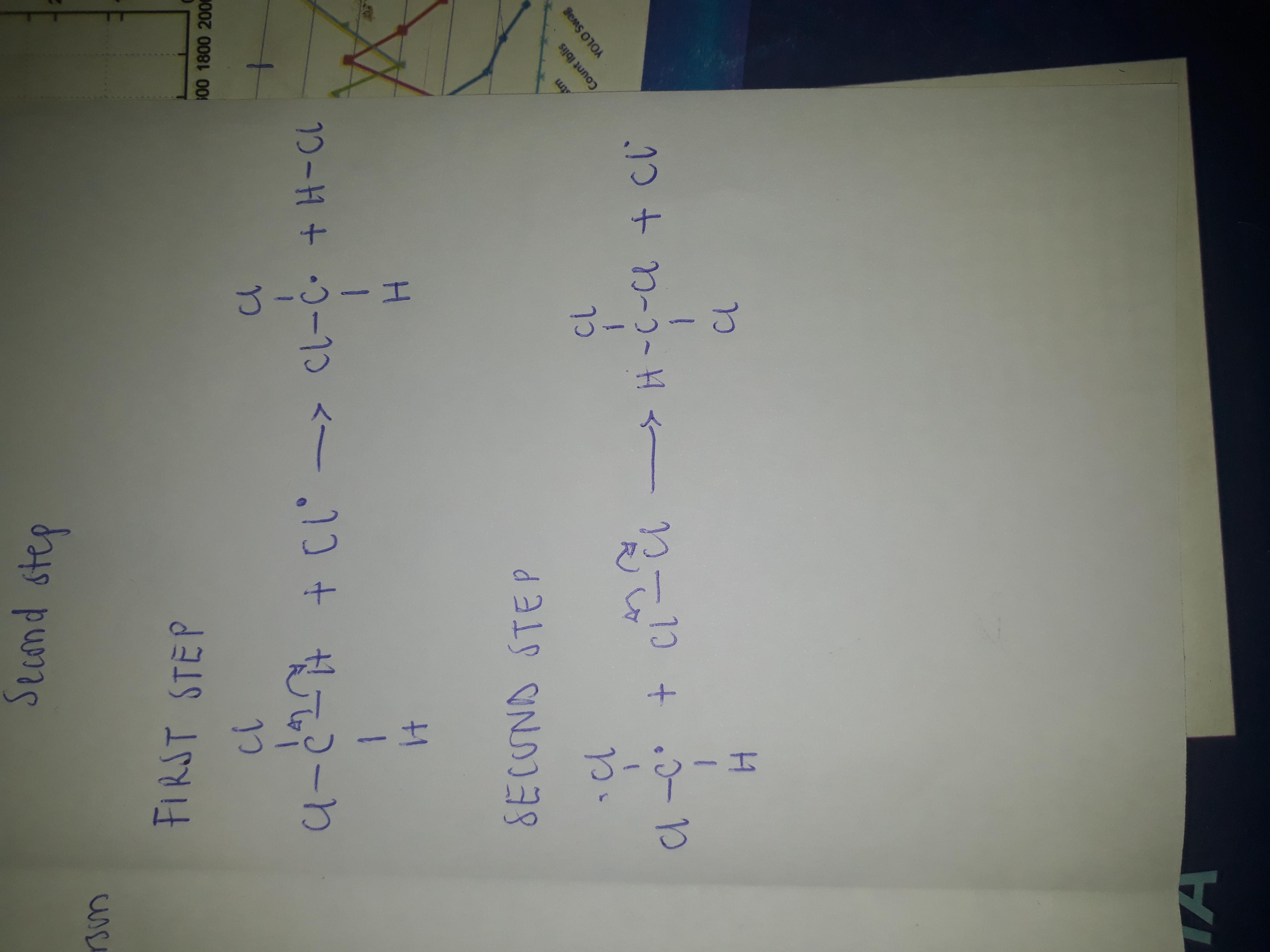
Which of the following represents a propagation step in the monochlorination of methylene chloride (CH2Cl2)?a. CHCl3 + Cl. Right
svetlana [45]

Answer:

B = CHCl2 + Cl2 --> CHCl3 + Cl

Explanation:

Free radical halogenation is a chlorination reaction on Alkane hydrocarbons. This involves the splitting of molecules into radicals/ unstable molecules in the presence of sunlight/ U.V light which ensures bonding of the molecules.

Free radical chlorination is divided into 3 steps which are:

The initiation step

The propagation step

The termination step

So in reference to the question, propagation step involves two steps.

The first step is where the molecule in this case the methylene chloride(CH2Cl2) loses a hydrogen atom and then bond with a chlorine atom radical to give a nethylwnw chloride radical and HCl.

The second step involves the reaction of this methylene chloride got in the first step with chlorine molecule to form trichloride methane and a chlorine radical.

You would find in the attachment the 2 step mechanism.

3 0
2 years ago
What is the mass of 3.35 mol Hg(IO3)2? 1,700 g 1,840 g 1,960 g 2,110 g
Tema [17]

Answer:- 1840 g.

Solution:- We have been given with 3.35 moles of Hg(IO_3)_2 and asked to calculate it's mass.

To convert the moles to grams we multiply the moles by the molar mass of the compound. Molar mass of the compound is the sum of atomic masses of all the atoms present in it.

molar mass of Hg(IO_3)_2 = atomic mass of Hg + 2(atomic mass of I) + 6(atomic mass of O)

= 200.59+2(126.90)+6(16.00)

= 200.59+253.80+96.00

= 550.39 gram per mol

Let's multiply the given moles by the molar mass:

3.35mol(\frac{550.39g}{1mol})

= 1843.8 g

Since, there are three sig figs in the given moles of compound, we need to round the calculated my to three sig figs also. So, on rounding off to three sig figs the mass becomes 1840 g.

8 0
2 years ago
A standard backpack is approximately 30cm x 30cm x 40cm. Suppose you find a hoard of pure gold while treasure hunting in the wil
Blizzard [7]

Explanation:

The dimensions of a standard backpack is 30cm x 30cm x 40cm

The mass of an average student is 70 kg

We know that, the density of gold is 19.3 g/cm³.

Let m be the mass of the backpack. So,

\text{density}=\dfrac{\text{mass}}{\text{volume}}\\\\m=d\times V\\\\m=19.3\ g/cm^3\times (30\times 30\times 40)\ cm^3\\\\m=694800\ g\\\\\text{or}\\\\m=694.8\ kg\approx 700\ kg

An average student has a mass of 70 kg. If we compare the mass of student and mass of backpack, we find that the backpack is 10 times of the mass of the student.

8 0
2 years ago
Other questions:
  • What is the name of the compound CuCO³?
    15·2 answers
  • How many ions are there in 0.187 mol of Na+ ions
    6·2 answers
  • Which species has the smaller bond angle, h3o+ or h2o?
    15·1 answer
  • If a runners power is 400 w as she runs, how much chemical energy dose she convert into other forms in 10.0 minuets?
    13·1 answer
  • In an experiment a student mixes a 50.0 mL sample of 0.100 M AgNO₃(aq) with a 50.0 mL sample of 0.100 M NaCl(aq) at 20.0°C in a
    6·1 answer
  • ) The only noble gas without eight valence electrons is __________. A) Ar B) Ne C) Kr D) He E) All noble gases have eight valenc
    13·1 answer
  • The Michaelis‑Menten equation models the hyperbolic relationship between [S] and the initial reaction rate V 0 V0 for an enzyme‑
    15·1 answer
  • 2. A compound with the following composition by mass: 24.0% C, 7.0% H, 38.0% F, and 31.0% P. what is the empirical formula
    7·1 answer
  • We would like to make a golden standard kilogram in the shape of circular cylinder. The density of gold is 19.32 g/cm3. a) Find
    9·1 answer
  • Consider the following chemical equation: NH4NO3(s)⟶NH+4(aq)+NO−3(aq) What is the standard change in free energy in kJmol at 298
    7·1 answer
Add answer
Login
Not registered? Fast signup
Signup
Login Signup
Ask question!