answer.
Ask question
Login Signup
Ask question
All categories
  • English
  • Mathematics
  • Social Studies
  • Business
  • History
  • Health
  • Geography
  • Biology
  • Physics
  • Chemistry
  • Computers and Technology
  • Arts
  • World Languages
  • Spanish
  • French
  • German
  • Advanced Placement (AP)
  • SAT
  • Medicine
  • Law
  • Engineering
aev [14]
2 years ago
6

6. Dr. Li boils water using a kettle with a 1.5 kW Nichrome (80% Ni and 20% Cr) heating element (resister heater). The diameter

and length of this heating element is 8 mm and 20 cm, respectively. When exposed to liquid water, the convection heat transfer between water and heating element is 800 W m2K . Please find: (25 Points) (1) The surface temperature and maximum temperature of the heating element when water is boiling in the kettle in Dr. Li’s office, ESB 751. (2) The surface temperature and maximum temperature when all liquid water has been evaporated and the heating element is exposed completely to the superheated vapor. You can assume the convection heat transfer between superheated water vapor and heating element is 24 W m2K . You can assume the temperature of the superheated water vapor is 100 °C. (3) Please justify if the heating element can survive in case (2) without melting.
Engineering
1 answer:
grigory [225]2 years ago
4 0

Assuming that:

The heat generation is uniform throughout the heating element, Nichrome wire.

The cross-sections are insulated and heat transfer is taking place only in the radial direction.

All the heat generated is conducted, there is energy storage.

Now, from the properties of Nichrome:

The melting temperature of Nichrome, T_m=1400 ^{\circ}C

Thermal conductivity, K=11.3 W/m^{\circ}C

Given that:

The power generated by the heating element, Q_g=1.5kW=1500W

Diameter, D=8mm=8\times10^{-3}m

So, radius, R=4\times10^{-3}m

Length, L=20cm=0.2m

The volume of the Nichrome wire,

V=\pi R^2L=\pi\times (4\times10^{-3})^2\times0.2=1.005\times10^{-5}m^3

Heat generation rate per unit volume,

q_g=\frac{Q_g}{V}=\frac{1500}{1.005\times10^{-5}}=149.2\times10^{6}W/m^3

With the assumptions made above, this is the case of heat transfer in one direction.

Let T be the temperature at the radius r.

Now, the heat generated within the cylinder of radius r is conducted in a radially outward direction. i.e

q_g(\pi r^2)L=-K(2\pi r L)\frac{dT}{dr} [where K is the thermal conductivity oof Nichrome]

\Rightarrow -\frac{q_g}{2K}rdr=dT

\Rightarrow T=-\frac{q_g}{4K}r^2+ C_0 , where C_0 is constant.

Let the surface temperature is T_s, i.e at r=R, T=T_s.

Putting this boundary condition to get C_0, we have

T=T_s+\frac{q_g}{4K}(R^2-r^2)

This is the temperature profile within the Nichrome wire, which is maximum at r=0.

So, the maximum temperature,

T_{max}=T_s+\frac{q_g}{4K}R^2\;\cdots(i)

(1) The water is boiling, to the temperature of the water is, T_b=100^{\circ}C.

The total heat generated within the heating element is convected to the water from the surface. i.e

Q_g=h_w(2\pi RL)(T_s-T_b)

where, h_w=800W/m^2K=800W/m^2^{\circ}C is the convective heat transfer constant (Given).

\Rightarrow 1500=800\times (2\pi\times4\times10^{-3}\times 0.2(T_s-100)

\Rightarrow T_s=100+373=473^{\circ}C

So, the surface temperature is 473^{\circ}C.

From equation (i), the maximum temperature is at the center of the wire which is

T_{max}=473+\frac{149.2\times10^{6}}{4\times11.3}(4\times10^{-3})^2

\Rightarrow T_{max}=473+53=526^{\circ}C

(2) In this case, the temperature of the superheated water vapor, T_b = 100^{\circ}C (Given)

The heat transfer coefficient between the superheated water vapor and the heating surface is, h_v=24W/mK=24W/m^{\circ}C.

Similarly, Q_g=h_v(2\pi RL)(T_s-T_b)

\Rightarrow 1500=24\times (2\pi\times4\times10^{-3}\times 0.2(T_s-100)

\Rightarrow T_s=100+12434=12534^{\circ}C

So, the surface temperature is 12534^{\circ}C.

From equation (i), the maximum temperature is at the center of the wire which is

T_{max}=12534+\frac{149.2\times10^{6}}{4\times11.3}(4\times10^{-3})^2

\Rightarrow T_{max}=12534+53=12587^{\circ}C

(3) The melting temperature of Chromium is 1400 ^{\circ}C.

So, the 1st case when the heating element is surrounded by water is safe as the maximum temperature within the element is below the melting temperature.

But, it the 2nd case, the heating element will melt out as the maximum temperature is much higher than the melting temperature of the element.


You might be interested in
The function below takes a single string parameter: input_string. If the input contains the lowercase letter z, return the strin
Whitepunk [10]

Answer:

# string_contains function is defined with input_string

# as arguments

def string_contains(input_string):

   # if-statement that check if letter z is in input_string

   if 'z' in input_string:

       # it print"has the letter z" if it has z

       print("has the letter z")

   else:

       # else it print "not worthwhile"

       print("not worthwhile")


# string_contains function is called

string_contains("The animal is zebra")        

string_contains("learning is fun")

Explanation:

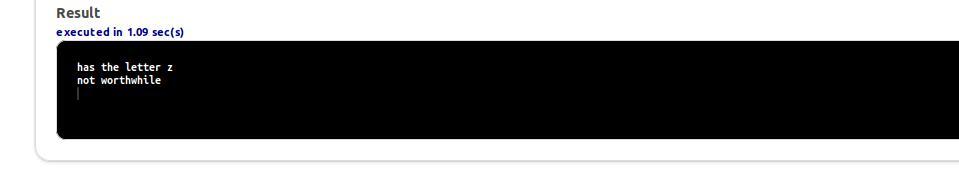
The code is written in Python and well commented.

Image of the output when the function is called is attached.

4 0
2 years ago
thermal energy is being added to steam at 475.8 kPa and 75% quality. determine the amount of thermal energy to be added to creat
eduard

Answer:

q_{in} = 528.6\,\frac{kJ}{kg}

Explanation:

Let assume that heating process occurs at constant pressure, the phenomenon is modelled by the use of the First Law of Thermodynamics:

q_{in} = h_{g} - h_{mix}

The specific enthalpies are:

Liquid-Vapor Mixture:

h_{mix} = 2217.2\,\frac{kJ}{kg}

Saturated Vapor:

h_{g} = 2745.8\,\frac{kJ}{kg}

The thermal energy per unit mass required to heat the steam is:

q_{in} = 2745.8\,\frac{kJ}{kg} - 2217.2\,\frac{kJ}{kg}

q_{in} = 528.6\,\frac{kJ}{kg}

7 0
2 years ago
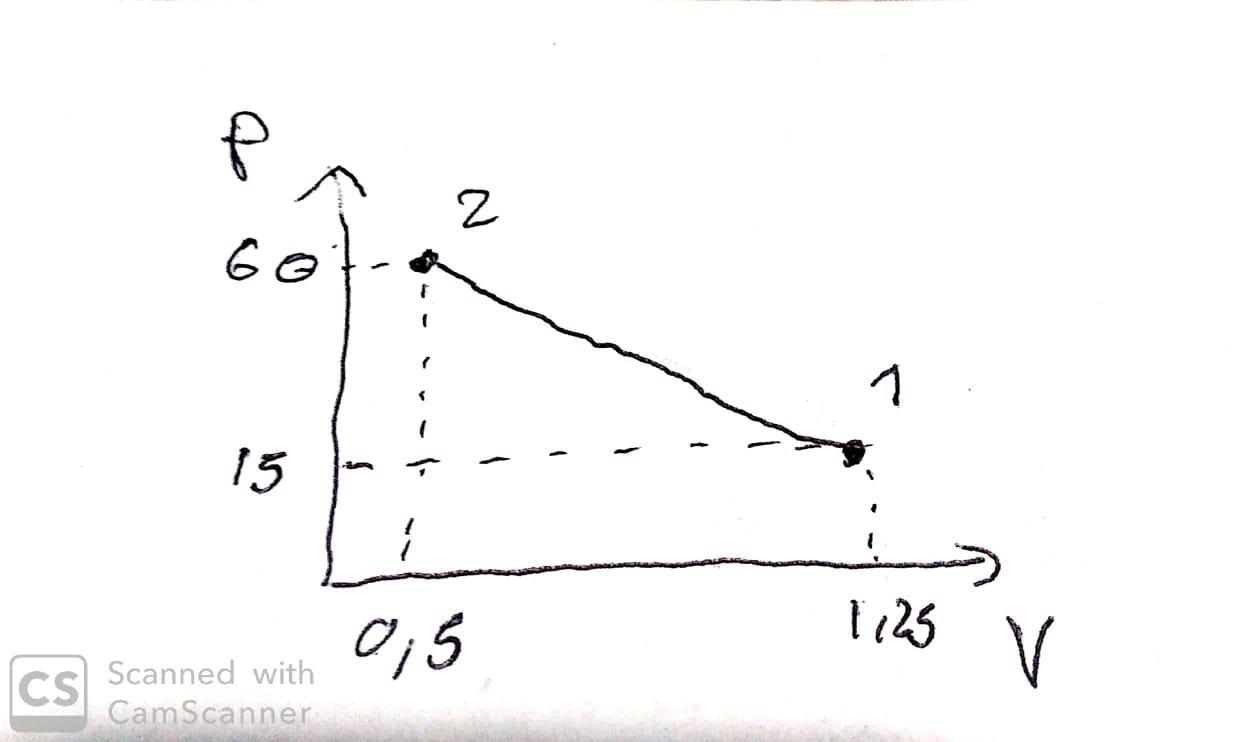
A closed system consisting of 4 lb of a gas undergoes a process during which the relation between pressure and volume is pVn 5 c
gayaneshka [121]

Answer:

V1=5<u>ft3</u>

<u>V2=2ft3</u>

n=1.377

Explanation:

PART A:

the volume of each state is obtained by multiplying the mass by the specific volume in each state

V=volume

v=especific volume

m=mass

V=mv

state 1

V1=m.v1

V1=4lb*1.25ft3/lb=5<u>ft3</u>

state 2

V2=m.v2

V2=4lb*0.5ft3/lb=  <u> 2ft3</u>

PART B:

since the PV ^ n is constant we can equal the equations of state 1 and state 2

P1V1^n=P2V2^n

P1/P2=(V2/V1)^n

ln(P1/P2)=n . ln (V2/V1)

n=ln(P1/P2)/ ln (V2/V1)

n=ln(15/53)/ ln (2/5)

n=1.377

3 0
2 years ago
A thin-walled tube with a diameter of 12 mm and length of 25 m is used to carry exhaust gas from a smoke stack to the laboratory
nlexa [21]

Answer:

(a)  h₁   = 204.45 W/m²k

(b) h₀ = 46.80 W/m².k

(c) T = T = 15.50°C

Explanation:

Given Data;

Diameter = 12mm

Length = 25 m

Entry temperature = 200°C

Flow rate = 0.006 kg/s

velocity = 2.5 m/s.

Step 1: Calculating the mean temperature;

(200 + 15)/2

Mean temperature = 107.5°C = 380.5 K

The properties of air at mean temperature 380.5 K are given as:

v = 24.2689*10⁻⁶m²/s

a = 35.024*10⁻⁶m²/s

μ    = 221.6 *10⁻⁷Ns/m²

k = 0.0323 W/m.k

Cp = 1012 J/kg.k

Step 2: Calculating the prantl number using the formula;

Pr = v/a

   = 24.2689*10⁻⁶/ 35.024*10⁻⁶

   = 0.693

Step3: Calculating the reynolds number using the formula;

Re = 4m/πDμ

    = 4 *0.006/π*12*10⁻³ * 221.6 *10⁻⁷

    = 0.024/8.355*10⁻⁷

    = 28725

Since Re is greater than 2000, the flow is turbulent. Nu becomes;

Nu = 0.023Re^0.8 *Pr^0.3

Nu = 0.023 * 28725^0.8 * 0.693^0.3

     = 75.955

(a) calculating the heat transfer coefficient:

Nu = hD/k

h = Nu *k/D

  = (75.955 * 0.0323)/12*10^-3

h   = 204.45 W/m²k

(b)

Properties of air at 15°C

v = 14.82 *10⁻⁶m²/s

k = 0.0253 W/m.k

a = 20.873 *10⁻⁶m²/s

Pr(outside) = v/a

                  = 14.82 *10⁻⁶/20.873 *10⁻⁶

                 = 0.71

Re(outside) = VD/v

                   = 2.5 * 12*10⁻³/14.82*10⁻⁶

                    =2024.29

Using Zakauskus correlation,

Nu = 0.26Re^0.6 * Pr^0.37 * (Pr(outside)/Pr)^1/4

    = 0.26 * 2024.29^0.6 *  0.71^0.37 * (0.71/0.693)^1/4

    = 22.199

Nu = h₀D/k

h₀ = Nu*k/D

     = 22.199* 0.0253/12*10⁻³

h₀ = 46.80 W/m².k

 (c)

Calculating the overall heat transfer coefficient using the formula;

1/U =1/h₁ +1/h₀

1/U = 1/204.45 + 1/46.80

1/U = 0.026259

U = 1/0.026259

U = 38.08

Calculating the temperature of the exhaust using the formula;

T -T₀/T₁-T₀ = e^-[uπDL/Cpm]

T - 15/200-15 = e^-[38.08*π*12*10⁻³*25/1012*0.006]

T - 15/185 = e^-5.911

T -15 = 185 * 0.002709

T = 15+0.50

T = 15.50°C

6 0
2 years ago
Which statement concerning symbols used on plans is true?
Zielflug [23.3K]

Answer:

The symbols are to be noted on the title sheet or other introductory sheet of the plans.

Explanation:

in able to be understood for example a map key is always on a map so the reader can use it efficently without confusion

8 0
2 years ago
Other questions:
  • generally compound curves are not filtered recommended for A. Road B. water way C. underground road D. rail way​
    12·1 answer
  • A 12-L volume of oil is subjected to a pressure change, which produces a volume strain on the oil of -3.0 × 10⁻⁴. The bulk modu
    6·1 answer
  • Which of the following is correct regarding the principal stresses and maximum in-plane shear stresses? a. Principal stresses ca
    14·1 answer
  • A meter stick can be read to the nearest millimeter and a travelling microscope can be read to the nearest 0.1 mm. Suppose you w
    11·1 answer
  • A negative pressure respirator brings fresh air to you through a hose<br>A) True<br>B)False​
    15·2 answers
  • An art collector is bidding on a statue that would complete a collection he is trying to assemble. The statue is being sold in a
    9·1 answer
  • 10. Aluminum-lithium (Al-Li) alloys have been developed by the aircraft industry to reduce the weight and improve the performanc
    7·1 answer
  • A commercial refrigerator with refrigerant-134a as the working fluid is used to keep the refrigerated space at -30C by rejecting
    13·1 answer
  • When encountering low visibility from rain or fog, you should use your ____.
    12·1 answer
  • Find the velocity and rate of flow of water through a rectangular channel of 6m wide and 3m deep when it's running full. The cha
    13·1 answer
Add answer
Login
Not registered? Fast signup
Signup
Login Signup
Ask question!