answer.
Ask question
Login Signup
Ask question
All categories
  • English
  • Mathematics
  • Social Studies
  • Business
  • History
  • Health
  • Geography
  • Biology
  • Physics
  • Chemistry
  • Computers and Technology
  • Arts
  • World Languages
  • Spanish
  • French
  • German
  • Advanced Placement (AP)
  • SAT
  • Medicine
  • Law
  • Engineering
jenyasd209 [6]
2 years ago
13

In oxidation–reduction reactions, ____.

Biology
1 answer:
OleMash [197]2 years ago
5 0
<h2>Answer:</h2><h3><em>chemical reaction</em></h3>

<h2>Explanation:</h2>

<h3>An oxidation-reduction (redox) reaction is a type of chemical reaction that involves a transfer of electrons between two species. An oxidation-reduction reaction is any chemical reaction in which the oxidation number of a molecule, atom, or ion changes by gaining or losing an electron.</h3>
You might be interested in
The following image shows a pencil submerged in a glass of water. A friend thinks that the pencil is broken. How would you expla
dezoksy [38]

Correct answer: A). Light slows down as it moves from the air in to the water, resulting in refraction, or a bending of light.

This is because as light travels through one media it travels in a straight line, however, when it travels from one media to another media it bends, light path bends because of the phenomenon of refraction of light.

The refraction takes place only at the boundary, as the light continues to cross the boundary, it travels in a straight line.

So, as the portion of the pencil is submerged in water, the light will travel from water to air.

Hence it appears to be broken because of refraction of light. So, the correct answer would be option A.


4 0
2 years ago
How could the duplication of the Hox gene complex help facilitate animal adaptive radiation?
cestrela7 [59]

Answer:

Duplication of hox genes is important in the radiation of animals because they are regulating genes of symmetry and the body plan of the animals' bodies. Some change or mutation in these genes during duplication can cause mutations and with these evolution of the species as it controls the different segments of these animals as they develop, launching the genetic programs that form various body structures, such as limbs and organs. .

4 0
2 years ago
Which statement describes the reaction for cellular respiration? The equation is carbon dioxide + water Right-arrow glucose + ox
ziro4ka [17]

Answer:

glucose + oxygen Right-arrow carbon dioxide + water and energy is produced in the form of ATP. This is the correct equation.

Explanation:

In cellular respiration -

If oxygen is present glucose molecules breakdown release energy in the form of ATP.

Here 1 glucose molecule in the presence of 6 oxygen molecules gives 6 carbon dioxide and 6 water molecules And 36 ATP as energy.

aerobic cellular respiration is very efficient in energy production as it gives high energy.

8 0
2 years ago
Read 2 more answers
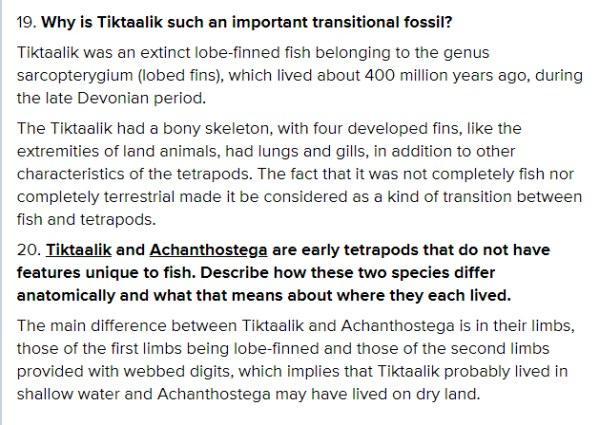
6. In fossils, what anatomical evidence indicates that gills were present?
Phoenix [80]

Answer and explanation:

6. In fossils, what anatomical evidence indicates that gills were present?

The anatomical evidence found in the fossils, such as special bone structures in the shoulders and skulls to support the gills, allows us to know the existence of these structures in some ancient species.

7. Many transitional species had gills, which means they lived in <u>aquatic environments</u>.

Gills are structures which allow people to breathe underwater, and many evolutionary transition species had them, such as the Tiktaalik, which also had lungs.

The existence of gill and lung respiration is what leads us to think that transition species were the first to leave the aquatic habitat to become terrestrial tetrapods.

8. Lungs allow an animal to breathe <u>air</u>. Why did this adaptation evolve?

Species considered transitional between fish and land animals were equipped with both gills and lungs.  

It is suggested that the appearance of the lungs is due to the lower concentration of oxygen in the water and the need to obtain oxygen from another source, such as air, where the oxygen concentration is higher. In these circumstances, increased oxygen demand forced some animals to leave the aquatic habitat.

9. Tetrapods use <u>lungs</u> to breathe. Do any modern tetrapods have gills? Explain.

Some present-day tetrapods - such as salamanders, toads and frogs - are amphibians, and in their larval stage they remain in an aquatic habitat, so they are equipped with gills during this stage of their life cycle.

In amphibians like the frog, the passage from the larval stage to the adult stage involves a process called metamorphosis, in which the gills disappear and the lungs develop, in addition to the appearance of the four limbs, which are absent in the larva.

13. Most modern tetrapods have <u>five</u> digits on front limbs and <u>five </u>digits on back limbs, although some species have fewer. How does this number compare to the number of digits on the limbs of transitional fossil forms?

The transitional species originally had fins, but fossils of the first tetrapods have been found with developed limbs and five or more digits, representing an equal or greater number of digits than current species.

An example of a larger number of toes is represented by the genus Acanthostega, with eight toes on each limb.

14. Why do many of the transitional fossils between fish and tetrapods have flat heads?

Many of the transition fossils between fish and tetrapods have flat heads, from top to bottom, because these species participated in the transition between aquatic and terrestrial habitat, adapted to living in shallower waters near the surface, and with gill and lung breathing capacity.

15. How did the anatomy of the shoulder and head change during tetrapod evolution?

The changes in the anatomy of the shoulder and head during the evolution of the tetrapod were basically three:

  • <em>The bony skeleton of the shoulder is separated from the skull, which in aquatic animals was attached. </em>
  • <em>The appearance of the neck, between both structures. </em>
  • <em>Development of an independent movement of the skull, with respect to the shoulder and the rest of the body.</em>

16. <u>Tiktaalik</u> and <u>Acanthostega </u>are fossil species have characteristics unique to fish as well as characteristics found in fish and tetrapods. Describe the characteristics of lobe-finned fish that are similar to those of tetrapods.

Lobe-finned fish -called sarcopterygians- like dipnoi, are lungfish, given the existence of functional lungs in their body. Another characteristic of lobefish is that each of their fins is attached to a single bone, as in the case of the humerus and femur of mammals.

The existence of lungs and the attachment of the limbs to a bone are common features among lobed finfish and tetrapods.

17. Which lobe-finned fish is alive today?

The coelacanth is one of the oldest species of fish that exist, as they are lobe-finned fish that were thought to be extinct, but still exist.

The characteristic of possessing lungs and bony skeleton relates them to the actual lung fishes and to the terrestrial vertebrates.

18. Acanthostega and Icythyostega have been called fish-like tetrapods. Explain why they are described as such and describe the environment in which they probably lived.

Both the Acanthostega and the Icythyostega were animals characterized by having four extremities and be equipped with gills and lungs at the same time, which determines that they are called tetrapods similar to fish.  

Their characteristics made them suitable for living in aquatic and terrestrial environments, so they probably inhabited shallow waters or even the surface of the earth.


8 0
2 years ago
Suppose that RNA polymerase was transcribing a eukaryotic gene with several introns all contained within the coding region. In w
Elenna [48]

Answer: synthesize a pre-rRNA 45S (35S in yeast), which matures and will form the major RNA sections of the ribosome. RNA polymerase II synthesizes precursors of mRNAs and most snRNA and microRNAs. RNA polymerase III synthesizes tRNAs, rRNA 5S and other small RNAs found in the nucleus and cytosol.

Explanation:

3 0
2 years ago
Other questions:
  • Which of the following is a feature of exocytosis but not endocytosis?
    13·1 answer
  • If a 9.0-volt battery is placed across a 5.0-ohm resistance, the current will be _____ amperes.
    14·1 answer
  • A microscope has different magnification powers. Using the If . . . , then . . . format, write a hypothesis that answers the lab
    8·2 answers
  • In chemiosmotic phosphorylation, what is the most direct source of energy that is used to convert ADP+ Pi + ATP?
    10·1 answer
  • If you were to add one of the eight citric acid cycle intermediates to the culture medium of yeast growing in the laboratory, wh
    6·1 answer
  • You have a cup of vegetable oil and a vial full of normal phospholipids. What would you predict would happen if you dropped the
    9·1 answer
  • A mutant version of mouse-ear cress (Arabidopsis thaliana) has been engineered to convert it from a long-day plant to a short-da
    13·1 answer
  • Which two characteristics describe reputable digital resources? They contain an author’s name. They sell products and services.
    5·1 answer
  • This is an onion root tip at low power (100x). The cells are too small to distinguish individual phases. What phase do most of t
    7·1 answer
  • What bodies of water may be cold
    5·2 answers
Add answer
Login
Not registered? Fast signup
Signup
Login Signup
Ask question!