answer.
Ask question
Login Signup
Ask question
All categories
  • English
  • Mathematics
  • Social Studies
  • Business
  • History
  • Health
  • Geography
  • Biology
  • Physics
  • Chemistry
  • Computers and Technology
  • Arts
  • World Languages
  • Spanish
  • French
  • German
  • Advanced Placement (AP)
  • SAT
  • Medicine
  • Law
  • Engineering
uranmaximum [27]
2 years ago
3

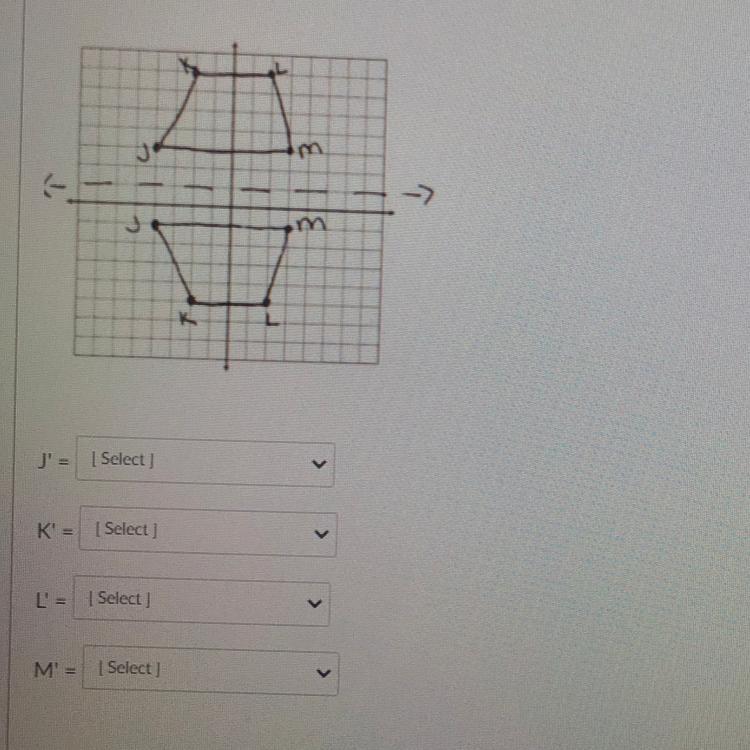
Trapezoid JKLM with vertices J(-4,3),K (-2,7),L(2,7), and M(3,3) in the line y=1. Find the cord images of the reflected object.

Mathematics
1 answer:
Tju [1.3M]2 years ago
6 0

9514 1404 393

Answer:

  • J'(-4, -1)
  • K'(-2, -5)
  • L'(2, -5)
  • M'(3, -1)

Step-by-step explanation:

Reflection over the line y=1 is equivalent to the transformation ...

  (x, y) ⇒ (x, 2-y)

Then the transformed coordinates are ...

  J(-4, 3) ⇒ J'(-4, -1)

  K(-2, 7) ⇒ K'(-2, -5)

  L(2, 7) ⇒ L'(2, -5)

  M(3, 3) ⇒ M'(3, -1)

_____

You can do the arithmetic (as we have done above), or you can simply read the coordinates of the reflected points from the graph.

You might be interested in
After riding her bike for 20 miles. Angela got off and walked her bike the rest of the way at 5 miles per hour. If the total tri
mylen [45]

Answer:

She rode her bike 20 miles... I believe this may be a trick question.

Step-by-step explanation:

Let's break down this problem...

If she is going at a rate of 5 miles per hour while walking than the maximum she could have walked in 5 hours is 25 miles.

If Angela rode her bike for 20 miles, and the got off her bike and walked "<em>the rest of the way</em>" then she should have walked 50 miles. However as we already know her rate is 5 miles per hour while walking, and therefore could only have covered half that distance in 5 hours.

Is this a multiple choice question? Is there any misssing informaation?

7 0
2 years ago
WILL BE BRANLIEST!!!
stiks02 [169]

Answer:

See explanation

Step-by-step explanation:

A. Solution set is in the attachment (dark green shading in the middle)

B. Yes, 2(5) + 3(1) ≤ 15; 13 is less than or equal to 15

5 + 1 > 3, 6 is greater than 3

C. (4, 2) means that he buys 4 sandwiches and 2 hot lunches

8 0
2 years ago
Read 2 more answers
Rahzel wants to determine how much gasoline he and his wife use in a month.He calculated that he used 78 1/3 gallons of gas last
attashe74 [19]
52. Rahzel wants to determine how much gasoline they had every month => He used 78 1/3 gallons of gas monthly => his wife used 41 3/8 gallons of gas last month How much is to total of gas that they both used. First let’s convert this fraction to decimal => 78 1/3 = 78.33 => 41 3/8 = 41.38 Now, let’s start adding. => 78.33 + 41.38 = 119.71 this is already rounded to the nearest hundredths.
7 0
2 years ago
Does anyone know how to do this?
xeze [42]

Answer:

Step-by-step explanation:

6 0
2 years ago
Modern Vehicles Company came up with two different plans for the next financial year. Plan Y: Increase vehicle production by 5%
ladessa [460]

Answer: plan Y will produce more vehicles after 4 years.

Step-by-step explanation:

1) Plan Y: Increase vehicle production by 5% every year. It means that the rate of production is in geometric progression. The formula for determining the sum of n terms, Sn of a geometric sequence is expressed as

Sn = (ar^n - 1)/(r - 1)

Where

n represents the number of term(years) in the sequence.

a represents the first term(number of vehicles in the present year) in the sequence.

r represents the common ratio.

From the information given,

a = 10000

r = 1 + 5/100 = 1.05

n = 4 years

Therefore, the sum of the vehicles produced in the first 4 years, S4 is

S4 = (10000 × 1.05^(4) - 1)/1.05 - 1

S4 = (10000 × 0.21550625)/0.05

S4 = 2155.0625/0.05

S4 = 43101 vehicles

2) Plan Z: Increase production by 300 vehicles every year. It means that the rate of production is in geometric progression. The formula for determining the sum of n terms of an arithmetic sequence is expressed as

Sn = n/2[2a + (n - 1)d]

Where

n represents the number of terms in the arithmetic sequence.

d represents the common difference of the terms in the arithmetic sequence.

a represents the first term of the arithmetic sequence.

From the information given,

n = 4 years

a = 10000

d = 300

Therefore, the sum of the first 4 terms, S4 would be

S4 = 4/2[10000 × 2 + (4 - 1)300]

S4 = 2[20000 + (3)300]

S4 = 2 × 20900

S4 = 41800 vehicles
6 0
2 years ago
Other questions:
  • Write two expressions that have a GCF of 8xy
    13·1 answer
  • The slope-intercept form of a linear equation is y = mx + b, where x and y are coordinates of an ordered pair, m is the slope of
    10·2 answers
  • I ate twice as many apples as bananas and 3 times as many blueberries as bananas. If I ate 12 fruits and berries altogether, how
    8·1 answer
  • Gladys has just purchased a new home. The house was priced at $105,000, and she chose a 40-year mortgage at 5.2%. What will her
    10·2 answers
  • Kim only has $24 to buy pens and notebooks. Each pen costs $2. Each
    10·2 answers
  • Suppose that the number of drivers who travel between a particular origin and destination during a designated time period has a
    6·1 answer
  • Noa was walking in the forest and measured the circumference of two trees that he found. The first tree measured 37 5/8 inches a
    11·2 answers
  • Which graph is the sequence defined by the function f(x) = 3(2)x-1?
    6·2 answers
  • Work out the missing numbers:<br> a)(-4)x =320
    12·2 answers
  • Giovanni justifies whether the expression –4x – 8 is equivalent to Negative 2 (x + 1) minus 2 (x + 3) by letting x = 3 in both e
    15·2 answers
Add answer
Login
Not registered? Fast signup
Signup
Login Signup
Ask question!
