answer.
Ask question
Login Signup
Ask question
All categories
  • English
  • Mathematics
  • Social Studies
  • Business
  • History
  • Health
  • Geography
  • Biology
  • Physics
  • Chemistry
  • Computers and Technology
  • Arts
  • World Languages
  • Spanish
  • French
  • German
  • Advanced Placement (AP)
  • SAT
  • Medicine
  • Law
  • Engineering
Alekssandra [29.7K]
2 years ago
9

A 60 Hz three-phase 115kV transmission line has a series impedance of 30+j150 ohms/phase. The shunt susceptance of this line is

phasemhosBc/42. The line to neutral voltages at buses p and q are kVVp0.651.63and kVVq006.65, respectively. Compute lossP, the three phase real power losses in MW for this transmission circuit.

Engineering
1 answer:
bearhunter [10]2 years ago
5 0

The complete and the correct format for the question is as follows:

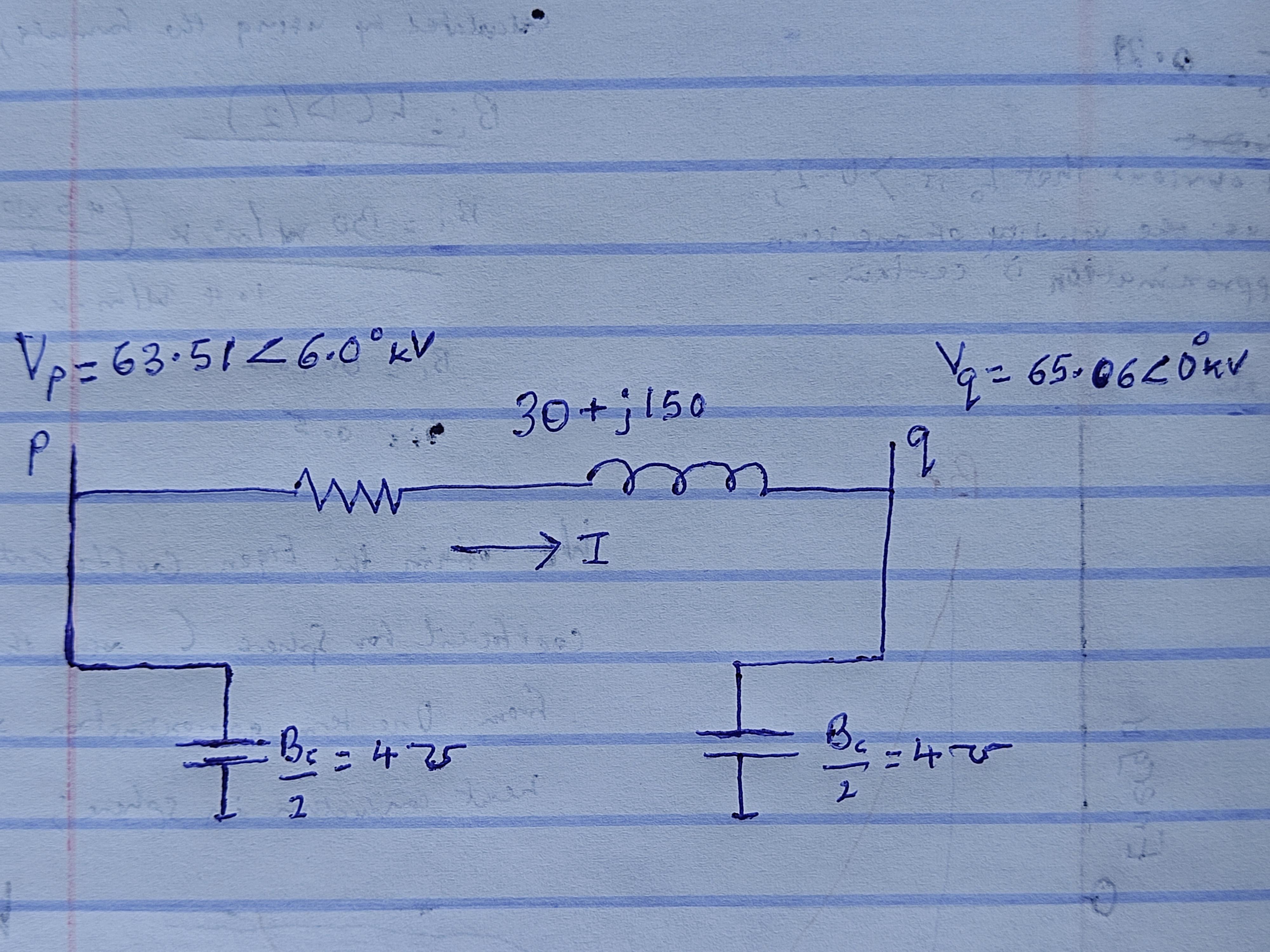
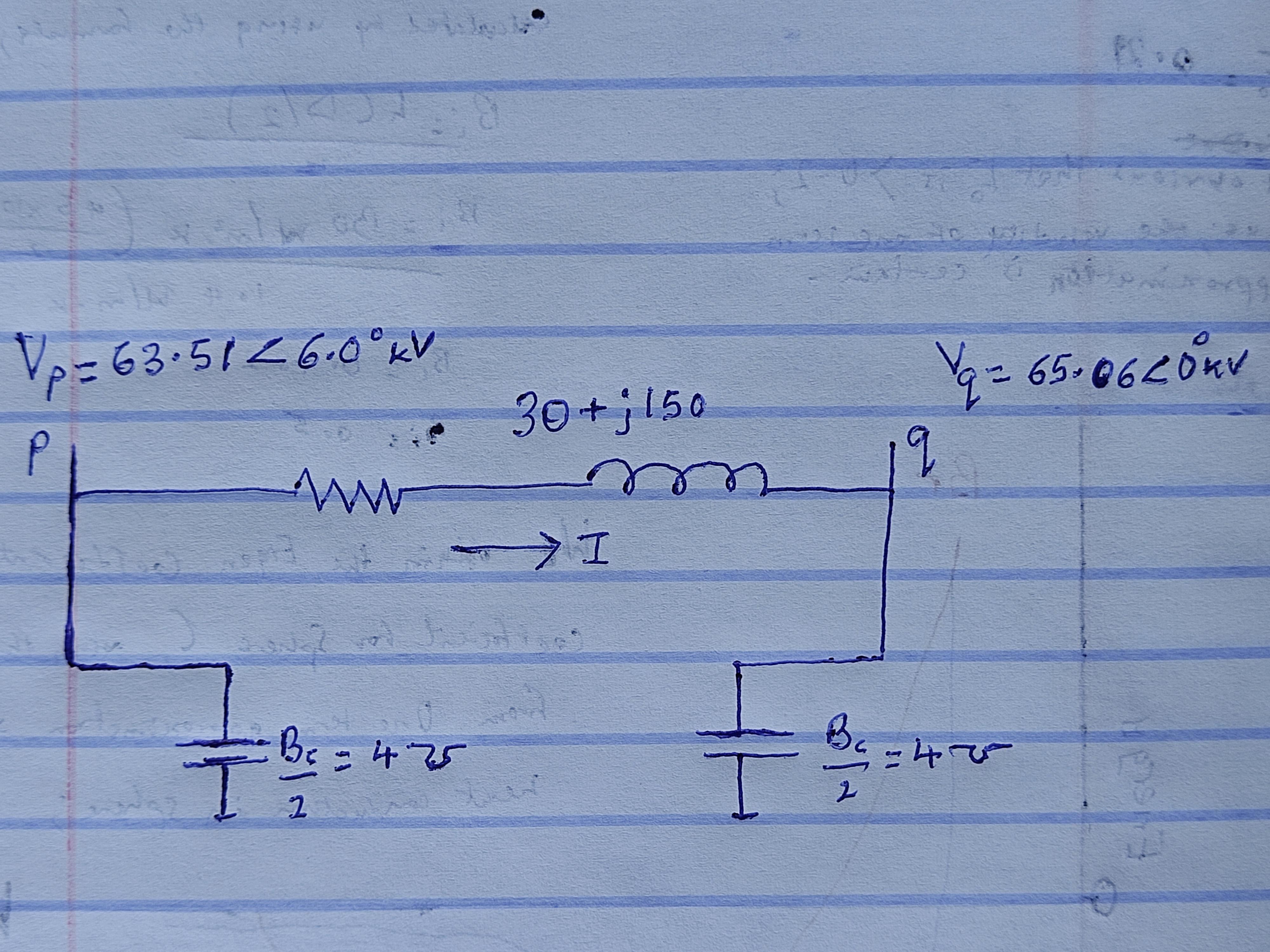
A 60 Hz three-phase 115kV transmission line has a series impedance of 30+j150 ohms/phase. The shunt susceptance of this line is \dfrac{B_c}{2} = 4 \ mhos /phase

The line to neutral voltages at buses p and q are and respectively. Compute , the three-phase real power losses in MW for this transmission circuit.

Answer:

0.183 MW

Explanation:

The diagrammatic illustration of the given information can be seen in the image attached below:

Thus: the current in the network can be computed as:

I =\dfrac{V_p-V_q}{Z +\dfrac{1}{Y}}

I =\dfrac{63.51 \times 10^3 \angle 6^0-656.06 \times 10^3 \angle 0^0 }{30 + j 150 -j0.125}

I  = 45.173 \angle 27.28^0 \ A

The P_{loss can be computed as:

P_{loss} = 3 \times I^2 \times  R

P_{loss} = 3 \begin {bmatrix} 45.173 \end {bmatrix} ^2  \times 30

Finally; the three-phase real power loss is:

P_{loss \ of  \ sphere} = 0.183  \ MW

You might be interested in
mechanically cleaned wastewater bar screen is constructed using 6.5-mm-wide bars spaced 5.0 cm apart center to center; the bars
Annette [7]

Answer: The head loss is 1.5 cm

Explanation:  Equation needed to solve is: h= (vs^2-v^2)/2gC^2

where C is the friction coefficient. To determine the area of flow, we nee to realize that the area available for flow over an area of 1*1 m, Aₓ= 0.87 m², observed from the correlation that for every width of 5.0 cm, we lose 6.5 mm, roughly about 12.9 or 13%.

For a fresh clean screen, the velocity will tend to increase by a factor of  (1/0.87).

The velocities through the screen equals to (0.4/0.87) = 0.46 m/s and (0.8/0.87) = 0.92 m/s.

Apply the above mentioned equation:

h= (0.92^2-0.8^2)/2*0.84^2*9.81 \\\\=0.01499\\=0.015 m = 0.015*100 = 1.50 cm

6 0
2 years ago
Which situation is an enabler for the rise of Artificial Intelligence (AI) in recent years?
Vladimir [108]

Explanation:

Which situation is an enabler for the rise of Artificial Intelligence (A in recent years? availability of cloud-based, hosted machine learning platforms.

8 0
2 years ago
Read 2 more answers
A suspension of Bacillus subtilis cells is filtered under constant pressure for recovery of protease. A pilot-scale filter is us
sattari [20]

The answer & explanation for this question is given in the attachment below.

7 0
2 years ago
Consider air entering a heated duct at P1 = 1 atm and T1 = 288 K. Ignore the effect of friction. Calculate the amount of heat pe
Ne4ueva [31]

Answer:

The solution for the given problem is done below.

Explanation:

M1 = 2.0

\frac{p1}{p*} = 0.3636

\frac{T1}{T*} = 0.5289

\frac{T01}{T0*} = 0.7934

Isentropic Flow Chart:  M1 = 2.0 , \frac{T01}{T1} = 1.8

T1 = \frac{1}{0.7934} (1.8)(288K) = 653.4 K.

In order to choke the flow at the exit (M2=1), the above T0* must be stagnation temperature at the exit.

At the inlet,

T02= \frac{T02}{T1}T1 = (1.8)(288K) = 518.4 K.

Q= Cp(T02-T01) = \frac{1.4(287 J / (Kg.K)}{1.4-1}(653.4-518.4)K = 135.7*10^{3} J/Kg.

5 0
2 years ago
Read 2 more answers
Finally you will implement the full Pegasos algorithm. You will be given the same feature matrix and labels array as you were gi
Diano4ka-milaya [45]

Answer:

In[7] def pegasos(feature_matrix, labels, T, L):

   """

   .

   let learning rate = 1/sqrt(t),

   where t is a counter for the number of updates performed so far       (between 1   and nT inclusive).

Args:

       feature_matrix - A numpy matrix describing the given data. Each row

           represents a single data point.

       labels - A numpy array where the kth element of the array is the

           correct classification of the kth row of the feature matrix.

       T -  the maximum number of times that you should iterate through the feature matrix before terminating the algorithm.

       L - The lamba valueto update the pegasos

   Returns: Is defined as a  tuple in which the first element is the final value of θ and the second element is the value of θ0

   """

   (nsamples, nfeatures) = feature_matrix.shape

   theta = np.zeros(nfeatures)

   theta_0 = 0

   count = 0

   for t in range(T):

       for i in get_order(nsamples):

           count += 1

           eta = 1.0 / np.sqrt(count)

           (theta, theta_0) = pegasos_single_step_update(

               feature_matrix[i], labels[i], L, eta, theta, theta_0)

   return (theta, theta_0)

In[7] (np.array([1-1/np.sqrt(2), 1-1/np.sqrt(2)]), 1)

Out[7] (array([0.29289322, 0.29289322]), 1)

In[8] feature_matrix = np.array([[1, 1], [1, 1]])

   labels = np.array([1, 1])

   T = 1

   L = 1

   exp_res = (np.array([1-1/np.sqrt(2), 1-1/np.sqrt(2)]), 1)


   pegasos(feature_matrix, labels, T, L)

Out[8] (array([0.29289322, 0.29289322]), 1.0)
Explanation:

In[7] def pegasos(feature_matrix, labels, T, L):

   """

   .

   let learning rate = 1/sqrt(t),

   where t is a counter for the number of updates performed so far       (between 1   and nT inclusive).

Args:

       feature_matrix - A numpy matrix describing the given data. Each row

           represents a single data point.

       labels - A numpy array where the kth element of the array is the

           correct classification of the kth row of the feature matrix.

       T -  the maximum number of times that you should iterate through the feature matrix before terminating the algorithm.

       L - The lamba valueto update the pegasos

   Returns: Is defined as a  tuple in which the first element is the final value of θ and the second element is the value of θ0

   """

   (nsamples, nfeatures) = feature_matrix.shape

   theta = np.zeros(nfeatures)

   theta_0 = 0

   count = 0

   for t in range(T):

       for i in get_order(nsamples):

           count += 1

           eta = 1.0 / np.sqrt(count)

           (theta, theta_0) = pegasos_single_step_update(

               feature_matrix[i], labels[i], L, eta, theta, theta_0)

   return (theta, theta_0)

In[7] (np.array([1-1/np.sqrt(2), 1-1/np.sqrt(2)]), 1)

Out[7] (array([0.29289322, 0.29289322]), 1)

In[8] feature_matrix = np.array([[1, 1], [1, 1]])

   labels = np.array([1, 1])

   T = 1

   L = 1

   exp_res = (np.array([1-1/np.sqrt(2), 1-1/np.sqrt(2)]), 1)


   pegasos(feature_matrix, labels, T, L)

Out[8] (array([0.29289322, 0.29289322]), 1.0)
6 0
2 years ago
Other questions:
  • A hydrogen-filled balloon to be used in high altitude atmosphere studies will eventually be 100 ft in diameter. At 150,000 ft, t
    7·1 answer
  • What are the three most common metals used in die casting?
    6·1 answer
  • A steel rotating-beam test specimen has an ultimate strength Sut of 1600 MPa. Estimate the life (N) of the specimen if it is tes
    8·1 answer
  • Gina is about to use a fire extinguisher on a small fire. What factor determines the type of extinguisher she should use
    9·2 answers
  • Define a function pyramid_volume with parameters base_length, base_width, and pyramid_height, that returns the volume of a pyram
    10·1 answer
  • tech A says that a Hall-effect sensor can be used in an electronic ignition system. Tech B says that an optical-type sensor can
    6·1 answer
  • The small washer is sliding down the cord OA. When it is at the midpoint, its speed is 28 m/s and its acceleration is 7 m/s 2 .
    13·1 answer
  • Two airstreams are mixed steadily and adiabatically. The first stream enters at 35°C and 30 percent relative humidity at a rate
    6·1 answer
  • Discuss the nature of materials causing turbidity in
    10·2 answers
  • George is replacing a burned out resistor in a circuit board. The board has a 10, a 20, and a 40 on resistor, all in parallel. W
    5·1 answer
Add answer
Login
Not registered? Fast signup
Signup
Login Signup
Ask question!