answer.
Ask question
Login Signup
Ask question
All categories
  • English
  • Mathematics
  • Social Studies
  • Business
  • History
  • Health
  • Geography
  • Biology
  • Physics
  • Chemistry
  • Computers and Technology
  • Arts
  • World Languages
  • Spanish
  • French
  • German
  • Advanced Placement (AP)
  • SAT
  • Medicine
  • Law
  • Engineering
Wewaii [24]
1 year ago
6

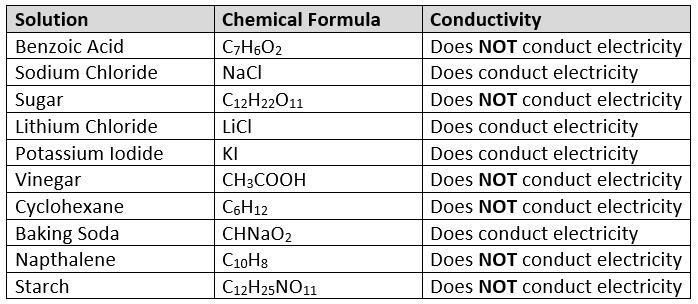
1. Carson completed conductivity testing on the solutions shown in the data table below and recorded his findings in the conduct

ivity column. After determining which solutions conducted electricity and which solutions did not conduct electricity, Carson needs to explain his findings so that he can make predictions about conductivity in the future without having to complete the testing. Why do some of the solutions conduct electricity and some of the solutions not conduct electricity?
Results of conductivity testing: image

Consider Carson's findings, then make a claim to answer the question. Be sure to support your claim with sufficient evidence and reasoning.

Chemistry
1 answer:
pishuonlain [190]1 year ago
4 0

Answer:

See below :)

Explanation:

There is an evident reason why some of the solutions Carson's has listed and observed, does conduct electricity and some that do.

A flow of electrical charge is called an electric current. Ions are atoms, or sets of atoms, that contain an electrical charge. There are two types of ions, cation or a positively charged ion containing a deficiency of electrons, and anion or a negatively charged ion which contains a surplus of electrons. When a solution conducts electricity the charge is carried within by ions that move through the solution. The larger the number of ions in the solution, the better the conductivity of the solution is. Pure water does not conduct very well because it contains very few ions, but when table salt (NaCl) is dissolved in the water, this solution does conduct well because the solution contains a more abundance of ions. The majority of the ions come from the table salt, chemically names sodium chloride. Because Sodium contains its sodium ions, and these are positive charge and chloride ions which is a negative charge, it is called an ionic substance. Not every substance is made up of ions, one such example is sugar (C12H22O11). Sugar is made up of uncharged particles also called molecules. Although sugar is a substance its molecules do not hold a charge, thus when sugar is dissolved in water, the solution does not conduct electricity, due to the lack of ions in the solution.

Therefore, depending on the ions that make up the compound, the substance would or would not conduct electricity.

You might be interested in
Table salt (NaCl) is a compound. Every molecule of table salt has the same properties as every other molecule of table salt beca
Fiesta28 [93]

Table salt (NaCl) is a compound. Every molecule of table salt has the same properties as every other molecule of table salt because they all have one sodium (Na) atom and one chlorine (Cl) atom. This is referred to as fixed composition.

Hope this helps! Please correct me if I'm wrong :)

4 0
2 years ago
Calculate the freezing point of a 0.100 m aqueous solution of k2so4, taking interionic attractions into consideration by using t
Leokris [45]
Ionic  salt  dissociate  completely  in  water   particularly in  water at  low  concentration.
 The  molal  freezing point  of  depression constant  for  water is 1.85kg/k/mol
therefore depression  of  freezing  point =1.853  x 0.100  x  2.32=0.429  degrees  celsius
hence  solute  freeze at - 0.429  degree  celsius
3 0
2 years ago
A student pours exactly 26.9 mL of HCl acid of unknown molarity into a beaker. The student then adds 2 drops of the indicator an
Assoli18 [71]
a.
Acids react with bases and give salt and water and the products.

Hence, HCl reacts with NaOH and gives NaCl salt and H₂O as the products. The reaction is,
            HCl(aq) + NaOH(aq) → NaCl(aq) + H₂O(l)

To balance the reaction equation, both sides hould have same number of elements.

Left hand side,                                             Right hand side,
             
H atoms = 2                                               H atoms = 2
            Cl atoms = 1                                               Cl atoms = 1
            Na atoms = 1                                               Na atoms = 1 
           O atoms = 1                                                   O atoms = 1

Hence, the reaction equation is already balanced.

b. 
Molarity (M)= moles of solute (mol) / Volume of the solution (L)
 
          HCl(aq) + NaOH(aq) → NaCl(aq) + H₂O(l)

Molarity of NaOH = <span>0.13 M
</span>Volume of NaOH added = <span>43.7 mL
Hence, moles of NaOH added = 0.13 M x 43.7 x 10</span>⁻³ L
                                                 = 5.681 x 10⁻³ mol

Stoichiometric ratio between NaOH and HCl is 1 : 1

Hence, moles of HCl = moles of NaOH
                                    = 
5.681 x 10⁻³ mol

5.681 x 10⁻³ mol of HCl was in <span>26.9 mL.

Hence, molarity of HCl = </span>5.681 x 10⁻³ mol / 26.9 x 10⁻³ L
                                     = 0.21 M
6 0
2 years ago
When one atom loses an electron and another atom accepts that electron a(n) bond between the two atoms results?
morpeh [17]
When an element losses its electron its called a cation. When an element accepted that electron it called anion. This is called an ionic bond.
8 0
2 years ago
A 100.0mL bubble of hot gases at 225 C and 1.80 atm escapes from an active volcano, what is the new volume of the bubble outside
Inessa05 [86]
<h3>Answer:</h3>

112.08 mL

<h3>Explanation:</h3>

From the question we are given;

  • Initial volume, V1 = 100.0 mL
  • Initial temperature, T1 = 225°C, but K = °C + 273.15

thus, T1 = 498.15 K

  • Initial pressure, P1 = 1.80 atm
  • Final temperature , T2 = -25°C

                                     = 248.15 K

  • Final pressure, P2 = 0.80 atm

We are required to calculate the new volume of the gases;

  • According to the combined gas law equation;

\frac{P1V1}{T1}=\frac{P2V2}{T2}

Rearranging the formula;

V2=\frac{P1V1T2}{T1P2}

Therefore;

V2=\frac{(1.80atm)(100mL)(248.15K)}{(498.15K)(0.80atm)}

V2=112.08mL

Therefore, the new volume of the gas is 112.08 mL
8 0
2 years ago
Other questions:
  • Elements that can be described by the hardness shininess and ductility
    9·1 answer
  • You are on a field trip to a nearby lake for biology class and want to perform a quick analysis of the water’s approximate pH le
    6·2 answers
  • Write the symbol for the monatomic ion that has a charge of 1– and the condensed electron configuration [ne]3s23p6.
    5·2 answers
  • List four ways you can avoid injury while using HCl and three steps you would take in case of an accidental exposure to HCl need
    6·2 answers
  • A common reaction is the formation of butyric acid from butyl alcohol. butyric acid is what causes the odor of rancid butter. ba
    14·2 answers
  • If a runners power is 400 w as she runs, how much chemical energy dose she convert into other forms in 10.0 minuets?
    13·1 answer
  • El amoniaco y el fluor reaccionan para formar tetrafluoruro de dinitrogeno y fluoruro de hidrogeno. segun la reaccion: NH3 + F2
    12·1 answer
  • Which statement about the spectrophotometric analysis of Red 40 dye is TRUE?
    8·1 answer
  • For each of the following substituents, indicate whether it withdraws electrons inductively, donates electrons by hyperconjugati
    9·1 answer
  • Give two examples (i.e. list 2 elements that are examples) of: a. an atom with a half-filled subshell b. an atom with a complete
    13·1 answer
Add answer
Login
Not registered? Fast signup
Signup
Login Signup
Ask question!
