answer.
Ask question
Login Signup
Ask question
All categories
  • English
  • Mathematics
  • Social Studies
  • Business
  • History
  • Health
  • Geography
  • Biology
  • Physics
  • Chemistry
  • Computers and Technology
  • Arts
  • World Languages
  • Spanish
  • French
  • German
  • Advanced Placement (AP)
  • SAT
  • Medicine
  • Law
  • Engineering
Trava [24]
2 years ago
13

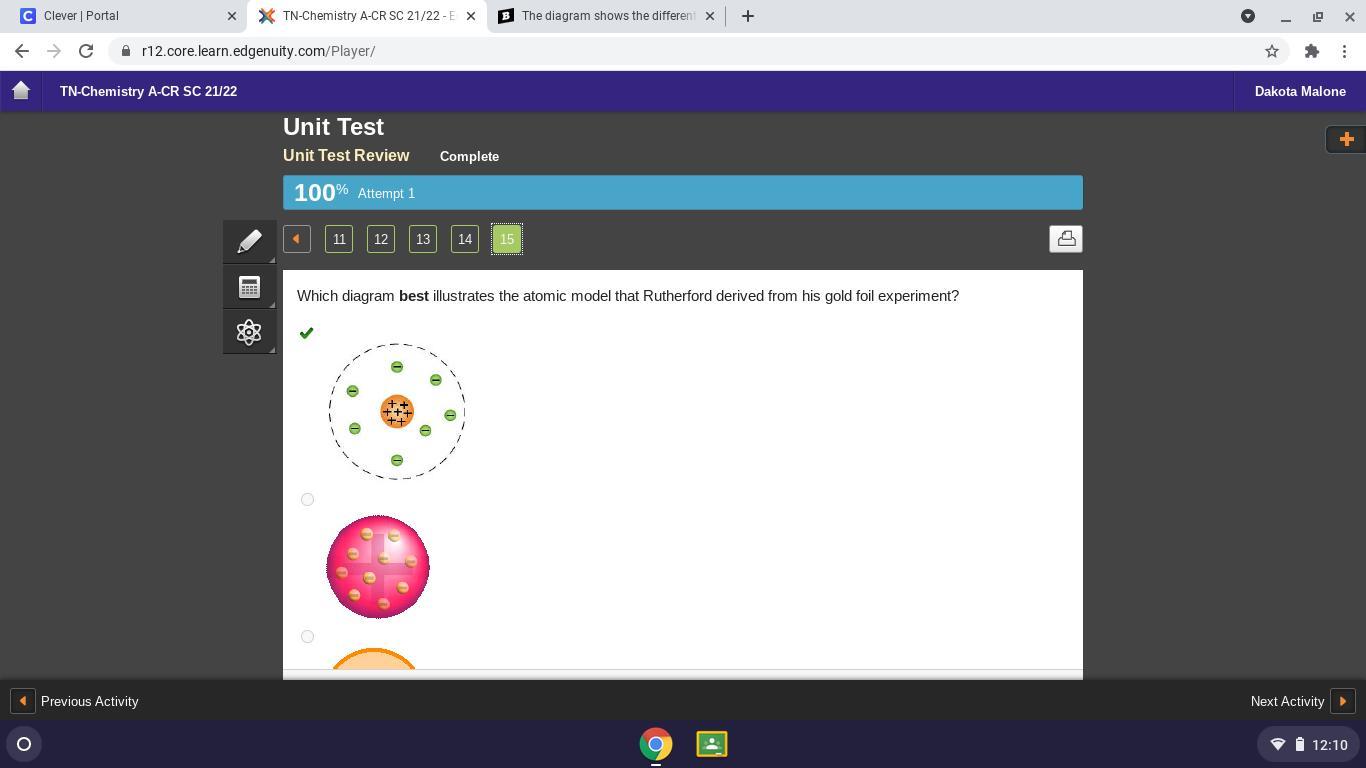
The diagram shows the different models of the atom that eventually led to the modern atomic theory. Four diagrams are shown labe

led Model A, Model B, Model C, Model D from left to right. The diagram labeled Model A has a small sphere with a positive sign on it. This small sphere at the center is surrounded by a shaded circle. The shaded circle has negative signs placed randomly inside it. The diagram labeled Model B is a large solid sphere. The diagram labeled Model C has a sphere at the center and a dotted cloud around the sphere. The dotted cloud is dense near the sphere and becomes faint as we move away from the sphere. The diagram labeled Model D has a sphere surrounded by three concentric circles. Each concentric circle has some spheres on it. Which model is based on Bohr's quantum model?
Chemistry
2 answers:
Nikolay [14]2 years ago
8 0

Answer:

the answer is B i just took the test on edge <3

Explanation:

because it do what it do

lesya692 [45]2 years ago
4 0

Answer:

The Answer is A on Edge 2021

Explanation:

I took the unit test exam and got a 100%

You might be interested in
Predict the initial and isolated products for the reaction. The starting material is a 6 carbon chain where there is a triple bo
satela [25.4K]

Answer:

See explanation and image attached

Explanation:

This reaction is known as mercuric ion catalyzed hydration of alkynes.

The first step in the reaction is attack of the mercuric ion on the carbon-carbon triple bond, a bridged intermediate is formed. This bridged intermediate is attacked by water molecule to give an organomercury enol. This undergoes keto-enol tautomerism, proton transfer to the keto group yields an oxonium ion, loss of the mercuric ion now gives equilibrium keto and enol forms of the compound. The keto form is favoured over the enol form.

7 0
2 years ago
It take 38.70cm³ of 1.90m NaoH to neutralize 10.30cm³ of H2so4 in a battery, calculate the molar concentration of H2so4
zlopas [31]

Answer:

M_{acid}=3.57M

Explanation:

Hello there!

In this case, since this acid-base neutralization is performed in a 1:2 mole ratio of acid to base as the former is a diprotic acid (two hydrogen ions in the molecule), we can write the following equation:

2M_{acid}V_{acid}=M_{base}V_{base}

In such a way, we can solve for the molarity of the acid, given the molarity and concentration of the NaOH base and the volume of the acid:

M_{acid}=\frac{M_{base}V_{base}}{2V_{acid}}

Thus, we plug in the given data to obtain:

M_{acid}=\frac{38.70cm^3*1.90M}{2(10.30cm^3)} \\\\M_{acid}=3.57M

Best regards!

8 0
2 years ago
Matt did an experiment to study the solubility of two substances. He poured 100 mL of water at 20 °C into each of two beakers la
Black_prince [1.1K]

Part 1 : Answer is only B substance is soluble in water.

In this experiment undissolved mass of each substance was measured. According to the given data, undissolved mass of substance B at 20 °C is 10 g while A is 50 g. Since, the initial added mass of each substance is 50 g, we can see that substance A is not soluble in water since the undissolved mass is 50 g.

Part 2 : Substance A is not soluble in water and substance B is soluble in water.

According to the given data, the undissolved mass of substance A remains as same as initial added mass, 50 g throughout the temperature range from 20 ° to 80 °C. Hence, we can conclude that substance A is not soluble in water.

But, according to the data, undissolved mass of substance B at 20 °C is 10 g. That means, 40 g of substance B was dissolved in water. When the temperature increases the undissolved mass of substance B decreases. Hence, we can conclude that substance B is soluble in water and solubility increases with temperature.


4 0
2 years ago
Read 2 more answers
What does the number represent in the isotope platinum-194?
vazorg [7]
The number in isotope platinum-194 stands for the <em>total </em>amount of protons and neutrons. In other words, this is the mass. =)
4 0
2 years ago
A can of soda contains many ingredients, including vanilla, caffeine, sugar, and water. Which ingredient is the solvent? caffein
tangare [24]

Answer:

Water

Explanation:

Water is universal solvent it can disolves other things
6 0
2 years ago
Read 2 more answers
Other questions:
  • If a runner completes a 10 kilometer race in 32.50 minutes, what is the 10.0 km pace in miles per hour? (1.609 km = 1 mile appro
    8·1 answer
  • Draw the structure of (z)-3-methylhept-3-ene. be sure the stereochemistry is drawn clearly.
    7·1 answer
  • Match each type of titration to its ph at the equivalence point for solutions at 25 ∘c. drag each item to the appropriate bin. v
    12·1 answer
  • ASAP PLEASE HELP:
    11·2 answers
  • The molar mass of copper(II) chloride (CuCl2) is 134.45 g/mol. How many formula units of CuCl2 are present in 17.6 g of CuCl2? 7
    9·2 answers
  • let 4 moles of methanol (liquid) combust in 3 moles of gaseous oxygen to form gaseous carbon dioxide and water vapor. Suppose th
    12·1 answer
  • The mole fraction of oxygen molecules in dry air is 0.2095. What volume of dry air at 1.00 atm and 25°C is required for burning
    9·1 answer
  • The infrared spectrum above represents the absorption of certain wavelengths of radiation by molecules of CO2. Which of the foll
    9·1 answer
  • Suppose the price of gasoline increases 10% and quantity of gasoline demanded in Orlando drops 5% per day. Demand for gasoline i
    11·1 answer
  • An object at 20∘C absorbs 25.0 J of heat. What is the change in entropy ΔS of the object? Express your answer numerically in jou
    12·1 answer
Add answer
Login
Not registered? Fast signup
Signup
Login Signup
Ask question!
