answer.
Ask question
Login Signup
Ask question
All categories
  • English
  • Mathematics
  • Social Studies
  • Business
  • History
  • Health
  • Geography
  • Biology
  • Physics
  • Chemistry
  • Computers and Technology
  • Arts
  • World Languages
  • Spanish
  • French
  • German
  • Advanced Placement (AP)
  • SAT
  • Medicine
  • Law
  • Engineering
lbvjy [14]
2 years ago
14

Calculate the number of vacancies per cubic meter at 1000∘C for a metal that has an energy for vacancy formation of 1.22 eV/atom

, a density of 6.25g/cm^3, and an atomic weight of 37.4 g/mol.
(A) 1.49×10^18 m^−3
(B) 7.18×10^22 m^−3
(C) 1.49×10^24 m^−3
(D) 2.57×10^24 m^−3
Engineering
1 answer:
Makovka662 [10]2 years ago
6 0

Answer:

C

Explanation:

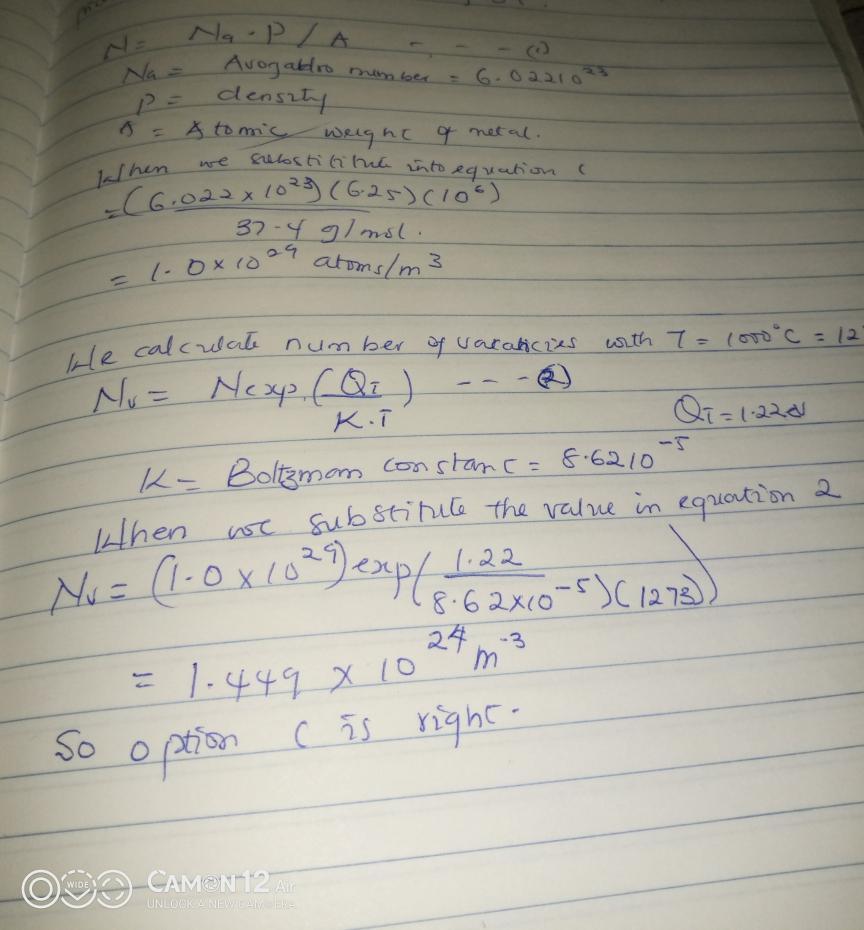
N = Na.P/A------(1)

Na = avogadro's number = 6.02210²³

P = density

A = atomic weight of metal

When we substitute into equation 1 above we get

1.0x10²⁹atoms/m³

From here we calculate the number of vacancies

T = 1000⁰c = 1273K

The formula to use is

Nv= Nexo(Qt/K.T) -----(2)

Qt = 1.22eV

K = Boltzmann's constant = 8.6210x10^-5

When we substitute values into equation 2

We get Nv = 1.49 x 10²⁴m-3

Therefore option c is correct

Check attachment for a more detailed calculation of this question

You might be interested in
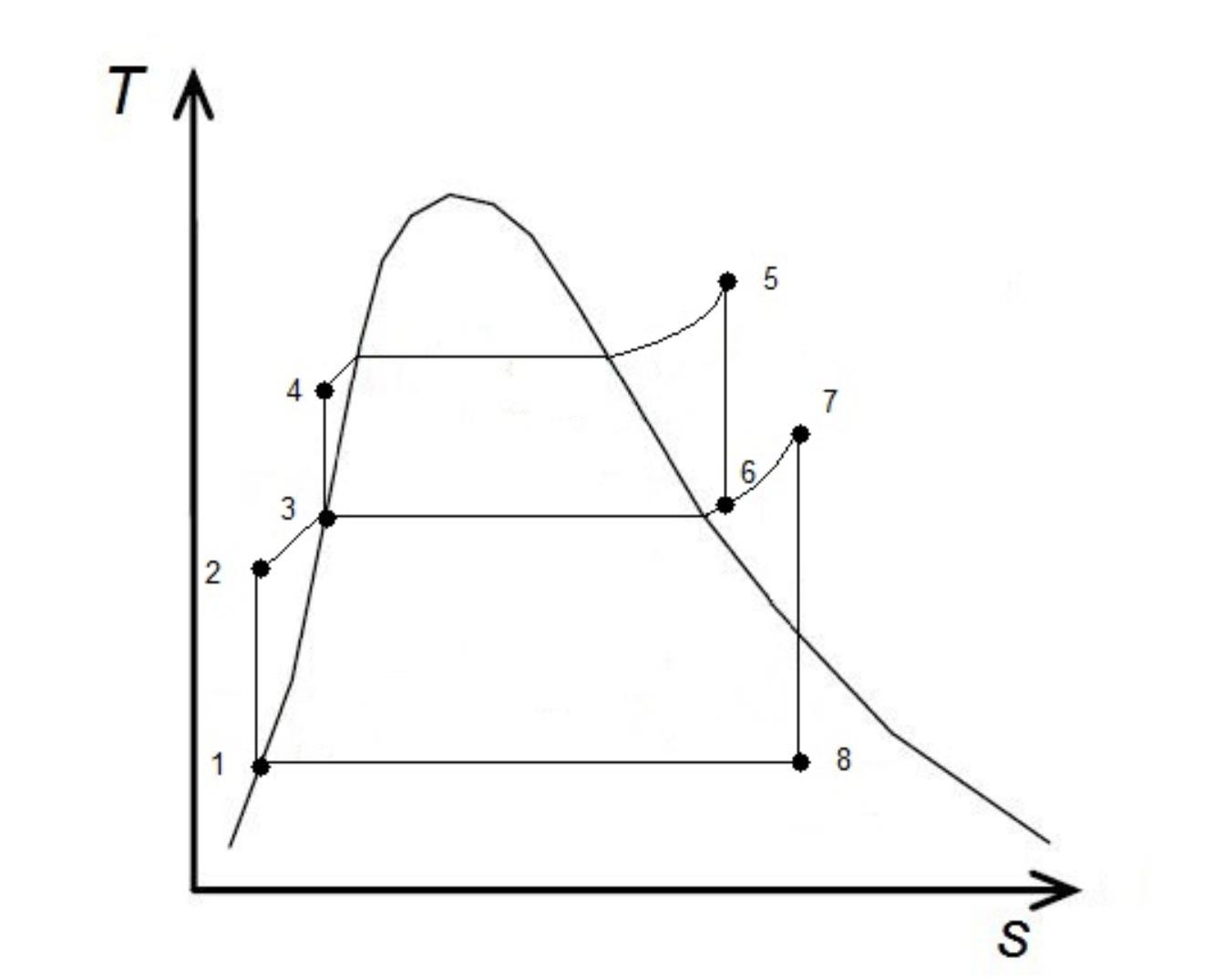
A steam power plant operates on an ideal reheat- regenerative Rankine cycle and has a net power output of 80 MW. Steam enters th
trasher [3.6K]

Answer:

flow(m) = 54.45 kg/s

thermal efficiency u = 44.48%

Explanation:

Given:

- P_1 = P_8 = 10 KPa

- P_2 = P_3 = P_6 = P_7 = 800 KPa

- P_4 = P_5 = 10,000 KPa

- T_5 = 550 C

- T_7 = 500 C

- Power Output P = 80 MW

Find:

-  The mass flow rate of steam through the boiler

-  The thermal efficiency of the cycle.

Solution:

State 1:

P_1 = 10 KPa , saturated liquid

h_1 = 192 KJ/kg

v_1 = 0.00101 m^3 / kg

State 2:

P_2 = 800 KPa , constant volume process work done:

h_2 = h_1 + v_1 * ( P_2 - P_1)

h_2 = 192 + 0.00101*(790) = 192.80 KJ/kg

State 3:

P_3 = 800 KPa , saturated liquid

h_3 = 721 KJ/kg

v_3 = 0.00111 m^3 / kg

State 4:

P_4 = 10,000 KPa , constant volume process work done:

h_4 = h_3 + v_3 * ( P_4 - P_3)

h_4 = 721 + 0.00111*(9200) = 731.21 KJ/kg

State 5:

P_5 = 10,000 KPa , T_5 = 550 C

h_5 = 3500 KJ/kg

s_5 = 6.760 KJ/kgK

State 6:

P_6 = 800 KPa , s_5 = s_6 = 6.760 KJ/kgK

h_6 = 2810 KJ/kg

State 7:

P_7 = 800 KPa , T_7 = 500 C

h_7 = 3480 KJ/kg

s_7 = 7.870 KJ/kgK

State 8:

P_8 = 10 KPa , s_8 = s_7 = 7.870 KJ/kgK

h_8 = 2490 KJ/kg

- Fraction of steam y = flow(m_6 / m_3).

- Use energy balance of steam bleed and cold feed-water:

                                        E_6 + E_2 = E_3

               flow(m_6)*h_6 + flow(m_2)*h_3 = flow(m_3)*h_3

                                    y*h_6 + (1-y)*h_3 = h_3

                                  y*2810 + (1-y)*192.8 = 721

Compute y:                          y = 0.2018

- Heat produced by the boiler q_b:

                             q_b = h_5 - h_4 +(1-y)*(h_7 - h_8)

                    q_b = 3500 -731.21 + ( 1 - 0.2018)*(3480 - 2810)

Compute q_b:               q_b = 3303.58 KJ/ kg

-Heat dissipated by the condenser q_c:

                                       q_c = (1-y)*(h_8 - h_1)

                                 q_c= ( 1 + 0.2018)*(2810 - 192)

Compute q_c:               q_c = 1834.26 KJ/ kg

- Net power output w_net:

                                     w_net = q_b - q_c

                                w_net = 3303.58 - 1834.26

                                    w_net = 1469.32 KJ/kg

- Given out put P = 80,000 KW

                                     flow(m) = P / w_net

compute flow(m)          flow(m) = 80,000 /1469.32 = 54.45 kg/s

- Thermal efficiency u:

                                     u = 1 - (q_c / q_b)

                                     u = 1 - (1834.26/3303.58)

                                     u = 44.48 %
5 0
2 years ago
air at 600 kPa, 330 K enters a well-insulated, horizontal pipe having a diameter of 1.2 cm and exits at 120 kPa, 300 K. Applying
notsponge [240]

Answer:

a) 251.31 m/s and 55.29 m/s

b) The mass flow rate is 0.0396 kg/s

c) The rate of entropy production is 0.0144 kW/K

Explanation:

a) The steady state is:

mi = mo

\frac{A_{i}V_{i}  }{v_{i} } =\frac{A_{o}V_{o}  }{v_{o} } \\V_{i} =V_{o}(\frac{v_{i}}{v_{o}} )=V_{o}(\frac{T_{i}P_{o} }{T_{o}P_{i} } )=V_{o}(\frac{330*120}{300*600}) =0.22V_{o}

The energy balance is:

h_{i}+\frac{V_{i}^{2} }{2} =h_{2}+\frac{V_{o}^{2} }{2} \\h_{i}-h_{o}+(\frac{V_{i}^{2}-V_{o}^{2}  }{2} )=0\\V_{o}=\sqrt{\frac{2(h_{i}-h_{o})}{0.9516} } =\sqrt{\frac{2*(330.24-300.19)x10^{3} }{0.9516} } =251.31m/s

Vi = 0.22 * 251.31 = 55.29 m/s

b) The mass flow rate is:

m=\frac{A_{o}V_{o}}{v_{o}} =\frac{\pi d^{2}V_{o}P_{o} }{4RT_{o}} =\frac{\pi *(0.012^{2})*251.31*120x10^{3}  }{4*287*300} =0.0396kg/s

c) The entropy produced is equal to:

\frac{Q}{T} +S_{gen} =m(s_{2} -s_{1} )\\0+S_{gen} =m(s_{2} -s_{1} )\\S_{gen} =m(s_{2} -s_{1} )\\S_{gen}=0.0396*(c_{p} ln\frac{T_{o}}{T_{i}} -Rln\frac{P_{o}}{P_{i}} )=0.0396*(1.004ln\frac{300}{330} -0.287ln\frac{120}{600} )=0.0144kW/K

3 0
2 years ago
Your roommate wants to learn about organizational chart. You can tell her that these charts can tell you all of these about an o
mars1129 [50]

Answer:

Control mechanisms

Explanation:

Organizational chart of any company will give details of different aspects of the company such as the major sub-units of the organization with the names of team leaders for different sub-units, it can also give you the span of control and the division of work within the company. However, the chart can't show you control mechanisms of different departments.

4 0
2 years ago
Water at 200C flows through a pipe of 10 mm diameter pipe at 1 m/s. Is the flow Turbulent ? a. Yes b. No
Degger [83]

Answer:

Yes, the flow is turbulent.

Explanation:

Reynolds number gives the nature of flow. If he Reynolds number is less than 2000 then the flow is laminar else turbulent.

Given:

Diameter of pipe is 10mm.

Velocity of the pipe is 1m/s.

Temperature of water is 200°C.

The kinematic viscosity at temperature 200°C is 1.557\times10^{-7}m2/s.

Calculation:

Step1

Expression for Reynolds number is given as follows:

Re=\frac{vd}{\nu}

Here, v is velocity, \nu is kinematic viscosity, d is diameter and Re is Reynolds number.

Substitute the values in the above equation as follows:

Re=\frac{vd}{\nu}

Re=\frac{1\times(10mm)(\frac{1m}{1000mm})}{1.557\times10^{-7}}

Re=64226.07579

Thus, the Reynolds number is 64226.07579. This is greater than 2000.

Hence, the given flow is turbulent flow.

5 0
2 years ago
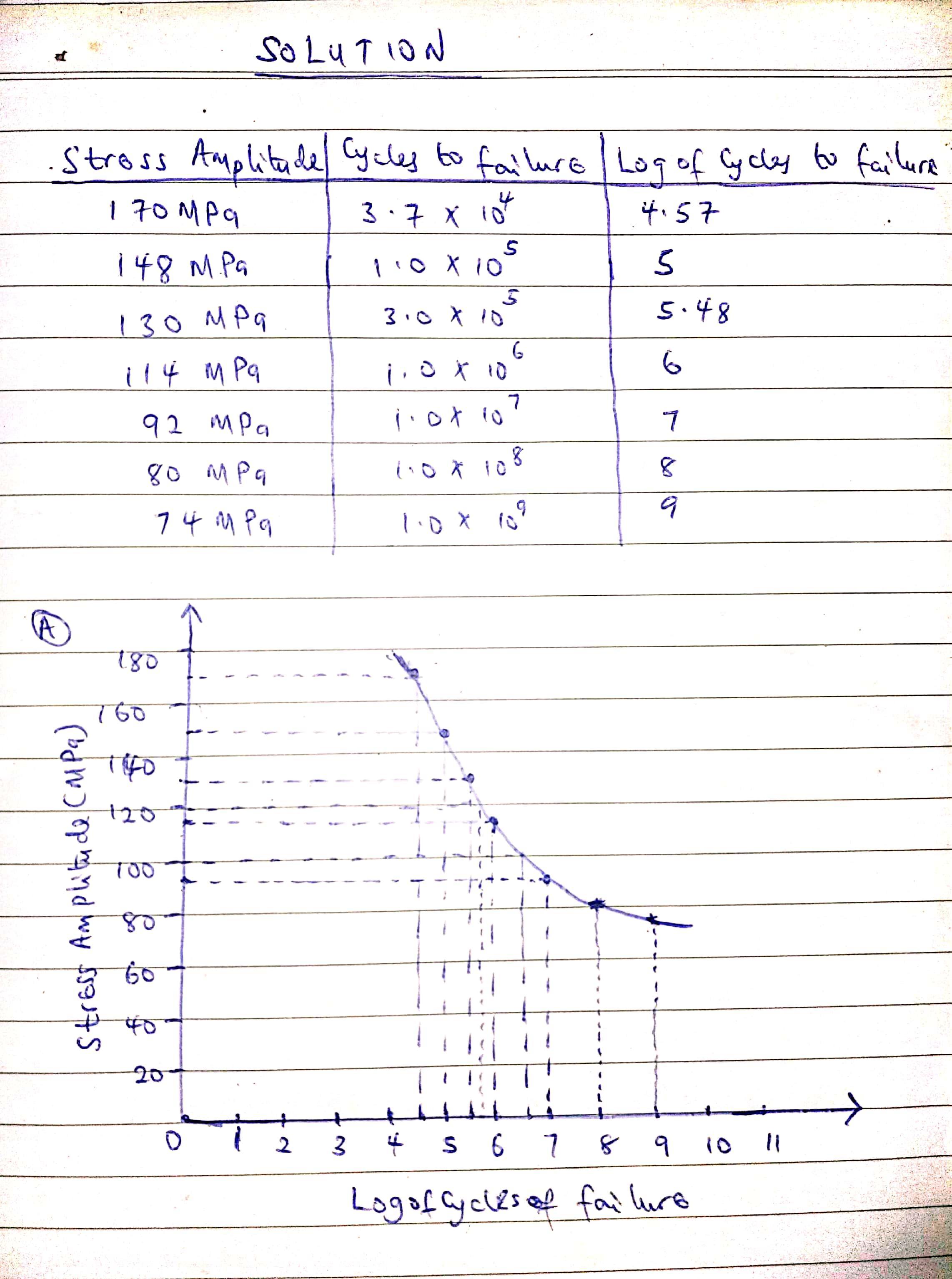
The fatigue data for a brass alloy are given as follows: Stress Amplitude (MPa) Cycles to Failure 170 3.7 × 10⁴ 148 1.0 × 10⁵ 13
prohojiy [21]

Answer:

i) S–N plot is attached

ii) fatigue strength = 100 MPa

iii) fatigue life = 5.62 x 10^(5) cycles

Explanation:

i) I have attached the S–N plot (stress amplitude versus logarithm of cycles to failure)

ii) The question says we should find the fatigue strength at 4 × 10^(6) cycles.

So let's find the log of this and trace it on the graph attached.

Log(4 × 10^(6)) = 6.6

From the graph attached, at log of cycle value of 6.6, the fatigue strength is approximately 100 MPa

iii) The question says we should find the fatigue life for 120 MPa.

Thus, from the graph, at stress amplitude of 120 MPa, the log of cycles is approximately 5.75.

Thus,the fatigue life will be the inverse log of 5.75.

Thus, fatigue life = 10^(5.75)

Fatigue life = 5.62 x 10^(5)

8 0
2 years ago
Other questions:
  • The hot water needs of an office are met by heating tab water by a heat pump from 16 C to 50 C at an average rate of 0.2 kg/min.
    5·1 answer
  • A joining process in which a filler metal is melted and distributed by capillary action between faying surfaces, the base metals
    12·1 answer
  • Sal has many options for how to spend her afternoon. She placed them in the order in which she values them: 1) go to a movie, 2)
    14·1 answer
  • The Gill Art Gallery wishes to maintain data on their customers, artists and paintings. They may have several paintings by each
    7·1 answer
  • A glycerin pump is powered by a 5-kW electric motor. The pressure differential between the outlet and the inlet of the pump at f
    13·1 answer
  • Milton has been tracking the migrating patterns of whales in the northwest Atlantic Ocean for five years. He knows where and whe
    5·2 answers
  • 11 Notează, în caiet, trăsăturile personajelor ce se pot
    13·1 answer
  • The typical Canadian worker is able to produce 100 board feet (a unit of measure) of lumber or 1000 light bulbs per year. The wo
    12·1 answer
  • Why is data driven analytics of interest to companies?
    9·1 answer
  • 1. A _____ is applied to a wall or roof rafters to add strength and keep the building straight and plumb.
    9·1 answer
Add answer
Login
Not registered? Fast signup
Signup
Login Signup
Ask question!