answer.
Ask question
Login Signup
Ask question
All categories
  • English
  • Mathematics
  • Social Studies
  • Business
  • History
  • Health
  • Geography
  • Biology
  • Physics
  • Chemistry
  • Computers and Technology
  • Arts
  • World Languages
  • Spanish
  • French
  • German
  • Advanced Placement (AP)
  • SAT
  • Medicine
  • Law
  • Engineering
babunello [35]
2 years ago
5

The fracture strength of glass may be increased by etching away a thin surface layer. It is believed that the etching may alter

the surface crack geometry (i.e. reduce crack length and increase tip radius). Calculate the ratio of the etched and original crack tip radii if the fracture strength is increased by a factor of 6 when 16.0% of the crack length is removed.
Engineering
1 answer:
Korvikt [17]2 years ago
6 0

Answer:

the ratio of the etched to the original crack tip radius is 30.24

Explanation:

Given the data in the question;

we determine the initial fracture stress using the following expression;

(σf)₁ = 2(σ₀)₁ [ α₁/(p_t)₁ ]^{1/2 ----- let this be equation 1

where; (σ₀)₁ is the initial fracture strength

(p_t)₁ is the original crack tip radius

α₁ is the original crack length.

first, we determine the final crack length;

α₂ = α₁ - 16% of α₁

α₂ = α₁ - ( 0.16 × α₁)

α₂ = α₁ - 0.16α₁

α₂ = 0.84α₁

next, we calculate the final fracture stress;

the fracture strength is increased by a factor of 6;

(σ₀)₂ = 6( σ₀ )₁

Now, expression for the final fracture stress

(σf)₂ = 2(σ₀)₂ [ α₂/(p_t)₂ ]^{1/2 ------- let this be equation 2

where (p_t)₂ is the etched crack tip radius

value of fracture stress of glass is constant

Now, we substitute 2(σ₀)₁ [ α₁/(p_t)₁ ]^{1/2 from equation for (σf)₂  in equation 2.

0.84α₁ for α₂.

6( σ₀ )₁ for (σ₀)₂.

∴

2(σ₀)₁ [ α₁/(p_t)₁ ]^{1/2  = 2(6( σ₀ )₁) [ 0.84α₁/(p_t)₂ ]^{1/2  

divide both sides by 2(σ₀)₁

[ α₁/(p_t)₁ ]^{1/2  =  6 [ 0.84α₁/(p_t)₂ ]^{1/2

[ 1/(p_t)₁ ]^{1/2  =  6 [ 0.84/(p_t)₂ ]^{1/2

[ 1/(p_t)₁ ]  =  36 [ 0.84/(p_t)₂ ]

1 / (p_t)₁ = 30.24 / (p_t)₂

(p_t)₂ = 30.24(p_t)₁

(p_t)₂/(p_t)₁ = 30.24

Therefore, the ratio of the etched to the original crack tip radius is 30.24

You might be interested in
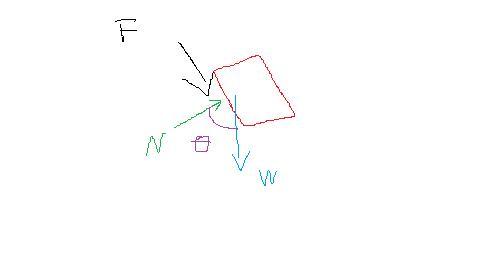
A curve in a speed track has a radius of 1000 ft and a rated speed of 120 mi/h. (From Sample Prob. 12.7 is the definition of rat
forsale [732]

Answer:

tan \theta = \frac{(176ft/s)^2}{1000 ft 32.2 ft/s^2}= 0.962

\theta = tan^{-1} (0.962) = 43.89

Explanation:

If the question is: Determine the banking angle θ

We have the forces involved on the figure attached.

For this case we know that the weight is given by:

W = mg

And for this case the centripetal acceleration would be given by:

a=\frac{v^2}{r}

If we analyze the sum of forces on x and y we have:

\sum F_x = m a_x

F + W sin \theta = ma cos theta

And if we solve for the force we got:

F = ma cos \theta - mg sin \theta = \frac{mv^2}{r} cos \theta - mg sin \theta

\sum F_y = m a_y

N - W cos \theta = ma sin \theta

If we solve for the normal force we got:

N =W cos \theta + ma sin \theta = \frac{mv^2}{r} sin \theta + mg cos \theta

In order to find the banking angle we use the fact that F =0

0 = \frac{mv^2}{r} cos \theta - mg sin \theta

tan \theta= \frac{v^2}{rg}

The velocity on this case is 120 mi/h if we convert this into ft/ s we got:

120 mi/h * \frac{5280 ft}{1mi} *\frac{1hr}{3600 s}= 176 ft/s

And then we have this:

tan \theta = \frac{(176ft/s)^2}{1000 ft 32.2 ft/s^2}= 0.962

\theta = tan^{-1} (0.962) = 43.89

5 0
2 years ago
If a server takes precisely 15 seconds to serve a customer and customers arrive exactly every 20 seconds, what is the average wa
labwork [276]
The average waiting time is 10 seconds
7 0
2 years ago
Consider insulation on a circular pipe For the same thickness and type of insulation, the thermal resistance of the insulation i
leonid [27]

Answer:

b). The same for all pipes independent of the diameter

Explanation:

We know,

R_{conduction}=\frac{ln(\frac{r_{2}}{r_{1}})}{2\pi LK}

R_{convection}=\frac{1}{h(2\pi r_{2}L)}

From the above formulas we can conclude that the thermal resistance of a substance mainly depends upon heat transfer coefficient,whereas radius has negligible effects on heat transfer coefficient.

We also know,

Factors on which thermal resistance of insulation depends are :

1. Thickness of the insulation

2. Thermal conductivity of the insulating material.

Therefore from above observation we can conclude that the thermal resistance of the insulation is same for all pipes independent of diameter.

5 0
2 years ago
Use the predicate specifications(x, y): x beats yF (x): x is an (American) football teamQ(x, y): x is quarterback of yL(x,y): x
attashe74 [19]

Answer:

a) ∀y∃x(Q(x, y))

b) (B(Jayhawks, W ildcats)→¬∀y(L(Jayhawks, y)))

c) ∃x(B(Wildcats, x) ∧ B(x, Jayhawks))

Explanation:

a) The statement can be rewritten as "For all football teams, there exists a quarterback" which is written in logical symbols.

b) The statement is an implication and thus have a premise and a conclusion. The premise states "Jayhawks beat the Wildcats" which is translated using B(x, y). The conclusion can be rewritten as "It is not the case that Jayhawks lose to all football teams".

c) The statement is a simple conjunction which can be written as "There exists a team x such that the Wildcats beats x and x beats Jayhawks"

7 0
2 years ago
A railcar with an overall mass of 78,000 kg traveling with a speed vi is approaching a barrier equipped with a bumper consisting
sergij07 [2.7K]

Answer:

v₀ = 2,562 m / s  = 9.2 km/h

Explanation:

To solve this problem let's use Newton's second law

              F = m a = m dv / dt = m dv / dx dx / dt = m dv / dx v

              F dx = m v dv

We replace and integrate

            -β ∫ x³ dx = m ∫ v dv

            β x⁴/ 4 = m v² / 2

We evaluate between the lower (initial) integration limits v = v₀, x = 0 and upper limit v = 0 x = x_max

        -β (0- x_max⁴) / 4 = ½ m (v₀²2 - 0)

         x_max⁴ = 2 m /β   v₀²


Let's look for the speed that the train can have for maximum compression

         x_max = 20 cm = 0.20 m


         v₀ =√(β/2m)   x_max²

Let's calculate

          v₀ = √(640 106/2 7.8 104)    0.20²

          v₀ = 64.05  0.04

          v₀ = 2,562 m / s

          v₀ = 2,562 m / s (1lm / 1000m) (3600s / 1h)

          v₀ = 9.2 km / h

5 0
2 years ago
Other questions:
  • A joining process in which a filler metal is melted and distributed by capillary action between faying surfaces, the base metals
    12·1 answer
  • Evan notices a small fire in his workplace. Since the fire is small and the atmosphere is not smoky he decides to fight the fire
    10·1 answer
  • Write a program that prompts the user to enter time in 12-hour notation. The program then outputs the time in 24-hour notation.
    6·1 answer
  • 4.9 Given that I 4 amps when Vs 40 volts and Is 4 amps and I 1 amp when Vs 20 volts and Is 0, use superposition and linearity to
    5·1 answer
  • Q5. A hypothetical metal alloy has a grain diameter of 2.4 x 10⁻² mm. After a heat treatment at 575°C for 500 min, the grain dia
    7·1 answer
  • An inventor claims to have developed an engine that does not use fuel but operates as a power cycle at steady state while receiv
    10·2 answers
  • In this module you learned about searching, sorting and algorithms in C++ and how to implement these elements in your C++ progra
    6·1 answer
  • Benzene vapor at 480°C is cooled and converted to a liquid at 25°C in a continuous condenser. The condensate is drained into 1.7
    15·1 answer
  • Discuss your interpretation of the confidence-precision trade-off, and provide a few examples of how you might make a choice in
    14·1 answer
  • While at a concert you notice five people in the crowd headed in the same direction. Your tendency to group them is due to? *
    10·1 answer
Add answer
Login
Not registered? Fast signup
Signup
Login Signup
Ask question!