answer.
Ask question
Login Signup
Ask question
All categories
  • English
  • Mathematics
  • Social Studies
  • Business
  • History
  • Health
  • Geography
  • Biology
  • Physics
  • Chemistry
  • Computers and Technology
  • Arts
  • World Languages
  • Spanish
  • French
  • German
  • Advanced Placement (AP)
  • SAT
  • Medicine
  • Law
  • Engineering
kupik [55]
2 years ago
12

4. Determine the size of the contact patch, relative displacement and the maximum contact pressure for a 20-mm-dia steel ball ro

lled against a flat aluminum plate with 1 kN force. Take Esteel = 200 GPa, νsteel = 0.3, EAl = 70 GPa and νAl = 1/3.
Engineering
1 answer:
wel2 years ago
3 0

Answer:

0.0806 mm

735.588 MPa

Explanation:

Given data:

Esteel = 200 GPa

vsteel = 0.3,

EAI = 70 GPa,  vAI = 1/3

diameter of steel ball = 20-mm

Applied force = 1 kN force

density of steel ( ρ ) = 8050 kg/m^3

weight of steel =  ρvg = 0.33 N

<u>Calculate the size of </u>

<u><em>i) contact patch</em></u>

size of contact patch  = \sqrt[3]{\frac{3FR}{4E} } ----------- ( 1 )

where: F = 1000 + 0.33 = 1000.33 N , r = 0.01 m,

E = 57.26 * 10^9 ( calculated value )  

Input values into equation 1

size of contact patch ( a ) = 0.0806 mm

<u><em>ii) maximum contact pressure </em></u>

P = 3F / 2πa^2

  = ( 3 * 1000.33 ) / 2π(0.0806)^2

  = 735.588 MPa

You might be interested in
Gina is about to use a fire extinguisher on a small fire. What factor determines the type of extinguisher she should use
amm1812

There’s 5 different types of fire extinguishers that you can differentiate by their color codes.

Red - Water based

Creme - Foam based

Blue - Powder based

Black - CO2 or carbon dioxide based

Yellow - Wet chemical based

What would determine the type of fire extinguisher used would be the class of fire it is.

Class A - Combustible materials ( i.e. paper, wood) Extinguishers to use - Red, Creme, Blue, and Yellow. (Do not use Black)

Class B - Flammable liquids ( i.e. paint, petrol, alcohol) Extinguishers to use - Creme, Blue, and Black. (Do not use Red or Yellow)

Class C - Flammable gases ( i.e. butane, methane) Extinguishers to use - Blue (Do not use Red, Creme, Black or Yellow)

Class D - Flammable metals ( i.e. lithium, potassium) Extinguishers to use - Blue (Do not use Red, Creme, Black or Yellow)

Class F - Deep fat fryers ( i.e. chip pans) Extinguishers to use - Yellow (Do not use Red, Creme, Blue or Black)

Electrical - any sort of electrical equipment

( i.e. computers, generators) Extinguishers to use - Blue and Black (Do not use Red, Creme or Yellow)

8 0
2 years ago
Read 2 more answers
Two kilograms of oxygen fills the cylinder of a piston-cylinder assembly. The initial volume and pressure are 2 m3 and 1 bar, re
valentinak56 [21]

Answer: Heat transfer (Q) is 521 kJ.

Explanation: In the piston-cilinder assembly, we can suppose that the oxygen act as an ideal gas, so, it can be used the General Gas Equation:

PV=\frac{m}{M}RT, where:

P is pressure;

V is volume;

m is mass;

M is molar mass;

R is a constant: R = 8.314.10^{-5} m³bar.K⁻¹.mol⁻¹;

T is temperature;

Using this equation, find the intial temperature:

PV = \frac{m}{M}RT

1.2 = \frac{2}{16}.8.314.10^{-5}.T

T = 1.924.10^{5} K

To determine the final temperature, use Combined Gas Law:

\frac{P_{i} . V_{i} }{T_{i} } = \frac{P.V }{T}, in which, the left side of the equality is related to the initial values and the right side, to the final values.

As pressure is constant:

\frac{V_{i} }{T_{i} } =\frac{V}{T}

T = \frac{V.T_{i} }{V_{i} }

T = \frac{4.1.924.10^{-5} }{2}

T = 3.85.10^{5} K

With the temperatures, calculate the heat transfer of the process:

Q = m.k.ΔT, where:

k is heat constant

ΔT = T - T_{i}

Q = m.k.ΔT

Q = 2.1.35.(3.85 - 1.92).10^{5}

Q = 521 kJ

The heat transfer in the process is 521 kJ.

6 0
2 years ago
Read 2 more answers
You work in Madison, Wisconsin. It is January and the area has been hit with bad weather. Another weather front is expected to a
Lelu [443]

Answer:

The best first sentence of your e-mail will be-

<u>Weather forecasters are predicting a blizzard this afternoon, so, as a result of this news, our supervisor has decided to close the office at noon so people can travel home safely.</u>

<u />

5 0
2 years ago
An 80-L vessel contains 4 kg of refrigerant-134a at a pressure of 160kPa. Determine (a) the temperature, (b) the quality, (c) th
makvit [3.9K]

Answer:

temperature -15.6 C, quality x=0.646, enthalpy h=667.20 KJ, volume of vapor phase Vg= 79.8 L

Explanation:

property table for R-134a

https://www.ohio.edu/mechanical/thermo/property_tables/R134a/R134a_PresSat.html

at 160 KPa , temperature = -15.66 C

quality x=mass of vapour/ total mass of liq-vap mixture

alternaternately: x=(v-vf)/(vg-vf)    

v=total volume i.e. volume of container"80L"   80L=0.08 cubic meter

vf=vol of liquid phase  vg=vol of vapor phase vf, vg values at 160Kpa

x=(0.08-0.0007437)/(0.1235-0.0007437)=0.646

enthalpy

h=hf+xhfg          hf, hfg values at 160Kpa

h=hf+xhfg=31.2+0.646(209.9)=166.80 KJ/Kg

for 4Kg R-134a h=m(166.80 KJ/Kg )=667.20 KJ

volume of vapor phase

vg at 160Kpa=0.1235 cubic meter for quality=1.

in this case quality=0.646 , so it will occupy 64.6% space of the vapor phase at quality=1.

vol. of vapor phase=0.646*0.1235=0.0798 cubic meter=79.8 L

7 0
2 years ago
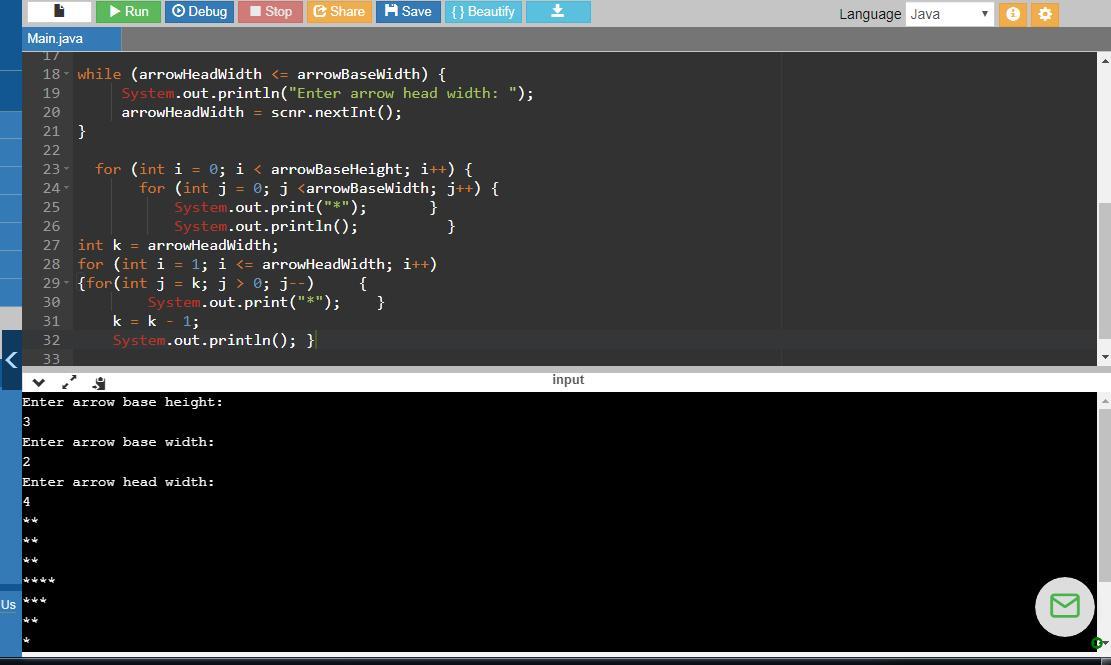
3.24 Program: Drawing a half arrow (Java) This program outputs a downwards facing arrow composed of a rectangle and a right tria
eimsori [14]

Answer:

Here is the JAVA program:

import java.util.Scanner; // to get input from user

public class DrawHalfArrow{ // start of the class half arrow

public static void main(String[] args) { // starts of main() function body

    Scanner scnr = new Scanner(System.in); //reads input

int arrowBaseHeight = 0; // stores the height of arrow base

int arrowBaseWidth  = 0; // holds width of arrow base

int arrowHeadWidth = 0; // contains the width of arrow head

// prompts the user to enter arrow base height, width and arrow head width

System.out.println("Enter arrow base height: ");

arrowBaseHeight = scnr.nextInt(); // scans and reads the input as int

System.out.println("Enter arrow base width: ");

arrowBaseWidth = scnr.nextInt();

/* while loop to continue asking user for an arrow head width until the value entered is greater than the value of arrow base width */

while (arrowHeadWidth <= arrowBaseWidth) {

    System.out.println("Enter arrow head width: ");

    arrowHeadWidth = scnr.nextInt(); }

//start of the nested loop

//outer loop iterates a number of times equal to the height of the arrow base

 for (int i = 0; i < arrowBaseHeight; i++) {

//inner loop prints the stars asterisks

      for (int j = 0; j <arrowBaseWidth; j++) {

          System.out.print("*");        } //displays stars

          System.out.println();          }

//temporary variable to hold arrowhead width value

int k = arrowHeadWidth;

//outer loop to iterate no of times equal to the height of the arrow head

for (int i = 1; i <= arrowHeadWidth; i++)

{     for(int j = k; j > 0; j--)     {//inner loop to print stars

       System.out.print("*");    } //displays stars

   k = k - 1;

   System.out.println(); } } } // continues to add more asterisks for new line

Explanation:

The program asks to enter the height of the arrow base, width of the arrow base and the width of arrow head. When asking to enter the width of the arrow head, a condition is checked that the arrow head width arrowHeadWidth should be less than or equal to width of arrow base arrowBaseWidth. The while loop keeps iterating until the user enters the arrow head width larger than the value of arrow base width.

The loop is used to output an arrow base of height arrowBaseHeight. So point (1) is satisfied.

The nested loop is being used which as a whole outputs an arrow base of width arrowBaseWidth. The inner loop draws the stars and forms the base width of the arrow, and the outer loop iterates a number of times equal to the height of the arrow. So (2) is satisfied.

A temporary variable k is used to hold the original value of arrowHeadWidth so that it keeps safe when modification is done.

The last nested loop is used to output an arrow head of width arrowHeadWidth. The inner loop forms the arrow head and prints the stars needed to form an arrow head. So (3) is satisfied.

The value of temporary variable k is decreased by 1 so the next time it enters  the nested for loop it will be one asterisk lesser.

The screenshot of output is attached.

3 0
2 years ago
Other questions:
  • A_____ transducer is a device that can convert an electronic controller output signal into a standard pneumatic output. A. pneum
    13·1 answer
  • Your assignment is to write a menu driven program. The menu will be responded to using a switch statement. The menu options (cas
    6·1 answer
  • A logic chip used in a computer dissipates 3 W of power in an environment at 120°F, and has a heat transfer surface area of 0.08
    11·1 answer
  • A fireboat is to fight fires at coastal areas by drawing seawater with a density of 1030 kg/m through a 20-cm-diameter pipe at a
    13·1 answer
  • A three-story school has interior column bays that are spaced 25 ft apart in both directions. If the loading on the flat roof is
    7·1 answer
  • The small 5-oz slider A moves without appreciable friction in the hollow tube, which rotates in a horizontal plane with a consta
    7·1 answer
  • Suggest how any sorting algorithm can be augmented in a way to make the best-case count of its key comparisons equal to just n−1
    6·1 answer
  • Two airstreams are mixed steadily and adiabatically. The first stream enters at 35°C and 30 percent relative humidity at a rate
    6·1 answer
  • According to the EWR specifications, ___ is responsible for picking up and disposing of debris or rubbish from
    15·1 answer
  • Problema sobre programacion orientada a objetos!!
    14·1 answer
Add answer
Login
Not registered? Fast signup
Signup
Login Signup
Ask question!