answer.
Ask question
Login Signup
Ask question
All categories
  • English
  • Mathematics
  • Social Studies
  • Business
  • History
  • Health
  • Geography
  • Biology
  • Physics
  • Chemistry
  • Computers and Technology
  • Arts
  • World Languages
  • Spanish
  • French
  • German
  • Advanced Placement (AP)
  • SAT
  • Medicine
  • Law
  • Engineering
attashe74 [19]
2 years ago
14

An unconstrained 10mm thick plate of steel 100mm on a side with a 25mm diameter hole in the center is heated from 20 degrees C t

o 120 degrees C. The linear CTE is 12x10-6/⁰C. What is the final diameter of the hole
Engineering
1 answer:
prisoha [69]2 years ago
8 0

Answer:

The correct answer is "25.03 mm".

Explanation:

Given:

Thickness of plate,

= 10 mm

On a side,

= 100 mm

Diameter hole,

= 25 mm

Coefficient of thermal expansion,

CTE = 12\times 10^{-6} /^{\circ} C

Now,

⇒ D_i\times (12\times 10^{-6}) \Delta \theta = \Delta D

=  25\times 12\times 10^{-6} \Delta \theta

= 3\times 10^{-4} \Delta \theta

= 3\times 10^{-2}

hence,

The final diameter of hole will be:

D_f=25.03 \ mm    

You might be interested in
Dust, dirt, or metal chips can pose a potential ____ injury risk in a shop.
pantera1 [17]

Answer:

Eye.

Explanation:

Dust, dirt, and metal chips are most unpleasant to get in your eyes. Just experience it and you'll know what I mean.

;)

3 0
2 years ago
Q3: Summation Write a recursive implementation of summation, which takes a positive integer n and a function term. It applies te
harina [27]

Answer:

Here is the recursive function summation:

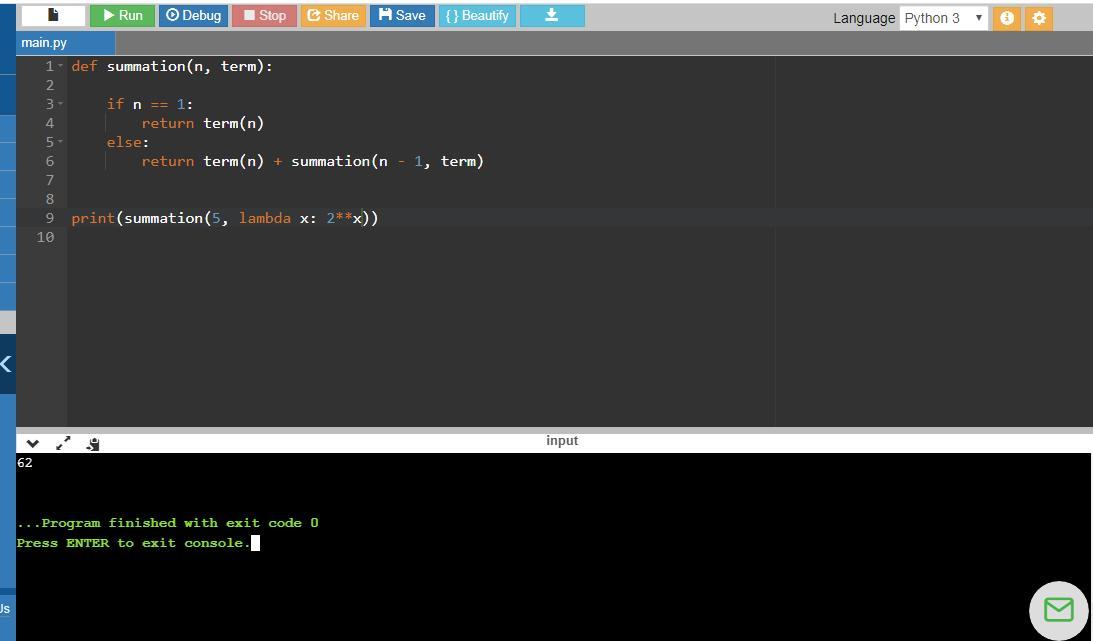
def summation(n, term):      

   if n == 1:  

       return term(n)

   else:

       return term(n) + summation(n - 1, term)

Explanation:

The function summation() has two arguments where n is a positive integer and term is a function term. term has the lambda function which is a small function having an argument and an expression e.g lambda b: b+20

So the summation() function is a recursive function which returns sum of the first n terms in the sequence defined by term ( a lambda function).

If you want to check if this function works, you can call this function by passing values to it like given in the question.

summation(5, lambda x: 2**x)

Here the value of n is 5 and the term is a lambda function x: 2**x

If you want to see the results of this function on output screen then use:

print(summation(5, lambda x: 2**x))

The print() function will print the results on screen.

This returns the sum of first 5 terms in sequence defined in the function x: 2**x

In recursive methods there are two cases: base case and recursive case. Base case is the stopping case which means that the recursion will stop when the base case/ base condition evaluates to true. The recursive case is when the function keeps calling itself so the recursive function keepsexecuting until the base case becomes true.

Here the base case is if n == 1:  So the recursive function calling itself until the value of n becomes 1.  

Recursive case is:

       return term(n) + summation(n - 1, term)

For the above example with n= 5 and term = x:2**x the recursions starts from n and adds all the terms of the series one by one and the value of n keeps decrementing by 1 at every recursive call.

When the value of n is equal to 1 the base case gets true and the recursion ends and the result of the sum is displayed in output.

This is how the summation() function works for the above function call:

2^1 + 2^2 + 2^3 + 2^4 + 2^5

n is 5 So this term function is called recursively 5 times and at every recursive call its value decreases by 1. Here the term function is used to compute 2 raise to power n. So in first recursive call the 2 raise to the power 5 is computed, then 5 is decremented and then in second recursive call to summation(), 2 raise to the power 4 is calculated, in third recursive call  to summation(), 2 raise to the power 3 is calculated, in fourth recursive call  to summation(), 2 raise to the power 2 is calculated, in fifth recursive call  to summation(), 2 raise to the power 1 is calculated, then the base condition is reached as n==1. So the recursion stops and the sum of the above computed power function results is returned which is 62.

2^1 + 2^2 + 2^3 + 2^4 + 2^5 = 62

The screen shot of recursive function along with the output of explained examples is attached.

6 0
2 years ago
Which of the following is NOT a characteristic of hazardous waste
lbvjy [14]

Answer:

A RCRA characteristic hazardous waste is a solid waste that exhibits at least one of four characteristics defined in 40 CFR Part 261 subpart C — ignitability (D001), corrosivity (D002), reactivity (D003), and toxicity (D004 - D043). combustible, or have a flash point less than 60 °C (140 °F).

8 0
2 years ago
An inventor claims to have devised a cyclical engine for use in space vehicles that operates with a nuclear fuel generated energ
slava [35]

Answer:

Inventor claim is not valid.

Explanation:

Given that

Source temperature = 510 K

Sink temperature = 270 K

Power produce = 4.1 KW

Heat reject = 15,000 KJ/h

Heat reject =4.16 KW

As we know that

Heat addition = Heat rejection + Power produce

Heat addition = 4.16 + 4.1 KW

Heat addition = 8.16 KW

So efficiency of engine

\eta =\dfrac{Power\ produces}{heat\ added}

\eta =\dfrac{4.1}{8.16}

\eta =0.502

Now check the maximum efficiency can be possible by using Carnot heat engine

As we know that efficiency of Carnot heat engine given as

\eta =1-\dfrac{T_L}{T_H}

By putting the value

\eta =1-\dfrac{T_L}{T_H}

\eta =1-\dfrac{270}{510}

\eta =0.47

So the efficiency of Carnot cycle is less than the efficiency of above given engine.So this engine is not possible.It means that inventor claim is not valid.

6 0
2 years ago
At a certain elevation, the pilot of a balloon has a mass of 120 lb and a weight of 119 lbf. What is the local acceleration of g
Crank

Answer:

1) g=31.87ft/s^2

2)m=120

W=119.64lbf

Explanation:

first part

the weight of a body with mass is calculated by the following equation

W=mg

we convert 120lb to slug

m=120lbx1slug/32.147lb=3.733slug

solving for g

g=W/m

g=119/3.733=31.87ft/s^2

second part

the mass is the same

m=120lb=3.733slug

Weight

W=3.733slug*32.05ft/s^2=119.64lbf

4 0
2 years ago
Other questions:
  • Water has a density of 1.94 slug/ft^3. What is the density expressed in SI units? Express the answer to three significant figure
    8·1 answer
  • 5. A typical paper clip weighs 0.59 g and consists of BCC iron. Calculate (a) the number of
    5·1 answer
  • Your assignment is to write a menu driven program. The menu will be responded to using a switch statement. The menu options (cas
    6·1 answer
  • Which one of the following activities is not an example of incident coordination
    15·1 answer
  • A piece of corroded metal alloy plate was found in a submerged ocean vessel. It was estimated that the original area of the plat
    6·1 answer
  • Why is it that dislocations play an important role in controlling the mechanical properties of metallic materials, however, they
    10·1 answer
  • Define initial set and final set. Briefly discuss one method used to determine them. The following laboratory tests are performe
    12·1 answer
  • A three-phase line has an impedance of 0.4 j2.7 ohms per phase. The line feeds two balanced three-phase loads that are connected
    9·1 answer
  • When comparing solids to fluids, the following is true: for elastic solids, the stress must be normal. For Newtonian fluids, the
    9·1 answer
  • Which of the following types of protective equipment protects workers who are passing by from stray sparks or metal while anothe
    8·1 answer
Add answer
Login
Not registered? Fast signup
Signup
Login Signup
Ask question!