answer.
Ask question
Login Signup
Ask question
All categories
  • English
  • Mathematics
  • Social Studies
  • Business
  • History
  • Health
  • Geography
  • Biology
  • Physics
  • Chemistry
  • Computers and Technology
  • Arts
  • World Languages
  • Spanish
  • French
  • German
  • Advanced Placement (AP)
  • SAT
  • Medicine
  • Law
  • Engineering
BartSMP [9]
2 years ago
10

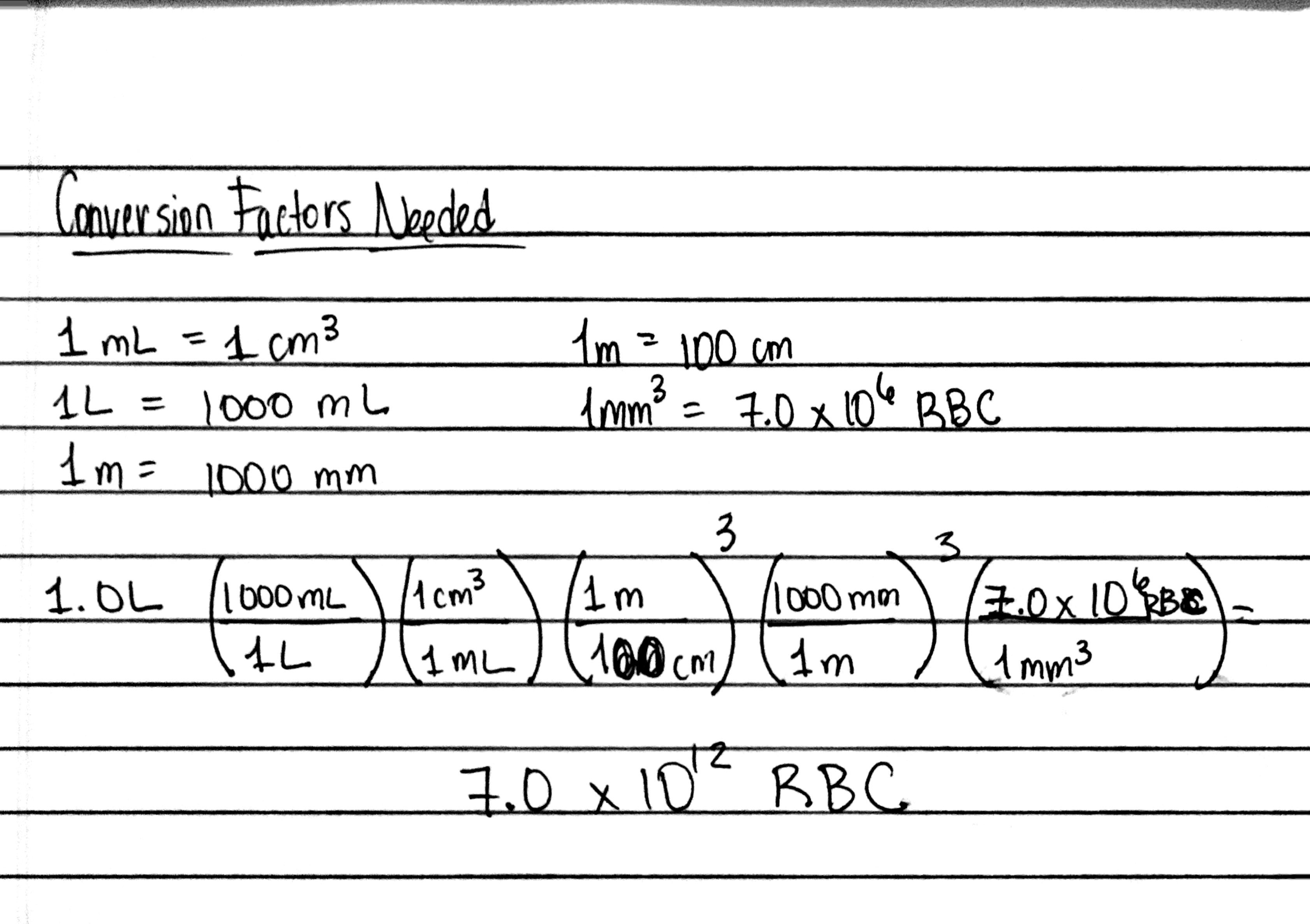
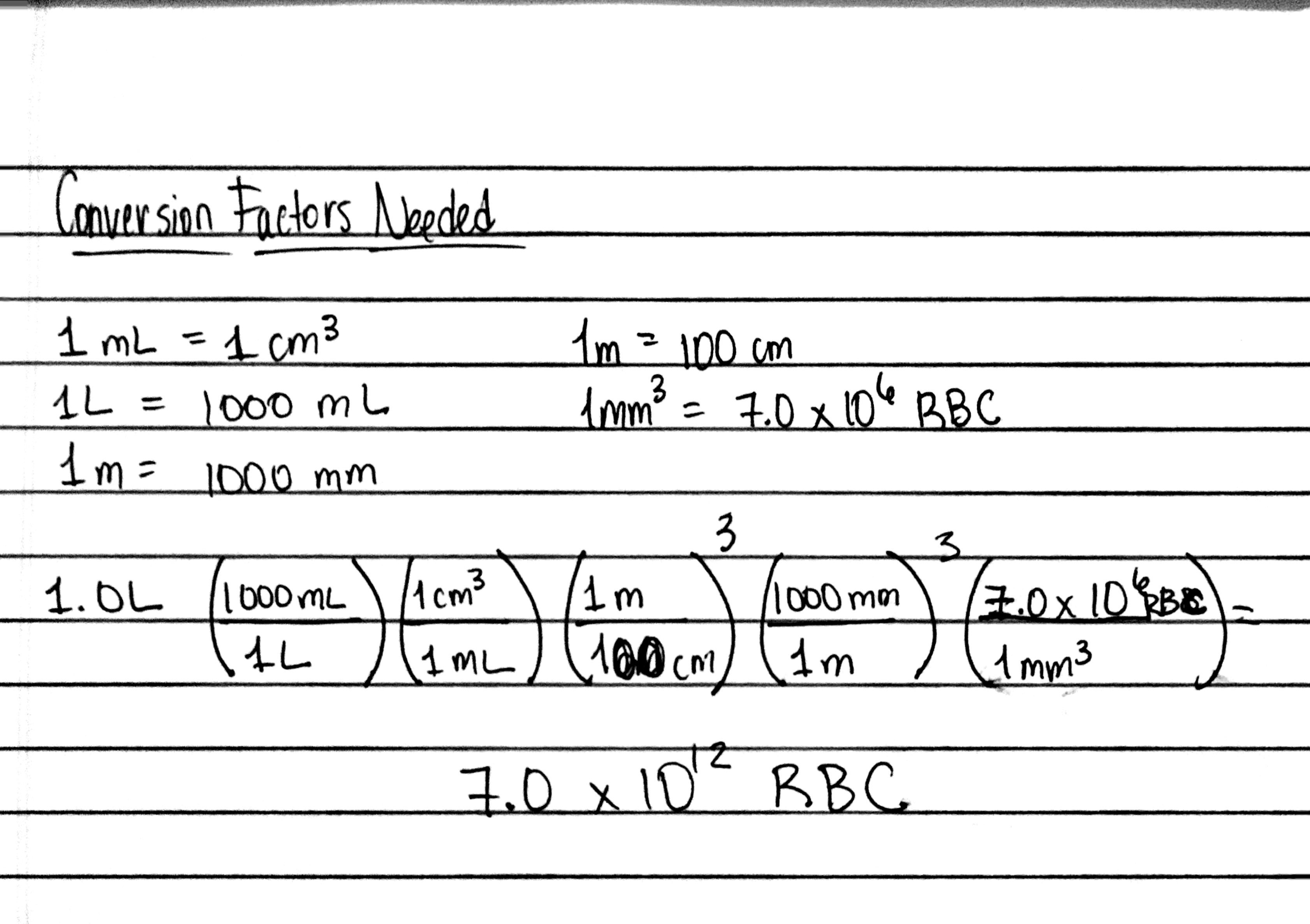
One cubic millimeter (mm3) of blood contains 7.0 x 10⁶ red blood cells. How many red blood cells are in 1.0 L of blood?

Chemistry
1 answer:
just olya [345]2 years ago
7 0
The question gives us a conversion factor---> 1 mm3= 7.0 x 10^6 RBC. so, to find how many red blood cells we have, we first need to convert the Liters to cm3 using this conversion factor--> 1 mL= 1 cm3

i have attached how to solve this problem.


You might be interested in
Stu Dent has finished his titration, and he comes to you for help with the calculations. He tells you that 20.00 mL of unknown c
Alexus [3.1K]

Answer:

0.3229 M HBr(aq)

0.08436M H₂SO₄(aq)

Explanation:

<em>Stu Dent has finished his titration, and he comes to you for help with the calculations. He tells you that 20.00 mL of unknown concentration HBr(aq) required 18.45 mL of 0.3500 M NaOH(aq) to neutralize it, to the point where thymol blue indicator changed from pale yellow to very pale blue. Calculate the concentration (molarity) of Stu's HBr(aq) sample.</em>

<em />

Let's consider the balanced equation for the reaction between HBr(aq) and NaOH(aq).

NaOH(aq) + HBr(aq) ⇄ NaBr(aq) + H₂O(l)

When the neutralization is complete, all the HBr present reacts with NaOH in a 1:1 molar ratio.

18.45 \times 10^{-3} L NaOH.\frac{0.3500molNaOH}{1LNaOH} .\frac{1molHBr}{1molNaOH} .\frac{1}{20.00 \times 10^{-3} LHBr} =\frac{0.3229molHBr}{1LHBr} =0.3229M

<em>Kemmi Major also does a titration. She measures 25.00 mL of unknown concentration H₂SO₄(aq) and titrates it with 0.1000 M NaOH(aq). When she has added 42.18 mL of the base, her phenolphthalein indicator turns light pink. What is the concentration (molarity) of Kemmi's H₂SO₄(aq) sample?</em>

<em />

Let's consider the balanced equation for the reaction between H₂SO₄(aq) and NaOH(aq).

2 NaOH(aq) + H₂SO₄(aq) ⇄ Na₂SO₄(aq) + 2 H₂O(l)

When the neutralization is complete, all the H₂SO₄ present reacts with NaOH in a 1:2 molar ratio.

42.18 \times 10^{-3} LNaOH.\frac{0.1000molNaOH}{1LNaOH} .\frac{1molH_{2}SO_{4}}{2molNaOH} .\frac{1}{25.00\times 10^{-3}LH_{2}SO_{4}} =\frac{0.08436molH_{2}SO_{4}}{1LH_{2}SO_{4}} =0.08436M

6 0
2 years ago
Analyze the example of this door knob wheel and axle.
bulgar [2K]

Answer:

28

Explanation:

Velocity ratio= Radius of wheel/radius of axle

Radius of wheel= 4.125 inches

Radius of axle= 0.125 inches

Velocity ratio = 4.125/0.125 = 33

Then;

Efficiency = mechanical advantage/velocity ratio × 100

Since the efficiency of the system = 85%

85 = mechanical advantage/33 × 100

Mechanical advantage = 85 × 33/100 = 28

4 0
2 years ago
The number of sp2 hybrid orbitals on the carbon atom in CO32– is
Vladimir79 [104]
The number of sp2 hybrid orbitals on the carbon atom in CO32– is 3. Because hybrids = combination of 2 different types of orbitals
sp2 = 1/3 s character + 2/3 p character
7 0
2 years ago
Read 2 more answers
A solution is made by dissolving 58.125 g of sample of an unknown, nonelectrolyte compound in water. The mass of the solution is
e-lub [12.9K]

Answer:

molecular weight (Mb) = 0.42 g/mol

Explanation:

mass sample (solute) (wb) = 58.125 g

mass sln = 750.0 g = mass solute + mass solvent

∴ solute (b) unknown nonelectrolyte compound

∴ solvent (a): water

⇒ mb = mol solute/Kg solvent (nb/wa)

boiling point:

  • ΔT = K*mb = 100.220°C ≅ 373.22 K

∴ K water = 1.86 K.Kg/mol

⇒ Mb = ? (molecular weight) (wb/nb)

⇒ mb = ΔT / K

⇒ mb = (373.22 K) / (1.86 K.Kg/mol)

⇒ mb = 200.656 mol/Kg

∴ mass solvent = 750.0 g - 58.125 g = 691.875 g = 0.692 Kg

moles solute:

⇒ nb = (200.656 mol/Kg)*(0.692 Kg) = 138.83 mol solute

molecular weight:

⇒ Mb = (58.125 g)/(138.83 mol) = 0.42 g/mol

8 0
2 years ago
A sample of an unknown compound with a mass of 0.847 g has the following composition: 50.51 % fluorine and 49.49 % iron. When th
sergejj [24]

Answer: 0,4278g of F and 0,4191g of Fe

Explanation: it's possible to calculate the mass of each element by multiplying the percentage (decimal) of the element by the mass of the compound.

For Fluorine (F)

0,847g * 0,5051 = 0,4278g of F

For iron (Fe)

0,847 * 0,4949 = 0,4191g of Fe

This is determined because even when the compound is decomposed, due to conservative law of mass, the decomposition process do not affect the amount of matter, so the mass of the elements remain even if they are separated from the original molecule.

At the end, the sum of the elements masses should be the total mass of the compound.
4 0
2 years ago
Read 2 more answers
Other questions:
  • Acetone and sodium chloride both have similiar mass. Explain why their other properties differ.
    9·2 answers
  • X-ray photons with a wavelength of 0.135 nm . express the energy numerically in kilojoules per mole.
    7·2 answers
  • If 89.6 joules of heat are needed to heat 20.0 grams of iron from 30.0°c to 40.0°c, what is the specific heat of the iron in jg?
    13·1 answer
  • Are The Reactions Of Ordinary Molecular Hydrogen Slow Or Rapid ? Why ?
    10·1 answer
  • Find the time Δt it takes the magnetic field to drop to zero. Express your answer in terms of some or all of the quantities a, B
    15·1 answer
  • A 10 ft diameter by 15 ft height vertical tank is receiving water (p 62.1 lb/ cu ft) at the rate of 300 gpm and is discharging t
    7·1 answer
  • HCN forms when synthetic fibers containing Orlon® or Acrilan® burn. Acrilan® has an empirical formula of CH2CHCN, so HCN is 50.9
    8·1 answer
  • 41Ca decays by electron capture. The product of this reaction undergoes alpha decay. What is the product of this second decay re
    11·1 answer
  • g A 0.25 mol sample of HBr is added to a 1.00 L buffer solution consisting of 0.68 M HCN and 0.35 M NaCN. Identify all species t
    10·1 answer
  • How many molecules of sulfur trioxide would react with 68.9 L of water at STP to produce sulfuric acid?
    9·1 answer
Add answer
Login
Not registered? Fast signup
Signup
Login Signup
Ask question!