answer.
Ask question
Login Signup
Ask question
All categories
  • English
  • Mathematics
  • Social Studies
  • Business
  • History
  • Health
  • Geography
  • Biology
  • Physics
  • Chemistry
  • Computers and Technology
  • Arts
  • World Languages
  • Spanish
  • French
  • German
  • Advanced Placement (AP)
  • SAT
  • Medicine
  • Law
  • Engineering
ZanzabumX [31]
2 years ago
4

While attempting a landing on the moon, astronauts had to change their landing site and land at a spot that was 4 kilometers awa

y from the original site. Assuming that they were at a height of 137 meters, calculate the horizontal velocity of the spacecraft during touchdown if it lands in a free-fall mode without using retro engines. Consider gravity = 1.63 meters/second2.

Physics
1 answer:
vfiekz [6]2 years ago
8 0
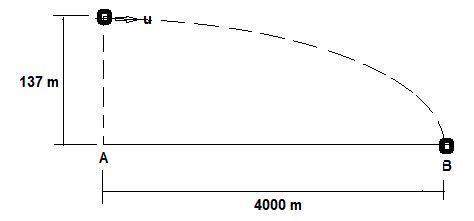
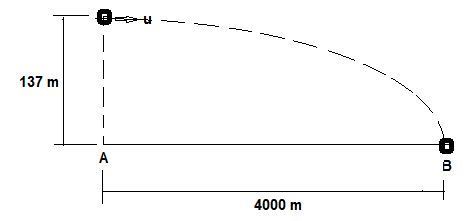
Refer to the figure below.

A = original landing site.
B = alternate landing site.

Assume that aerodynamic resistance is negligible.

The craft lands in free-fall mode, therefore its original vertical velocity is zero.
It travels downward by 137 m at gravitational acceleration of g = 1.63 m/s².
 The time of travel, t, obeys the equation
(137 m) = (1/2)(1.63 m/s²)*(t s)²
Therefore
t² = (137*2)/1.63 = 168.098  => t = 12.965 s.

The constant horizontal velocity, u, required to travel 4 km (or 4000 m) in time, t, is given by
(u m/s)*(12.965 s) = (4000 m)
u = 4000/12.965 = 308.5 m/s (nearest tenth)

Answer: 308.5 m/s

You might be interested in
Consider a father pushing a child on a playground merry-go-round. the system has a moment of inertia of 84.4 kg · m2. the father
-Dominant- [34]
<span>At time t1 = 0 since the body is at rest, the body has an angular velocity, v1, of 0. At time t = X, the body has an angular velocity of 1.43rad/s2. Since Angular acceleration is just the difference in angular speed by time. We have 4.44 = v2 -v1/t2 -t1 where V and t are angular velocity and time. So we have 4.44 = 1.43 -0/X - 0. Hence X = 1.43/4.44 = 0.33s.</span>
6 0
2 years ago
Read 2 more answers
A sample of tendon 3.00 cm long and 4.00 mm in diameter is found to break under a minimum force of 128 N. If instead the sample
Hatshy [7]

Answer:128 N

Explanation:

Sample of 3 cm and 4 mm diameter found to break under a minimum force of 128 N .

If sample is 1.5 cm long with same cross-sectional area then minimum force required to break is also 128 N because the applied force is same for any length and diameter of tendon.        

3 0
2 years ago
a child hits a ball with a force of 350 N. (a) If the ball and bat are in contact for 0.12 is, what impulse does the ball receiv
Lina20 [59]

Explanation:

Given that,

Force with which a child hits a ball is 350 N

Time of contact is 0.12 s

We need to find the impulse received by the ball. The impulse delivered is given by :

J=F\times t\\\\J=350\times 0.12\\\\J=42\ N-m

So, the impulse is 42 N-m..

We know that he change in momentum is also equal to the impulse delivered.

So, impulse = 42 N-m and change in momentum =42 N-m.

7 0
2 years ago
A proton of mass mp is released from rest just above the lower plate and reaches the top plate with speed vp. An electron of mas
vodka [1.7K]

Answer:

v_e=\sqrt{\frac{m_pv_p^2}{m_e}}

Explanation:

You can consider that the force that acts over the proton is the same to the force over the electron. This is because the electric force is given by:

F=qE

F_p=F_e

where E is the constant electric field between the parallel plates, and is the same for both electron and proton. Also, the charge is the same.

by using the Newton second law for the proton, and by using kinematic equation for the calculation of the acceleration you can obtain:

m_pa_p=qE\\\\a_p=\frac{v_p^2}{2d}\\\\\frac{m_pv_p^2}{2d}=qE

(it has been used that vp^2 = v_o^2+2ad) where d is the separation of the plates, ap the acceleration of the proton, vp its velocity and mp its mass.

By doing the same for the electron you obtain:

\frac{m_ev_e^2}{2d}=qE

we can equals these expressions for both proton and electron, because the forces qE are the same:

\frac{m_pv_p^2}{2d}=\frac{m_ev_e^2}{2d}\\\\v_e=\sqrt{\frac{m_pv_p^2}{m_e}}

4 0
2 years ago
Two wires are stretched between two fixed supports and have the same length. One wire A there is a second-harmonic standing wave
lina2011 [118]

(a) Greater

The frequency of the nth-harmonic on a string is an integer multiple of the fundamental frequency, f_1:

f_n = n f_1

So we have:

- On wire A, the second-harmonic has frequency of f_2 = 660 Hz, so the fundamental frequency is:

f_1 = \frac{f_2}{2}=\frac{660 Hz}{2}=330 Hz

- On wire B, the third-harmonic has frequency of f_3 = 660 Hz, so the fundamental frequency is

f_1 = \frac{f_3}{3}=\frac{660 Hz}{3}=220 Hz

So, the fundamental frequency of wire A is greater than the fundamental frequency of wire B.

(b) f_1 = \frac{v}{2L}

For standing waves on a string, the fundamental frequency is given by the formula:

f_1 = \frac{v}{2L}

where

v is the speed at which the waves travel back and forth on the wire

L is the length of the string

(c) Greater speed on wire A

We can solve the formula of the fundamental frequency for v, the speed of the wave:

v=2Lf_1

We know that the two wires have same length L. For wire A, f_1 = 330 Hz, while for wave B, f_B = 220 Hz, so we can write the ratio between the speeds of the waves in the two wires:

\frac{v_A}{v_B}=\frac{2L(330 Hz)}{2L(220 Hz)}=\frac{3}{2}

So, the waves travel faster on wire A.
7 0
2 years ago
Other questions:
  • What type of weather modification involves the use of large fans to mix surface air with air aloft?
    12·1 answer
  • An object at rest is suddenly broken apart into two fragments by an explosion one fragment acquires twice the kinetic energy of
    14·1 answer
  • A block moves at 5 m/s in the positive x direction and hits an identical block, initially at rest. A small amount of gunpowder h
    10·1 answer
  • A person of mass m stands on roller skates facing a wall.After pushing against the wall with a constant force F he moves away, r
    9·1 answer
  • What determines whether the equilibrium temperature of a mixture of two amounts of water will be closer to the initially cooler
    5·1 answer
  • There are many well-documented cases of people surviving falls from heights greater than 20.0 m. In one such case, a 55.0 kg wom
    7·1 answer
  • Which phrases describe NASA's goals in the coming years? Check all that apply.
    5·2 answers
  • From mechanics, you may recall that when the acceleration of an object is proportional to its coordinate, d2xdt2=−kmx=−ω2x , suc
    10·1 answer
  • What type of equilibrium is guaranteed by each condition of equilibrium
    12·1 answer
  • Consider a space shuttle which has a mass of about 1.0 x 10⁵ kg and circles the Earth at an altitude of about 200.0 km. Calculat
    10·1 answer
Add answer
Login
Not registered? Fast signup
Signup
Login Signup
Ask question!