answer.
Ask question
Login Signup
Ask question
All categories
  • English
  • Mathematics
  • Social Studies
  • Business
  • History
  • Health
  • Geography
  • Biology
  • Physics
  • Chemistry
  • Computers and Technology
  • Arts
  • World Languages
  • Spanish
  • French
  • German
  • Advanced Placement (AP)
  • SAT
  • Medicine
  • Law
  • Engineering
natita [175]
2 years ago
14

Angie’s rotation maps triangle XYZ to triangle X’Y’Z’. X(3, –6) maps to X’(–3, 6) Y(1, –2) maps to Y’(–1, 2) Z(–1, –5) maps to Z

’(1, 5) Which describes the rotation? mc015-1.jpg rotation mc015-2.jpg clockwise rotation mc015-3.jpg counterclockwise rotation mc015-4.jpg clockwise rotation

Mathematics
2 answers:
Advocard [28]2 years ago
6 1

Answer with explanation:

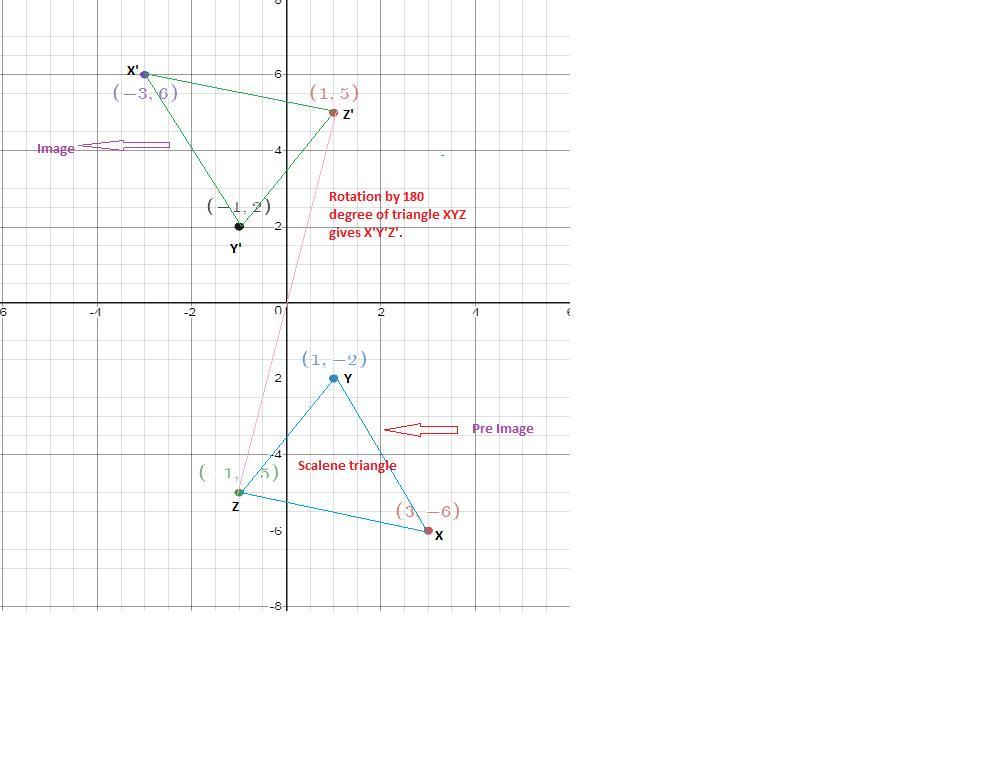
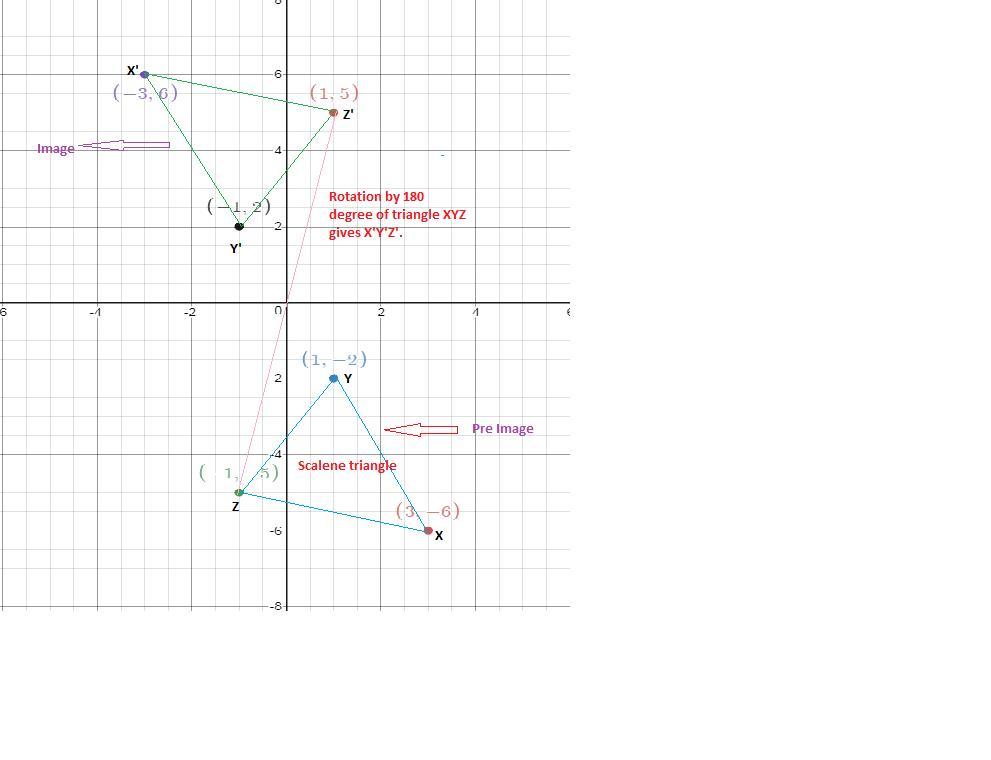
Vertices of Triangle X Y Z →→ Pre-Image : X(3,-6),Y(1,-2),Z(-1,-5)

Vertices of Triangle X' Y' Z' →→ Image : X'(-3,6),Y'(-1,2),Z'(1,5)

→→Drawing the Triangle XYZ and X'Y'Z' on coordinate plane

→All sides are unequal in length, so it is a Scalene Triangle.

Joining Z and Z'

⇒And ,finding that , if we rotate Triangle X Y Z in Anti clockwise Direction  by an angle of 180°, it gives Triangle X'Y'Z'.

Option :Anti Clockwise Rotation by an angle of 180°

zhannawk [14.2K]2 years ago
7 0

Answer:

180° rotation about the origin

Step-by-step explanation:

Analysing triangles XYZ and X'Y'Z' it can be seen that coordinates of point X (3, -6) were changed to (-3,  6), that is, (x, y) were changed to (-x, -y). The relation between Y and Y', and between Z and Z' is the same. A 180° rotation about the origin translates point (x, y) to point (-x, -y). In a 180° rotation, clockwise or counterclockwise rotation doesn't make any difference.

You might be interested in
Divide rs 350 in ratio 2:5​
mihalych1998 [28]

Answer:

100 : 250

Step-by-step explanation:

Sum the parts of the ratio, 2 + 5 = 7 parts

Divide the quantity by 7 to find the value of one part of the ratio.

350 ÷ 7 = 50 ← value of 1 part of the ratio, thus

2 parts = 2 × 50 = 100

5 parts = 5 × 50 = 250

350 = 100 : 250 in the ratio 2 : 5

6 0
2 years ago
Find the volume V of the solid obtained by rotating the region bounded by the given curves about the specified line. y = 1 + sec
masha68 [24]

Using the washer method, the volume is given by the integral

\displaystyle\pi\int_{-\pi/3}^{\pi/3}\bigg((3-1)^2-((1+\sec x)-1)^2\bigg)\,\mathrm dx=2\pi\int_0^{\pi/3}(4-\sec^2x)\,\mathrm dx

where 3 - 1 = 2 is the distance from <em>y</em> = 3 to the axis of revolution, and similarly (1 + sec(<em>x</em>)) - 1 = sec(<em>x</em>) is the distance from <em>y</em> = 1 + sec(<em>x</em>) to the axis. The integrand is symmetric about <em>x</em> = 0, so the integral "folds" in on itself, and the integral from -π/3 to π/3 is twice the integral from 0 to π/3.

So the volume is

\displaystyle2\pi\int_0^{\pi/3}(4-\sec^2x)\,\mathrm dx=2\pi(4x-\tan x)\bigg|_0^{\pi/3}=\boxed{\dfrac{8\pi^2}3-2\pi\sqrt3}

4 0
2 years ago
Distributed property for 0.75(3.5a-6b)
Alika [10]
0.75(3.5a -6b)
= 0.75* (3.5a) -0.75* (6b) (distributive property)
= 2.625a -4.5b

The final answer is 2.625a -4.5b~
5 0
2 years ago
What are the solutions of the equation (2x + 3)2 + 8(2x + 3) + 11 = 0? Use u substitution and the quadratic formula to solve.
zvonat [6]

Answer:

x=-2.38

x=-4.62


Step-by-step explanation:

The question is  (2x+3)^2+8(2x+3)+11=0

<em>We let u=2x+3, so the equation becomes:</em>

u^2+8u+11=0

Where a=1, b=8, c=11


Putting it in the quadratic formula, we have:

<u>Quadratic formula:</u> \frac{-b+-\sqrt{b^2-4ac} }{2a}

Substituting we have: \frac{-8+-\sqrt{(8)^2-4(1)(11)} }{2(1)}\\=\frac{-8+-\sqrt{20} }{2}\\=\frac{-8+-2\sqrt{5} }{2}\\=-4+\sqrt{5}, -4-\sqrt{5} }


<em>We let u=2x+3, so x is:</em>

<em>u=2x+3\\(-4+\sqrt{5})=2x+3\\x=\frac{-7+\sqrt{5}}{2}=-2.38</em>

<em>and</em>

<em>u=2x+3\\(-4-\sqrt{5})=2x+3\\x=\frac{-7-\sqrt{5}}{2}=-4.62</em>


The solutions of the equation is x=-2.38 (rounded to 2 decimal places), and x=-4.62 (rounded to 2 decimal places)

6 0
2 years ago
Quadrilateral $abcd$ is a trapezoid with $ab$ parallel to $cd$. we know $ab = 20$ and $cd = 12$. what is the ratio of the area o
alekssr [168]
Draw a diagram to illustrate the problem as shown below.

The area of triangle acb is
A₁ = (1/2)*20*h = 10h

The area of trapezoid abcd is
A₂ = (1/2)*(20+12)*h = 16h

The ratio A₁/A₂ is
A₁/A₂ = (10h)/(16) = 5/8

Answer:
The ratio of triangle acb to the area of trapezoid abcd is 5/8.

4 0
2 years ago
Other questions:
  • A factor for (f/g, i, n) could be obtained by multiplying the (p/g, i, n) factor by the _______________ factor.
    7·2 answers
  • Your phone plan charges you initial fee and then a certain amount depending on the amount of data you use they send you periodic
    6·2 answers
  • Fast Pax Annual Salaries (Thousands of Dollars) Analysts determined that the $255,000 salary is an outlier. The box-and-whisker
    6·2 answers
  • Rachel is going to calculate the following expression: 3.32/1.66+18.4. She calculates the expression as it is written and then w
    15·2 answers
  • The table shows Mr. Winkler’s schedule for paying off his credit card balance. A 5-column table with 4 rows. Column 1 is labeled
    10·2 answers
  • What is the sum? StartFraction 3 y Over y squared + 7 y + 10 EndFraction + StartFraction 2 Over y + 2 EndFraction
    9·1 answer
  • Triangle A B C is shown. Angle B C A is a right angle. The length of hypotenuse A B is 26, the length of A C is 10, and the leng
    10·2 answers
  • What value of x makes this equation true?<br> -12 + 5x = -24 + x
    9·1 answer
  • An electronics company sells computer monitors
    10·2 answers
  • If AB=9, the diagram blank the case of a degenerate triangle because blank. The case of a degenerate triangle justifies the use
    10·1 answer
Add answer
Login
Not registered? Fast signup
Signup
Login Signup
Ask question!