answer.
Ask question
Login Signup
Ask question
All categories
  • English
  • Mathematics
  • Social Studies
  • Business
  • History
  • Health
  • Geography
  • Biology
  • Physics
  • Chemistry
  • Computers and Technology
  • Arts
  • World Languages
  • Spanish
  • French
  • German
  • Advanced Placement (AP)
  • SAT
  • Medicine
  • Law
  • Engineering
avanturin [10]
2 years ago
5

If the actual yield of the reaction was 75% instead of 100%, how many molecules of no would be present after the reaction was ov

er? express your answer as an integer.
Chemistry
2 answers:
artcher [175]2 years ago
8 0
To be able to answer this equations, we must set given information. Suppose the reaction to yield NO is:

N₂ + O₂ → 2 NO

Next, suppose you have 1 g of each of the reactants. Determine first which is the limiting reactant.

1 g N₂ (1 mol N₂/ 28 g)(2 mol NO/1 mol N₂)= 0.07154 mol NO present

Number of molecules = 0.07154 mol NO(6.022×10²³ molecules/mol)
<em>Number of molecules = 4.3×10²² molecules NO present</em>
DerKrebs [107]2 years ago
3 0

The reaction will be

2NO  + O2 ---< 2NO2

so as per balanced equation two moles of NO will react with one mole of O2 to give two moles of NO2

In this particular question, 5 molecules of O2 and 8 molecules of NO are present

so the limiting reagent is NO

now the 8 molecules of NO should react with 4 molecules of O2 for 100% yield

As the mentioned yield is 75% only, it means only 75% of NO molecules will react

75% of 8 = 6

So six molecules of NO will react with 3 molecules of O2 to give 75% yield

so after reaction we will be left with  2 molecules of NO


You might be interested in
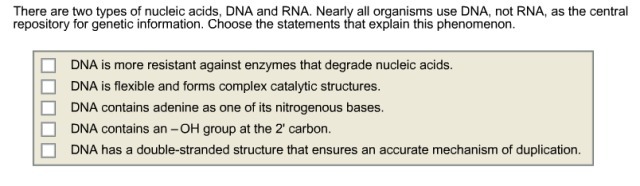
There are two types of nucleic acids, dna and rna. nearly all organisms use dna, not rna, as the central repository for genetic
Leya [2.2K]
Found the choices. Pls see attachment. 

The statements that explains this phenomenon are:
1) DNA contains adenine as one of its nitrogenous bases.
2) DNA has a double-stranded structure that ensures an accurate mechanism of duplication.

6 0
2 years ago
Draw the product obtained when trans-2-butene is treated first with br2 in ch2cl2, second with nanh2 in nh3, and then finally wi
oee [108]

<span>In order to do this, you have change the alkene into an alkyne. That is the aim of Br2/CH2Cl2 trailed by NaNH2. The Br2 with form a vic dihalide (3,4-dibromo octane). Adding of NaNH2 will execute two E2 reactions. -NH2 will eliminate an H from carbons 3 and 4. This double elimination will make the alkyne. Then handling the alkyne with H2/Lindlar will form the cis alkene. The final product will be CIS-3-octene.</span>

3 0
2 years ago
How many hydrogen bonds can CH2O make to water
VladimirAG [237]
Hydrogen bonds are not like covalent bonds. They are nowhere near as strong and you can't think of them in terms of a definite number like a valence. Polar molecules interact with each other and hydrogen bonds are an example of this where the interaction is especially strong. In your example you could represent it like this: 

<span>H2C=O---------H-OH </span>

<span>But you should remember that the H2O molecule will be exchanging constantly with others in the solvation shell of the formaldehyde molecule and these in turn will be exchanging with other H2O molecules in the bulk solution. </span>

<span>Formaldehyde in aqueous solution is in equilibrium with its hydrate. </span>

<span>H2C=O + H2O <-----------------> H2C(OH)2</span>
5 0
2 years ago
At a temperature of __________ °c, 0.444 mol of co gas occupies 11.8 l at 889 torr.
Novay_Z [31]
<span>ideal gas law is: PV = nRT P = pressure (torr) = 889 torr V = volume (Liters) = 11.8 L n = moles of gas = 0.444 mol R = gas constant = 62.4 (L * torr / mol * k) solve for T (in kelvin) T = PV/nR T = (889*11.8)/(.444*62.4) T = 378.6 K convert to C (subtract 273) T = 105.6 deg C</span>
3 0
2 years ago
Read 2 more answers
1. Which liquid sample is a pure substance?
IRISSAK [1]

The whole Activity , poem and paragraph is missing in the question.

Answer:

(1) Liquid A

(2) Solid A

Explanation:

Using this part of the given poem

Substances and mixtures behave differently,

During boiling and melting most especially

Boiling point of substance is fixed while mixture is not

Substance melts completely but mixture does not

The boiling point of the Pure substance remain fixed after reaching its boiling point this is shown by Liquid A

Solid A is melting completely so Solid A is a pure substance.

6 0
2 years ago
Other questions:
  • If a runner completes a 10 kilometer race in 32.50 minutes, what is the 10.0 km pace in miles per hour? (1.609 km = 1 mile appro
    8·1 answer
  • 28 ml of 0.10 m hcl is added to 60 ml of 0.10 m sr(oh)2. determine the concentration of oh− in the resulting solution.
    6·2 answers
  • Which of the following is an example of how science can solve social problems? It can stop excessive rain from occurring. It can
    14·2 answers
  • Match the correct properties and characteristics of each type of rock?
    11·2 answers
  • A sample of gas has a volume of 215 cm3 at 23.5 degrees Celsius and 84.6kPa what volume will the gas occupy at stp
    13·2 answers
  • NaOH was titrated to the phenolphthalein endpoint with a known concentration of HCl. The student conducting the experiment place
    5·1 answer
  • In the electrochemical cell using the redox reaction below, the anode half reaction is ________. Sn4+ (aq) + Fe (s) → Sn2+ (aq)
    13·1 answer
  • To save time you can approximate the initial volume of water to ±1 mL and the initial mass of the solid to ±1 g. For example, if
    14·1 answer
  • The pressure inside of a sealed tube if you raise the temperature go ______..
    14·2 answers
  • One of the most common causes of inaccurate melting point ranges is rapid heating of the compound. Under these circumstances, ho
    6·1 answer
Add answer
Login
Not registered? Fast signup
Signup
Login Signup
Ask question!