answer.
Ask question
Login Signup
Ask question
All categories
  • English
  • Mathematics
  • Social Studies
  • Business
  • History
  • Health
  • Geography
  • Biology
  • Physics
  • Chemistry
  • Computers and Technology
  • Arts
  • World Languages
  • Spanish
  • French
  • German
  • Advanced Placement (AP)
  • SAT
  • Medicine
  • Law
  • Engineering
Nana76 [90]
2 years ago
6

One of the most common causes of inaccurate melting point ranges is rapid heating of the compound. Under these circumstances, ho

w will the observed MP range compare to the true MP range
Chemistry
1 answer:
Inessa05 [86]2 years ago
8 0

Answer:

INCREASE in the difference between the melting point measured and the true melting temperature.

Explanation:

Melting point of a compound is defined as the temperature at which the soils compound changes into liquid at the atmospheric pressure. There are different circumstances that can lead to inaccurate melting point. These include:

--> presence of impurities in the compound,

--> Molecular composition,

--> Force of attraction, and

--> Rapid heating of the compound.

Under the circumstances of rapid heating of the compound, there would be an increase in the melting point range when compared with the true melting point range of the compound.

The higher the heating rate, the more rapid the rise in oven temperature, increasing the difference between the melting point measured and the true melting temperature.

You might be interested in
In a hospital laboratory, a 10.0 mL sample of gastric juice (predominantly HCl), obtained several hours after a meal, was titrat
LiRa [457]

Answer: 1.14

Explanation:

HCl+NaOH\rightarrow NaCl+H_2O

To calculate the molarity of acid, we use the equation given by neutralization reaction:

n_1M_1V_1=n_2M_2V_2

where,

n_1,M_1\text{ and }V_1 are the n-factor, molarity and volume of acid which is HCl

are the n-factor, molarity and volume of base which is NaOH.

We are given:

n_1=1\\M_1=?\\V_1=10.0mL\\n_2=1\\M_2=0.1M\\V_2=7.2mL

Putting values in above equation, we get:

1\times M_1\times 10.0=1\times 0.1\times 7.2\\\\M_1=0.072M

To calculate pH of gastric juice:

molarity of H^+ = 0.072

pH=-log[H^+]

pH=-log(0.072)=1.14

Thus the pH of the gastric juice is 1.14

3 0
2 years ago
Which sample of ethanol has particles with the highest average kinetic energy?
ale4655 [162]
The second one.
Remember, temperature is the AVERAGE kinetic energy. So, looking for highest average kinetic energy means looking for highest temperature, which is 55.
Note: the amount of the substance does not determine the average kinetic energy. 
6 0
2 years ago
Read 2 more answers
How many grams of antifreeze C2H4(OH)2 would be required per 500 g of water to prevent the water from freezing at a temperature
Wewaii [24]

Answer:

333.7 g.

Explanation:

  • The depression in freezing point of water (ΔTf) due to adding a solute to it is given by: <em>ΔTf = Kf.m.</em>

Where, ΔTf is the depression in water freezing point (ΔTf = 20.0°C).

Kf is the molal freezing point depression constant of the solvent (Kf = 1.86 °C/m).

m is the molality of the solution.

<em>∴ m = ΔTf/Kf</em> = (20.0°C)/(1.86 °C/m) = <em>10.75 m.</em>

molaity (m) is the no. of moles of solute per kg of the solvent.

∵ m = (no. of moles of antifreeze C₂H₄(OH)₂)/(mass of water (kg))

∴ no. of moles of antifreeze C₂H₄(OH)₂ = (m)(mass of water (kg)) = (10.75 m)(0.5 kg) = 5.376 mol.

∵ no. of moles = mass/molar mass.

<em>∴ mass of antifreeze C₂H₄(OH)₂ = no. of moles x molar mass </em>= (5.376 mol)(62.07 g/mol) =<em> 333.7 g.</em>

5 0
2 years ago
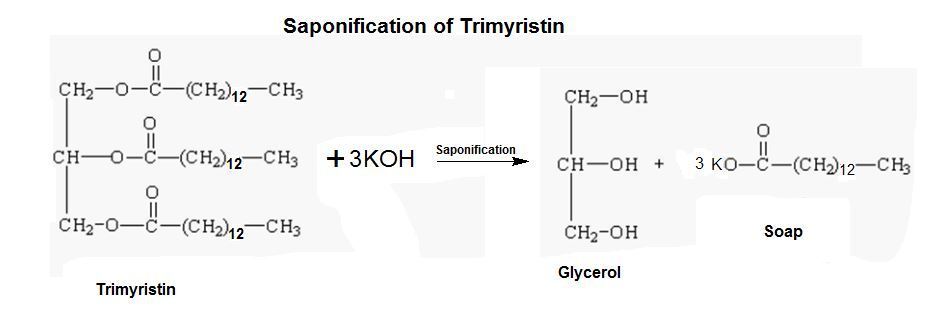
Draw the condensed structural formula in the equation for the saponification of trimyristin with koh
Ludmilka [50]

Explanation: Saponification reaction is a reaction in which hydrolysis of fats takes place under basic conditions giving glycerol and a salt of corresponding fatty acid.

We are given a Fatty acid called as Trimyristin.

Its reaction with KOH leads to the formation of soap and is given by the equation:

Trimyristin+3 KOH\rightarrow Glycerol+Soap

C_{45}H_{86}O_6+3KOH\rightarrow C_3H_5(OH)_3+3CH_3(CH_2)_{12}CO_2K

The condensed structural formula for the equation is given in the image attached.

4 0
2 years ago
Read 2 more answers
The solubility of N2 in blood can be a serious problem (the "bends") for divers breathing compressed air (78% N2 by volume) at d
OLga [1]

Answer:

The volume is 19.7 mL

Explanation:

<u>Step 1</u>: Given data

Pressure at sea level = 1.00 atm

Pressure at 50 ft = 2.47535 atm

kH for N2 in water at 25°C is 7.0 × 10⁻⁴ mol/L·atm

Molarity (M) = kH x P

<u>Step 2</u>: Calculate molarity

M at sea level:

M = 7.0*10^-4 * (1.00atm * 0.78) = 5.46*10^-4 mol/L

M at 50ft:

M = 7.0*10^-4 * (2.47535atm * 0.78) = 13.5*10^-4 mol/L

We should find the volume of N2. To find the volume whe have to find the number of moles first. This we calculate by calculating the difference between M at 50 ft and M at sea level.

13.5*10^-4 mol/L - 5.46*10^-4 mol/L = 8.04*10^-4 mol/L

Step 3: Calculate volume

P*V=nRT

with P = 1.00 atm

with V = TO BE DETERMINED

with n =  8.04*10^-4 mol/L  *1L = 8.04*10^-4

with R= 0.0821 atm * L/ mol *K

with T = 25 °C = 273+25 = 298 Kelvin

To find the volume, we re-organize the formula to: V=nRT/P

V= (8.04*10^-4 mol * 0.0821 (atm*L)/(mol*K)* 298K ) / 1.00atm = 0.0197L = 19.7ml

The volume is 19.7 mL

5 0
2 years ago
Other questions:
  • Why does iron not fit the pattern in column 7
    13·1 answer
  • To begin the experiment, 1.11g of methane CH4 is burned in a bomb calorimeter containing 1000 grams of water. The initial temper
    7·1 answer
  • What is the chemical formula for ammonium sulfate?
    8·2 answers
  • What is the poh of an aqueous solution at 25.0 °c that contains 1.35 × 10⁻⁸ m hydroxide ion?
    9·1 answer
  • Problem page a virus has a mass of ×9.010−12mg and an oil tanker has a mass of ×3.0107kg . use this information to answer the qu
    5·2 answers
  • If a large marshmallow has a volume of 2.50 i n 3 and density of 0.242 g/c m 3 , how much would it weigh in grams? 1 i n 3 =16.3
    7·1 answer
  • Which of the following does not participate in, nor is a component of, the electron transport chain? (Remember that molecules ca
    8·1 answer
  • Police often monitor traffic with "K-band" radar guns, which operate in the microwave region at 22.235 GHz (1 GHz = 109 Hz). Fin
    7·1 answer
  • Logic Puzzle: Determine the concentration in the eye dropper. Write the steps below. What is the concentration of the solution i
    10·1 answer
  • The mass of an atom comes from _____. A. the nucleus B. the neutrons C. the electro​​​​ns D. the protons
    15·1 answer
Add answer
Login
Not registered? Fast signup
Signup
Login Signup
Ask question!