answer.
Ask question
Login Signup
Ask question
All categories
  • English
  • Mathematics
  • Social Studies
  • Business
  • History
  • Health
  • Geography
  • Biology
  • Physics
  • Chemistry
  • Computers and Technology
  • Arts
  • World Languages
  • Spanish
  • French
  • German
  • Advanced Placement (AP)
  • SAT
  • Medicine
  • Law
  • Engineering
Vaselesa [24]
2 years ago
13

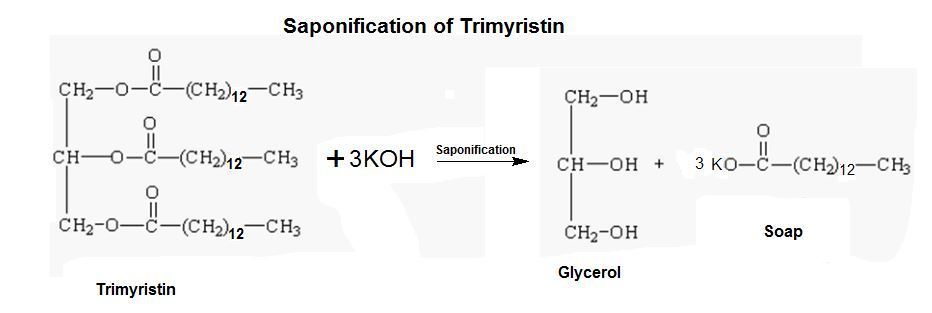
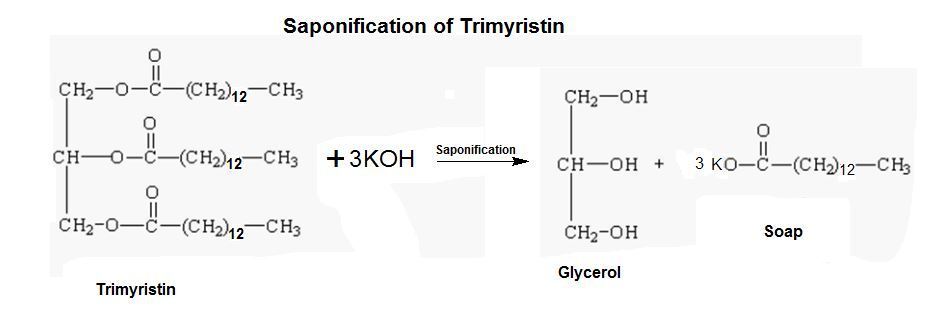
Draw the condensed structural formula in the equation for the saponification of trimyristin with koh

Chemistry
2 answers:
Ludmilka [50]2 years ago
4 0

Explanation: Saponification reaction is a reaction in which hydrolysis of fats takes place under basic conditions giving glycerol and a salt of corresponding fatty acid.

We are given a Fatty acid called as Trimyristin.

Its reaction with KOH leads to the formation of soap and is given by the equation:

Trimyristin+3 KOH\rightarrow Glycerol+Soap

C_{45}H_{86}O_6+3KOH\rightarrow C_3H_5(OH)_3+3CH_3(CH_2)_{12}CO_2K

The condensed structural formula for the equation is given in the image attached.

PIT_PIT [208]2 years ago
4 0
<span>Answer: Trimyristin is the triester formed from glycerol and three molecules of myristic acid, a long chain fatty acid. Hydrolysis would be C45H86O6 -> C3H8O3 + 3 C14H28O2</span>
You might be interested in
If you pump air into cycle tyre a slight warming effect is noticed at valve stem why
SSSSS [86.1K]
Probably the kinetic energy of rubbing the pump against the valve, combined with the increase in gas pressure in the tire itself.
8 0
2 years ago
A sample of an unknown substance has a mass of .158 kg if 2,510 J of heat is required to heat the substance from 32°C to 61°C wh
ziro4ka [17]

Answer: 0.548J/g°C

Explanation:

Q = s × m × DeltaT

Q = Heat (J)

S = Specific Heat Capacity

M = mass (g)

DeltaT = Change in temperature (°C)

0.158Kg x 1000 = 158g

2.510J = s x 158g x (61°C-32°C)

2.510J/(158g x 29°C) = s

S = 0.54779.... J/g°C

S = 0.548 J/g°C

7 0
2 years ago
The amount of energy that must be absorbed or lost to raise or lower the temperature of 1 g of liquid water by 1°C _____.
MatroZZZ [7]

Answer:

c

Explanation:

1 calorie = 4.184J/g×°C

This also happens to be the specific heat capacity of water, which is the amount of energy it takes to raise the temperature of 1mL of water by 1°C

6 0
2 years ago
a 16.0g sample of iron was heated from 0 degrees Celsius o 35.0 degrees Celsius.the iron absorbed 246.4J of energy as heat. what
frosja888 [35]
Specific heat means the amount heat needed when unit mass of a substrate increase one degree of temperature. So the specific heat = the heat absorbed/(the mass of the substrate * change in temperature) = 264.4/(16*35)=0.472 J/(g*℃)
5 0
2 years ago
Read 2 more answers
Compound A, C6H12 reacts with HBr/ROOR to give compound B, C6H13Br. Compound C, C6H14, reacts with bromine and light to produce
Savatey [412]

Answer:

The question involves drawing of structures and showing mechanism in which brainly text editor did not support. I made sure I created a pdf file with both the anwsers and explanations in it. The pdf can be found in the attachment below.  

Explanation:

Download pdf
3 0
2 years ago
Other questions:
  • Do you think that solids can undergo convection? explain
    8·1 answer
  • Tanks of compressed gas must be kept away from heat sources. If a compressed–gas tank is heated too much, it may explode and cau
    7·2 answers
  • Which expression represents the equilibrium constant expression for sulphurous acid (H2SO3)?
    8·1 answer
  • How to calculate electronegativity with 3 elements?
    11·1 answer
  • ASAP PLEASE HELP:
    11·2 answers
  • How many moles are contained in 3.131 × 1024 particles?
    8·1 answer
  • Consider the following molecules and the description of the bonding present in each: CH3CH2CH2CH3CH3CH2CH2CH3 (C−CC−C and C−HC−H
    15·1 answer
  • The list below includes some of the properties of butane, a common fuel. Identify the chemical properties in the list. Check all
    14·1 answer
  • 4. Which statement gives you enough information to say that the atom is electrically neutral?
    14·1 answer
  • Calculate the molar mass of a 2.89 g gas at 346 ml, a temperature of 28.3 degrees Celsius, and a pressure of 760 mmHg.
    14·1 answer
Add answer
Login
Not registered? Fast signup
Signup
Login Signup
Ask question!