answer.
Ask question
Login Signup
Ask question
All categories
  • English
  • Mathematics
  • Social Studies
  • Business
  • History
  • Health
  • Geography
  • Biology
  • Physics
  • Chemistry
  • Computers and Technology
  • Arts
  • World Languages
  • Spanish
  • French
  • German
  • Advanced Placement (AP)
  • SAT
  • Medicine
  • Law
  • Engineering
jarptica [38.1K]
2 years ago
10

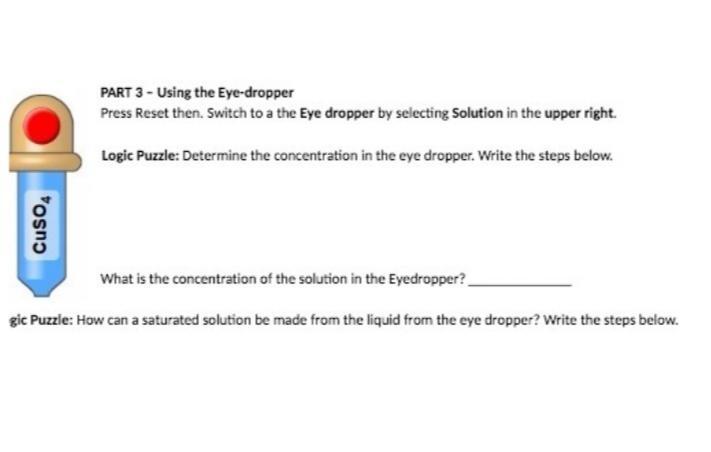
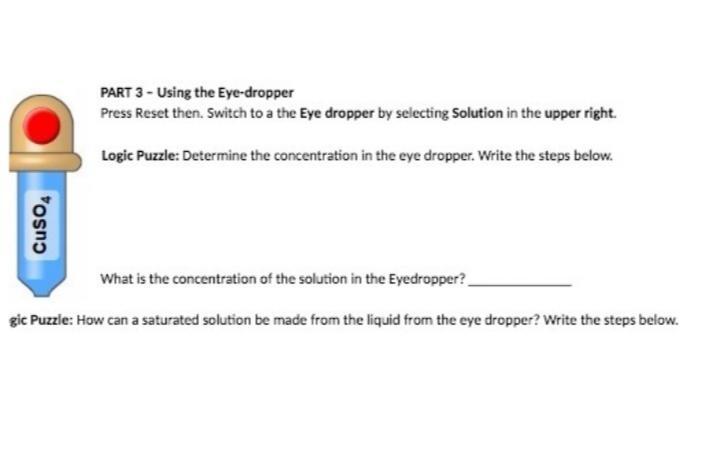
Logic Puzzle: Determine the concentration in the eye dropper. Write the steps below. What is the concentration of the solution i

n the Eyedropper?

Chemistry
1 answer:
romanna [79]2 years ago
4 0

Answer: copper (II) Sulphate

Explanation:

a.) The concentration in the eye dropper is copper (II) tetraoxo sulphate (vi)

Which is also called copper (II) sulphate

b.) Copper sulfate is a chemical compound with the formula CuSO4 and can be made in a chemistry laboratory by reacting copper oxide with sulphuric acid.

Apparatus used are :

Safety goggles, Bunsen burner, tripod. Test tube, beaker, conical flask, funnel and filter paper.

Procedures:

Check that the air hole on the Bunsen burner is fully closed, and turn on the gas tap. Light a splint and hold it two inches over the top of the Bunsen burner to ignite the gas.

Pour 20 cm3 of the dilute sulphuric acid into the beaker. Open the air hole on the Bunsen burner to give a blue flame, and place the beaker on the tripod. Heat the sulphuric acid until almost boiling.

Add a small amount of the copper oxide powder into the beaker using a spatula. Stir the mixture for 30 seconds with the glass stirring rod. Repeat until one gram of copper oxide powder has been added.

Continue to heat for another two minutes to ensure the reaction has completed. Turn off the Bunsen burner and allow the beaker to cool slightly.

Place a funnel in the conical flask, and fold a filter paper to fit the funnel. Swirl the beaker gently to ensure the contents of the solution are mixed, then pour the solution slowly through the filter paper. This step removes any unreacted copper oxide remaining. Clear blue copper sulfate solution will be left in the flask. If there are any impurities remaining in the solution, repeat the filter process.
You might be interested in
Aurelia dropped a piece of metal into a beaker, and then she added acid to it. She saw colorless bubbles rising from the metal.
timofeeve [1]

Answer:

Chemical change

Explanation:

From all indicators, Aurelia is seeing a chemical change occurring in the reaction here.

A chemical change is a change in which new substances are produced. For every chemical change:

  • they are not easily reversible
  • they lead to production of new kinds of substances
  • involves mass change
  • require considerable amount of energy.

We start off and end with:

         Metal   +     Acid →     Black metal     +    rising gaseous bubbles

Clearly, it is shown that new products are formed and this reaction is impossible to reverse in order to get the reactants back.

This is a typical chemical change.

4 0
2 years ago
Read 2 more answers
calculate the specific heat capacity for gold n 105 joules are required to heat 30.0 grams of gold from 27.7c to 54.9c
Pepsi [2]

<u>Answer:</u>

<em>The specific heat capacity for gold in 105 joules which are required to heat 30.0 grams of gold is 0.129 J/(g℃)</em>

<u>Explanation:</u>

We make use of the formula

Q=m \times c \times \Delta T

where

∆T = final T - initial T

= 54.9℃ - 27.7℃ = 27.2℃

Q is the heat energy in Joules = 105J

c is the specific heat capacity = ?

m is the mass of Gold = 30.0g

Q=m \times c \times \Delta T

Rearranging the formula

c= \frac {Q}{(m\times \Delta T)}

= \frac {105J}{(30.0g \times 27.2 ^\circ{C})}\\\\= \frac {105J}{(816g^\circ{C})}

So,

c = 0.129 J/(g℃)

(Answer)

7 0
2 years ago
Amy performed an experiment in lab. She improperly mixed the chemicals, and an explosion of light, sound, and heat occurred. Whe
svlad2 [7]

<span>The energy that was produced is called, heat combustion. It is an energy released in the form of heat when chemicals are mixed. An explosion of light and sound are the common characteristics of heat combustion. The chemical reaction takes place because of the presence of oxygen and hydrocarbon or organic molecule substances that when mixed form carbon dioxide and water which then releases heat and explosive characteristics.</span>

5 0
2 years ago
Read 2 more answers
Combustion of gasoline in automobiles produces poisonous gases. Catalytic converters that contain solid platinum, palladium, and
bagirrra123 [75]
It provides an alternative pathway for the rxn.
5 0
2 years ago
The human eye is able to detect as little as 2.35 × 10⁻¹⁸ j of green light of wavelength 510 nm. Calculate the minimum number of
Mariulka [41]

Answer:

  • <em>The minimum number of photons that can be detected by the human eye is </em><u><em>6.03 × 10 ¹⁶</em></u><em> photons.</em>

Explanation:

The energy of one photon of light is related to the wavelength by the equation:

  • E = h×c/λ

Where, E is the energy of one photon, h is the Planck's constant, c is the speed of light, and λ is the wavelength of the light.

You are given with <em>λ = 510 nm</em> (nanometers), which you must convert to m (meters), to use SI units ⇒ λ = 510 × 10⁻⁹ m.

The <em>physical constansts </em>needed are:

  • Planck's constant, h = 6.63 × 10⁻³⁴ J.s
  • Speed of light, in vacuum, c = 3.0 × 10⁻⁸ m/s

Now you can substitute in the formula can compute for the value of E:

  • E = 6.63×10⁻³⁴ J.s × 3.0 × 10⁻⁸ m/s / (510×10⁻⁹ m) = 0.039 × 10⁻³³ J

Since, that is the energy of one photon of green light, to calculate the number of photons that can be detected by the human eye, you need to divide the amounf of <em>energy the human eye is able to detect, 2.35 × 10⁻¹⁸ J , </em>by the energy of a photon:

  • number of photons = 2.35×10 ⁻¹⁸J / 0.039 × 10⁻³³ J/ photon

  • number of photons = 60.3 × 10¹⁵ photons = 6.03 × 10¹⁶photons
6 0
2 years ago
Other questions:
  • What is the name of the compound CuCO³?
    15·2 answers
  • Hydrogen has three isotopes with mass numbers of 1, 2, and 3 and has an average atomic mass of 1.00794 amu. This information ind
    10·2 answers
  • If you pump air into cycle tyre a slight warming effect is noticed at valve stem why
    8·1 answer
  • Consider the reaction: 2clf3(g) + 2nh3(g) → n2(g) + 6hf(g) + cl2(g) when calculating the δh°rxn, why is the δhf° for n2 not impo
    9·1 answer
  • List the following compounds in decreasing electronegativity difference. cl2 hcl nacl
    13·1 answer
  • Three units put together in different patterns essentially make
    12·2 answers
  • Given that Kw for water is 2.4×10⁻¹⁴ M2 at 37 °C, calculate the pH of a neutral aqueous solution at 37 °C, which is the normal h
    10·1 answer
  • A 1.80 g sample of barium chloride hydrate, BaCl2 ⋅ xH2O is treated with excess sulfuric acid, forming a BaSO4 precipitate which
    6·2 answers
  • Solid calcium carbonate (CaCO3) reacts with hydrochloric acid (HCI) to form carbon dioxide, water, and
    7·2 answers
  • How many chloride ions are in 0.486 moles of chloride ions?​
    11·1 answer
Add answer
Login
Not registered? Fast signup
Signup
Login Signup
Ask question!
