answer.
Ask question
Login Signup
Ask question
All categories
  • English
  • Mathematics
  • Social Studies
  • Business
  • History
  • Health
  • Geography
  • Biology
  • Physics
  • Chemistry
  • Computers and Technology
  • Arts
  • World Languages
  • Spanish
  • French
  • German
  • Advanced Placement (AP)
  • SAT
  • Medicine
  • Law
  • Engineering
ioda
2 years ago
14

How many molecules of ascorbic acid (vitamin c, c6h8o6) are in a 500 mg tablet?

Chemistry
2 answers:
Kamila [148]2 years ago
8 0

1.71 x 10²¹ molecules of ascorbic acid.

<h3>Further explanation</h3>

<u>The Problem:</u>

How many molecules of ascorbic acid (vitamin C or C₆H₈O₆) are in a 500 mg tablet?

<u>The Process:</u>  

Step-1

We prepare the molar mass of ascorbic acid or C₆H₈O₆.  

Relative atomic mass (in rounding to integers):  

  • C = 12 g/mol
  • H = 1 g/mol  
  • O = 16 g/mol  

In ascorbic acid, there are six carbon atoms, eight hydrogen atoms, and six oxygen atoms. Therefore the molar mass is given by  

\boxed{(12 \times 6) + (1 \times 8) + (16 \times 6) = 176 \ g/moles}  

Step-2

We calculate the moles of 500 mg ascorbic acid. Let us convert it to 0.5 g.

\boxed{ \ moles = \frac{mass}{molar \ mass} \ } \rightarrow \boxed{ \ moles = \frac{0.5 \ g}{176 \ g/mol} \ }

Therefore we get 2.84 x 10⁻³ moles.

Step-3

Remember this, one mole contains 6.02 x 10²³ molecules, which is called The Avogadro's number.  

Let us convert 2.84 x 10⁻³ moles to the number of molecules (N).  

\boxed{ \ moles = \frac{N}{6.02 \times 10^{23}} \ } \rightarrow \boxed{ \ N = moles \times 6.02 \times 10^{23} \ }

\boxed{ \ N = 2.84 \times 10^{-3} \ moles \times 6.02 \times 10^{23} \ \frac{molecules}{mol} \ }

Thus the amount of molecules in 500 mg C₆H₈O₆ are \boxed{ \ 1.71 \times 10^{21} \ molecules \ }.  

- - - - - - -  

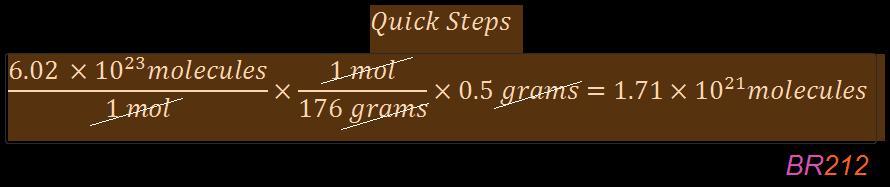
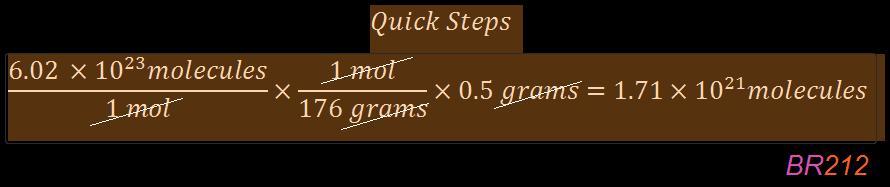
Quick Steps  

\boxed{ \ \frac{6.02 \times 10^{23} \ molecules}{1 \ mol} \times \frac{1 \ mole}{176 \ gram} \times 0.5 \ grams \ } = \boxed{ \ 1.71 \times 10^{21} \ molecules \ }

<h3>Learn more  </h3>
  1. Determine the mass of aspirin from the number of molecules brainly.com/question/10567477
  2. Determine the number of moles of water produced. brainly.com/question/4142557
  3. What is the formula for the hydrate?  brainly.com/question/13012523

Elden [556K]2 years ago
6 0
1) molar mass of the C6H8O<span>6, you need to consult the atomic weight of the C, H and O atoms that are in the periodic table: C is 12; H is 1; O is 16
(12x6)+(1x8)+(16x6)= 176g/mol

</span><span>176 g = 1 mol
0,5 g =  x mol                500mg= 0,5 grams

molar mass = mass÷ moles
176 = 0,5÷ x
x= 2,84 x 10⁻³ mol

2) To find the number of molecules present in those </span>2,84 x 10⁻³ mol we need to multiple the moles by the <span>Avogadro's constant
No. of molecules = Avogadro's constant  x n° of moles
</span>No. of molecules = 6.022 x 10²³ x 2,84 x 10⁻³ <span>
= 1.71 x 10²¹ molecules of vit C. </span>


You might be interested in
Explain the effects of nh3 and hcl on the cuso4 solution in terms of le chatelier's principle
Fittoniya [83]

The Principle of Le Chatelier states that if a system in equilibrium is subjected to a disturbance, the system will react in such a way that it will diminish the effect of that disturbance. Thus, when the concentration of one of the substances in an equilibrium system is changed, the equilibrium varies in such a way that it can compensate for this change.

For example, if the concentration of one of the reactants is increased, the equilibrium shifts to the right or to the side of the products. Also, if you add more reagents, the reaction will move even more to the right until the balance is re-established again, increasing the quantity of products.

In this way, adding HCl to a solution of CuSO4 will produce the following reaction:

CuSO4 (aq) + 2HCl (aq) ⇔ CuCl2 (aq) + H2SO4 (aq)

Initially the solution of CuSO4 in water will be blue, but when adding HCl the solution will change color to green, since the aqueous solutions of CuCl2 are green. By adding more HCl this color will intensify as the balance shifts to the right, producing more CuCl2 and H2SO4.

On the other hand, adding NH3 to a solution of CuSO4 will produce the following reaction

CuSO4 (aq) + 4NH3 (aq) ⇔ [Cu(NH3)4] SO4 (s)

Thus, by adding NH3 to the CuSO4 solution we will observe the formation of a precipitate corresponding to [Cu(NH3) 4] SO4. <u>When adding more NH3, the formation of more precipitate will be observed as the equilibrium moves to the right, producing a greater quantity of [Cu (NH3) 4] SO4.</u>
6 0
2 years ago
A 20.0-mL sample of lake water was acidified with nitric acid and treated with excess KSCN to form a red complex (KSCN itself is
Novosadov [1.4K]

Answer:

8.09x10⁻⁵M of Fe³⁺

Explanation:

Using Lambert-Beer law, the absorbance of a sample is proportional to its concentration.

In the problem, the Fe³⁺ is reacting with KSCN to produce Fe(SCN)₃ -The red complex-

The concentration of Fe³⁺ in the reference sample is:

4.80x10⁻⁴M Fe³⁺ × (5.0mL / 50.0mL) = 4.80x10⁻⁵M Fe³⁺

<em>Because reference sample was diluted from 5.0mL to 50.0mL.</em>

<em>That means a solution of  4.80x10⁻⁵M Fe³⁺ gives an absorbance of 0.512</em>

Now, as the sample of the lake gives an absorbance of 0.345, its concentration is:

0.345 × (4.80x10⁻⁵M Fe³⁺ / 0.512) = <em>3.23x10⁻⁵M.  </em>

As the solution was diluted from 20.0mL to 50.0mL, the concentration of Fe³⁺ in Jordan lake is:

3.23x10⁻⁵M Fe³⁺ × (50.0mL / 20.0mL) = <em>8.09x10⁻⁵M of Fe³⁺</em>

4 0
2 years ago
A sample of 0.300 mg pure chromium was added to excess hydrochloric acid to form a 10.0 mL aqueous solution of a chromium (III)
DerKrebs [107]

extinction coefficient (ε) = 347 L·mol⁻¹·cm⁻¹

Explanation:

The chemical reaction between chromium (Cr) and hydrochloric acid (HCl):

2 Cr + 6 HCl → 2 CrCl₃ + 3 H₂

number of moles = mass / molar weight

number of moles of Cr = 0.3 × 10⁻³ (g) / 52 (g/mole)

number of moles of Cr = 5.77 × 10⁻⁶ moles

From the chemical reaction we see that 2 moles of Cr will produce 2 moles of CrCl₃ so 5.77 × 10⁻⁶ moles of Cr will produce 5.77 × 10⁻⁶ moles of CrCl₃.

molar concentration = number of moles / volume (L)

molar concentration of CrCl₃ = 5.77 × 10⁻⁶ / 10 × 10⁻³

molar concentration of CrCl₃ = 5.77 × 10⁻⁴ moles / L

Now we need to transform percent transmittance (%T) in absorbance (A) using the following formula:

A = 2 - log (%T)

A = 2 - log (62.5)

A = 2 - 1.8

A = 0.2

We know that absorbance (A) is defined in respect with extinction coefficient (ε), cell length (l) and concentration (c):

A = εlc

ε = A / lc

ε = 0.2 / (1 × 5.77 × 10⁻⁴)

ε = 0.0347 × 10⁴

ε = 347 L·mol⁻¹·cm⁻¹

Learn more about:

molar concentration

brainly.com/question/13971392

#learnwithBrainly

7 0
2 years ago
what mass of lithium chloride, licl must be dissolved to make a 0.194M solution that has volume of 1.00 l
Bogdan [553]
MXV= (0.194M)(1.00L)=0.194moles
42.39LiClg/molex0.194moles=8.2g LiCl
6 0
2 years ago
2 HI(g) ⇄ H2(g) + I2(g) Kc = 0.0156 at 400ºC 0.550 moles of HI are placed in a 2.00 L container and the system is allowed to rea
Alex_Xolod [135]

<u>Answer:</u> The concentration of hydrogen gas at equilibrium is 0.0275 M

<u>Explanation:</u>

Molarity is calculated by using the equation:

\text{Molarity}=\frac{\text{Number of moles}}{\text{Volume of solution (in L)}}

Moles of HI = 0.550 moles

Volume of container = 2.00 L

\text{Initial concentration of HI}=\frac{0.550}{2}=0.275M

For the given chemical equation:

                          2HI(g)\rightleftharpoons H_2(g)+I_2(g)

<u>Initial:</u>                  0.275

<u>At eqllm:</u>           0.275-2x      x         x

The expression of K_c for above equation follows:

K_c=\frac{[H_2][I_2]}{[HI]^2}

We are given:

K_c=0.0156

Putting values in above expression, we get:

0.0156=\frac{x\times x}{(0.275-2x)^2}\\\\x=-0.0458,0.0275

Neglecting the negative value of 'x' because concentration cannot be negative

So, equilibrium concentration of hydrogen gas = x = 0.0275 M

Hence, the concentration of hydrogen gas at equilibrium is 0.0275 M

4 0
2 years ago
Other questions:
  • To determine the atomic mass of an element, the masses of all the naturally occurring isotopes of that element are averaged toge
    14·2 answers
  • Explain why the actual electron configurations of 2-7-1-1 represents a sodium in an excited state
    10·1 answer
  • What is the pH of a solution prepared by mixing 50.00 mL of 0.10 M methylamine, CH3NH2, with 20.00 mL of 0.10 M methylammonium c
    6·1 answer
  • Using your data above, draw conclusions about the d-splitting for each ligand (H2O, en, phen). Order the complexes from least to
    13·1 answer
  • What is the value of the σ∗1s mo wave function at the nodal plane?
    15·2 answers
  • A 5 gram piece of aluminum foil at 100 degrees C is dropped into a 25 gram container of water at 20 degrees C. What is the final
    15·2 answers
  • an unknown metal of mass 512 g at a temperature of 15C is dropped into 325 g of water held in a 100 g aluminum container at the
    7·1 answer
  • How many lead (Pb) atoms will be generated when 5.38 moles of ammonia react according to the following equation: 3PbO+2NH3→3Pb+N
    12·2 answers
  • A ground state hydrogen atom absorbs a photon of light having a wavelength of 93.7 nm.93.7 nm. What is the final state of the hy
    14·1 answer
  • IF YOU GIVE A LINK OR DON"T ACTUALLY ANSWER THIS QUESTION RIGHT JUST FOR POINTS I WILL REPORT YOUR ANSWER AND YOU
    14·2 answers
Add answer
Login
Not registered? Fast signup
Signup
Login Signup
Ask question!
