answer.
Ask question
Login Signup
Ask question
All categories
  • English
  • Mathematics
  • Social Studies
  • Business
  • History
  • Health
  • Geography
  • Biology
  • Physics
  • Chemistry
  • Computers and Technology
  • Arts
  • World Languages
  • Spanish
  • French
  • German
  • Advanced Placement (AP)
  • SAT
  • Medicine
  • Law
  • Engineering
Musya8 [376]
2 years ago
6

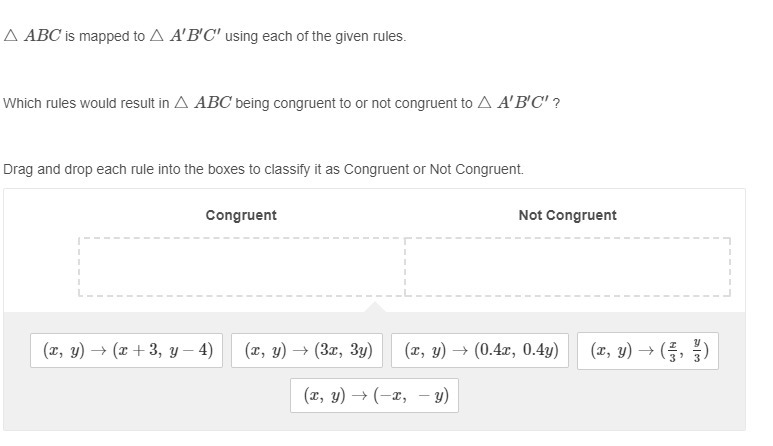
△ABC is mapped to △A′B′C′ using each of the given rules.

Mathematics
2 answers:
faltersainse [42]2 years ago
7 0

Answer:

Congruent:  (x, y)→(x+3, y-4); (x, y)→(-x, -y)

Not Congruent:  (x, y)→(3x, 3y); (x, y)→(0.4x, 0.4y); (x, y)→(x/3, y/3)

Step-by-step explanation:

Transformations that result in congruent figures are translations, rotations and reflections.  Translations that result in figures that are <em>not</em> congruent are dilations.

The first transformation, (x, y)→(x+3, y-4) is a translation 3 units to the right and 4 units down.  This will result in congruent figures, since it only slides the figure.

The second transformation, (x, y)→(3x, 3y) is a dilation by a factor of 3.  A dilation is a stretch or a shrink; a dilation factor of 3 will stretch the figure.  Since it is stretched, it is not the same size and therefore not congruent.

The third transformation, (x, y)→(0.4x, 0.4y) is a dilation by a factor of 0.4.  This dilation will shrink the figure.  Since it is shrunk, it is not the same size and therefore not congruent.

The fourth transformation, (x, y)→(x/3, y/3) is a dilation by a factor of 1/3.  This dilation will shrink the figure.  Since it is shrunk, it is not the same size and therefore not congruent.

The fifth transformation, (x, y)→(-x, -y) is a reflection.  This does not change the size of the figure, just the placement and orientation of it.  Since the size is not changed, the figure is congruent.
BabaBlast [244]2 years ago
4 0

Answer:- Congruent =  (x, y)→(x+3, y-4)

                                        (x, y)→(-x, -y)

               Not Congruent=  (x, y)→(3x, 3y)

                                            (x, y)→(0.4x, 0.4y)

                                             (x, y)→(x/3, y/3)

Explanation:

1.The transformation (x, y)→(x+3, y-4) is a translation ,where the x coordinates of points of ΔABC translate 3 units toward right and the y coordinate translate 4 units downwards .Translation is rigid transformation which does not change the size of the figure, it just translate every point of a figure by a fixed distance to create its image. Thus this would result in △ABC being congruent to △A′B′C′.

2.The transformation (x, y)→(3x, 3y) is a dilation by a factor of 3.Since after dilation the size of image becomes different, thus this would result in △ABC being not congruent to △A′B′C′.

3.The transformation (x, y)→(0.4x, 0.4y) is a dilation by a factor of 0.4.Since after dilation the size of image becomes different, thus this would result in △ABC being not congruent to △A′B′C′.  

4.The transformation (x, y)→(x/3, y/3) is a dilation by a factor of 1/3. Since after dilation the size of image becomes different, thus this would result in △ABC being not congruent to △A′B′C′.

5.The transformation (x, y)→(-x, -y) is a reflection. Reflection is a rigid transformation which does not change the size of the figure, it create exactly same sized image of the original figure, Thus this would result in △ABC being congruent to △A′B′C′.


You might be interested in
A desert has both fruit and yoghurt inside.Altogether the mass of the fruit and yoghurt is 175g. The ratio of the mass of fruit
Dafna11 [192]

Answer:

125g

Step-by-step explanation:

You can find the mass of the yoghurt by dividing the mass of the fruit and the yoghurt by the sum of the ratio,(2+5), then multiplying that value by 5.

8 0
2 years ago
How much heat is required to raise the temperature of
Elina [12.6K]

Answer:

The amount of heat required to raise the temperature of liquid water is 9605 kilo joule .

Step-by-step explanation:

Given as :

The mass of liquid water = 50 g

The initial temperature = T_1 = 15°c

The final temperature = T_2  = 100°c

The latent heat of vaporization of water = 2260.0 J/g

Let The amount of heat required to raise temperature = Q Joule

Now, From method

Heat = mass × latent heat × change in temperature

Or, Q = m × s × ΔT

or, Q =  m × s × ( T_2 - T_1 )

So, Q = 50 g × 2260.0 J/g × ( 100°c - 15°c )

Or, Q =  50 g × 2260.0 J/g × 85°c

∴   Q = 9,605,000  joule

Or, Q =  9,605 × 10³ joule

Or, Q = 9605 kilo joule

Hence The amount of heat required to raise the temperature of liquid water is 9605 kilo joule . Answer

4 0
2 years ago
Point T, the midpoint of segment RS, can be found using the formulas x = (6 – 2) + 2 and y = (4 – 6) + 6. What are the coordinat
Fiesta28 [93]

Question:

Point T, the midpoint of segment RS, can be found using the formulas x = (1/2) (6 – 2) + 2 and y = (1/2) (4 – 6) + 6. What are the coordinates of point T?

Answer:

T(4,5)

Step-by-step explanation:

Given

x = \frac{1}{2}(6 - 2) + 2

y = \frac{1}{2}(4 - 6) + 6

Required

Determine the coordinates of T

The coordinates of T can be represented as T(x,y)

To do this, we simply solve for x and y

x = \frac{1}{2}(6 - 2) + 2

Solve 6 - 2

x = \frac{1}{2}*4 + 2

Solve 1/2 * 4

x = 2 + 2

x = 4

y = \frac{1}{2}(4 - 6) + 6

Solve 4 - 6

y = \frac{1}{2}*-2 + 6

Solve 1/2 * -2

y = -1 + 6

y = 5

Hence, the coordinates of T(x,y) is:

T(x,y) = T(4,5)

5 0
2 years ago
Read 2 more answers
4. Tina wants to secure sequins on a piece of felt shaped like a rectangle with a length of 10 cm and width of 21 cm. What is th
mote1985 [20]
First we find the area 10 x 21 = 210 then we multiply 210 x .70 and we get 147.00 total cost. d. 147.00
4 0
2 years ago
Read 2 more answers
What values of c and d make the equation true? RootIndex 3 StartRoot 162 x Superscript c Baseline y Superscript 5 Baseline EndRo
Reil [10]

Answer:

<em>c=6, d=2</em>

Step-by-step explanation:

<em>Equations </em>

We must find the values of c and d that make the below equation be true

\sqrt[3]{162x^cy^5}=3x^2y \sqrt[3]{6y^d}

Let's cube both sides of the equation:

\left (\sqrt[3]{162x^cy^5}\right )^3=\left (3x^2y \sqrt[3]{6y^d}\right)^3

The left side just simplifies the cubic root with the cube:

162x^cy^5=\left (3x^2y \sqrt[3]{6y^d}\right)^3

On the right side, we'll simplify the cubic root where possible and power what's outside of the root:

162x^cy^5=3^3x^6y^3 (6y^d)

Simplifying

x^cy^5=x^6y^{3+d}

Equating the powers of x and y separately we find

c=6

5=3+d

d=2

The values are

\boxed{c=6,d=2}

3 0
2 years ago
Read 2 more answers
Other questions:
  • The table shows how an elevator 500 feet above the ground is descending at a steady rate.
    15·2 answers
  • What is the slope intercept form of (3,3) (7,-1)
    6·1 answer
  • Which graph represents viable values for y = 5.5x, where x is the number of cans of tomato paste and y is the total weight of th
    6·2 answers
  • There are cars and motorcycles in a campus parking lot. The parking attendant noticed there are a total of 294 tires and a total
    11·1 answer
  • A flat rectangular piece of aluminum has a perimeter of 60 inches. The length is 14 inches longer than the width. Find the width
    10·1 answer
  • An 80 ounce bottle of apple juice contains 32 ounces of water a 64 ounce bottle of orange juice has 48 ounces of water which jui
    10·2 answers
  • In a study of exercise, a large group of male runners walk on a treadmill for six minutes. Their heart rates in beats per minute
    8·1 answer
  • 4. On square JKLM below, if J is located at
    15·1 answer
  • 30 POINTS PLZ HELP ME!!!!
    10·2 answers
  • Can someone help please??
    6·1 answer
Add answer
Login
Not registered? Fast signup
Signup
Login Signup
Ask question!
