answer.
Ask question
Login Signup
Ask question
All categories
  • English
  • Mathematics
  • Social Studies
  • Business
  • History
  • Health
  • Geography
  • Biology
  • Physics
  • Chemistry
  • Computers and Technology
  • Arts
  • World Languages
  • Spanish
  • French
  • German
  • Advanced Placement (AP)
  • SAT
  • Medicine
  • Law
  • Engineering
mr_godi [17]
2 years ago
9

Use bond energies to determine δhrxn for the reaction between ethane and chlorine. ch3ch3(g)+cl2(g)→ch3ch2cl(g)+hcl(g)

Chemistry
2 answers:
tia_tia [17]2 years ago
6 0

The value of \Delta {H_{{\text{reaction}}}} of the reaction {\text{C}}{{\text{H}}_3}{\text{C}}{{\text{H}}_3}\left( g \right) + {\text{C}}{{\text{l}}_2}\left( g \right) \to {\text{C}}{{\text{H}}_{\text{3}}}{\text{C}}{{\text{H}}_{\text{2}}}{\text{Cl}}\left( g \right) + {\text{HCl}}\left( g \right) is \boxed{ - 113\;{\text{kJ/mol}}}.

Further explanation:

Heat of reaction:

The heat released or absorbed in a chemical reaction due to the difference in the bond energies (BE) of reactants and products in the reaction is known as the heat of reaction. It is represented by\Delta {H_{{\text{reaction}}}}.

The heat of reaction \left( {\Delta {H_{{\text{reaction}}}}} \right)can have two values:

Case I: If the reaction is endothermic, more energy needs to be supplied to the system than that released by it. So \Delta {H_{{\text{reaction}}}} comes out to be positive.

Case II: If the reaction is exothermic, more energy is released by the system than that supplied to it. So \Delta {H_{{\text{reaction}}}} comes out to be negative.

The formula to calculate the heat of reaction is,

\boxed{\Delta {H_{{\text{reaction}}}} = \sum {\text{B}}{{\text{E}}_{{\text{reactant bond broken}}}} - \sum {\text{B}}{{\text{E}}_{{\text{product bond formed}}}}}

Here,

\Delta {H_{{\text{reaction}}}} is the heat of reaction.

{\text{B}}{{\text{E}}_{{\text{product bond formed}}}} is the bond energy of bond formation in products.

{\text{B}}{{\text{E}}_{{\text{reactant bond broken}}}} is the bond energy of bond breakage in reactants.

The given reaction occurs as follows:

{\text{C}}{{\text{H}}_3}{\text{C}}{{\text{H}}_3}\left(g\right)+{\text{C}}{{\text{l}}_2}\left(g\right) \to {\text{C}}{{\text{H}}_{\text{3}}}{\text{C}}{{\text{H}}_{\text{2}}}{\text{Cl}}\left(g\right)+{\text{HCl}}\left(g\right)

The number of broken bonds is one C-H bond and one Cl-Cl bond.

The number of bonds formed is one C-Cl bond and one H-Cl bond.

The formula to calculate the enthalpy of the given reaction is as follows:

\Delta {H_{{\text{reaction}}}} = \left[ {\left( {1{\text{B}}{{\text{E}}_{{\text{C}} - {\text{H}}}} + 1{\text{B}}{{\text{E}}_{{\text{Cl}} - {\text{Cl}}}}} \right) - \left( {{\text{1B}}{{\text{E}}_{{\text{C}} - {\text{Cl}}}} + {\text{1B}}{{\text{E}}_{{\text{H}} - {\text{Cl}}}}} \right)} \right]                …… (1)

The bond energy of C-H bond is 414 kJ/mol.

The bond energy of Cl-Cl bond is 243 kJ/mol.

The bond energy of C-Cl bond is 339 kJ/mol.

The bond energy of H-Cl bond is 431 kJ/mol.

Substitute these values in equation (1).

\begin{aligned}\Delta {H_{{\text{reaction}}}}&=\left[ {\left( {41{\text{4 kJ/mol}}+243{\text{ kJ/mol}}} \right) - \left( {339{\text{ kJ/mol}}+431{\text{ kJ/mol}}}\right)}\right]\\&=\left[ {65{\text{7 kJ/mol}} - 77{\text{0 kJ/mol}}}\right]\\&=-11{\text{3 kJ/mol}}\\\end{aligned}

Learn more:

1. Calculate the enthalpy change using Hess’s Law: brainly.com/question/11293201

2. Find the enthalpy of decomposition of 1 mole of MgO: brainly.com/question/2416245

Answer details:

Grade: Senior School

Subject: Chemistry

Chapter: Thermodynamics

Keywords: C-Cl, C-H, H-Cl, Cl-Cl, -113 kJ/mol, heat of reaction, released, absorbed, exothermic, endothermic, positive, negative.
STALIN [3.7K]2 years ago
3 0
For this reaction to proceed, the following bond breaking should occur: 

*one C-H bond
* one Cl-Cl bond

After, the following bond formations should occur:
*one C-Cl bond
*one H-Cl bond

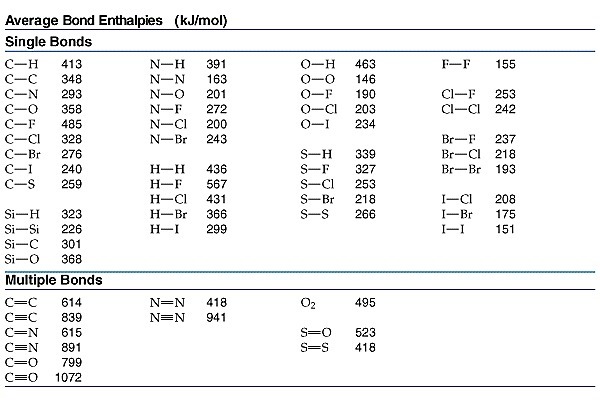
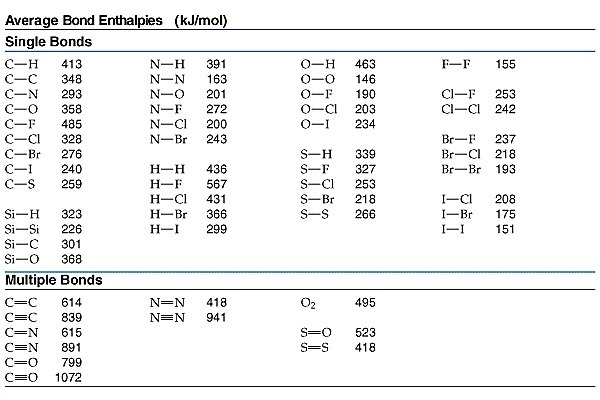
Now, add the bond energies for the respective bond energies which can be found in the attached picture. For bond formations, energy is negative. For bond breaking, energy is positive.

ΔHrxn = (1)(413) + (1)(242) + 1(-328) + 1(-431) = <em>-104 kJ</em>

You might be interested in
According to the equation below, how many moles of Ca(OH)2 are required to react with 1.36 mol H3PO4 to produce Ca3(PO4)2? 3Ca(O
allsm [11]

<u>Answer:</u> The amount of calcium hydroxide needed to react is 2.04 moles

<u>Explanation:</u>

We are given:

Moles of phosphoric acid = 1.36 moles

For the given chemical equation:

3Ca(OH)_2+2H_3PO_4\rightarrow Ca_3(PO_4)_2+6H_2O

By Stoichiometry of the reaction:

2 moles of phosphoric acid reacts with 3 moles of calcium hydroxide

So, 1.36 moles of phosphoric acid will react with = \frac{3}{2}\times 1.36=2.04mol of calcium hydroxide

Hence, the amount of calcium hydroxide needed to react is 2.04 moles

3 0
2 years ago
A transition in the balmer series for hydrogen has an observed wavelength of 434 nm. Use the Rydberg equation below to find the
DanielleElmas [232]

Answer:

i. n = 5

ii. ΔE = 7.61 × 10^{-46} KJ/mole

Explanation:

1. ΔE = (1/λ) = -2.178 × 10^{-18}(\frac{1}{n^{2}_{final} } - \frac{1}{n^{2}_{initial}  })

    (1/434 × 10^{-9}) = -2.178 × 10^{-18} (\frac{n^{2}_{initial} - n^{2}_{final}  }{n^{2}_{final} n^{2}_{initial}   })

⇒ 434 × 10^{-9} = (1/-2.178 × 10^{-18})\frac{n^{2}_{final} *n^{2}_{initial}   }{n^{2}_{initial} - n^{2}_{final}    }

But, n_{final} = 2

434 × 10^{-9} = (1/2.178 × 10^{-18})\frac{2^{2} n^{2}_{initial}  }{n^{2}_{initial} - 2^{2}  }

434 × 10^{-9}  × 2.178 × 10^{-18} = (\frac{4n^{2}_{initial}  }{n^{2}_{initial} - 4 })

⇒ n_{initial} = 5

Therefore, the initial energy level where transition occurred is from 5.

2. ΔE = hf

     = (hc) ÷ λ

    = (6.626 × 10−34 × 3.0 × 10^{8} ) ÷ (434 × 10^{-9})

    = (1.9878 × 10^{-25}) ÷ (434 × 10^{-9})

    = 4.58 × 10^{-19} J

    = 4.58 × 10^{-22} KJ

But 1 mole = 6.02×10^{23}, then;

energy in KJ/mole = (4.58 × 10^{-22} KJ) ÷ (6.02×10^{23})

         = 7.61 × 10^{-46} KJ/mole

7 0
2 years ago
22. How many atoms are there in 344.75 g of gold nugget? a. 1.05 x 10 to the power of 24 atoms b. 1.05 x 10 to the power of 23 a
mixas84 [53]

Answer:

1.053×10²⁴ atoms of gold

Explanation:

Hello,

Gold nugget are usually the natural occurring gold and they contain 85% - 90% weight of pure gold.

In this question, we're required to find the number of atoms in 344.75g of a gold nugget.

We can use mole concept relationship between Avogadro's number and molar mass.

1 mole = molar mass

Molar mass of gold = 197 g/mol

1 mole = Avogadro's number = 6.022 × 10²³ atoms

Number of mole = mass / molar mass

Mass = number of mole × molar mass

Mass = 1 × 197

Mass = 197g

197g is present in 6.022×10²³ atoms

344.75g will contain x atoms

x = (344.75 × 6.022×10²³) / 197

X = 1.053×10²⁴ atoms

Therefore 344.75g of gold nugget will contain 1.053×10²⁴ atoms of gold

5 0
2 years ago
Pure platinum is too soft to be used in jewelry because it scratches easily. To increase the hardness so that it can be used in
Zina [86]

Answer:

percentage mass of platinum in the alloy ≈ 90.60 %

Explanation:

The alloy is 8.528 g sample of an alloy containing platinum and cobalt . The alloy react with excess nitric acid to form cobalt(ii) nitrate . Platinum is resistant to acid so it will definitely not react with the acid only the cobalt metal in the alloy will react with the acid.

The chemical reaction can be represented as follows:

Co (s) + HNO₃ (aq) → Co(NO₃)₂ (aq) +  NO₂ (l) + H₂O (l)

The balanced equation

Co (s) + 4HNO₃ (aq) → Co(NO₃)₂(aq) + 2NO₂ (l) + 2H₂O (l)

Cobalt is the limiting reactant

atomic mass of cobalt = 58.933 g/mol

Molar mass of Co(NO₃)₂ = 58.933 + 14 × 2 + 16 × 6 = 58.933 + 28 + 96 = 182.933  g

58.933 g of cobalt produce 182.933  g of  Co(NO₃)₂

? gram of cobalt will produce 2.49 g of Co(NO₃)₂

cross multiply

grams of cobalt that will react = (58.933 × 2.49)/182.933

grams of cobalt that will react = 146.74317000/182.933

grams of cobalt that will react= 0.8021689362 g

grams of cobalt that will react = 0.802 g

mass of platinum in the alloy  = 8.528 g - 0.802 g = 7.726 g

percentage  mass of platinum in the alloy = 7.726/8.528 × 100 = 772.600/8.528 = 90 .595 %

percentage mass of platinum in the alloy ≈ 90.60 %

6 0
2 years ago
Which one of the following statements is correct?
adell [148]

Answer:

Tissues form organs, and organs form systems. Hope this helped!

Explanation:

7 0
2 years ago
Other questions:
  • Write the symbol for the monatomic ion that has a charge of 1– and the condensed electron configuration [ne]3s23p6.
    5·2 answers
  • 6. Find the number of centimeters in 1.00 x 10² yards. (1 yd = 3 ft, 1 ft = 12 in, 2.54 cm = 1
    5·1 answer
  • What is the theoretical yield of aluminum that can be produced by the reaction of 60.0 g of aluminum oxide with 30.0 g of carbon
    12·1 answer
  • A generic element, Z, has two isotopes, 45Z and 47Z, and an average atomic mass of 45.36 amu. The natural abundances of the two
    8·1 answer
  • What type of ossification occurs to form an immovable joint
    15·1 answer
  • Methane and chlorine react to form chloromethane, CH3Cl and hydrogen chloride. When 29.8 g of methane and 40.3 g of chlorine gas
    10·2 answers
  • What is the mass in grams of 0.40 moles of sodium borohydride
    11·2 answers
  • the image above shows a chamber with a fixed volume filled with gas at a pressure of 1560 mmHg and a temperature of 445.0 K. If
    11·1 answer
  • A blacksmith making a tool heats 525 grams of steel to 1230°C. After hammering the steel, she places it into a bucket of water t
    5·1 answer
  • Alveolar air (a mixture of nitrogen, oxygen, and carbon dioxide) has a total pressure of 0.998 atm. If the partial pressure of o
    13·1 answer
Add answer
Login
Not registered? Fast signup
Signup
Login Signup
Ask question!
