answer.
Ask question
Login Signup
Ask question
All categories
  • English
  • Mathematics
  • Social Studies
  • Business
  • History
  • Health
  • Geography
  • Biology
  • Physics
  • Chemistry
  • Computers and Technology
  • Arts
  • World Languages
  • Spanish
  • French
  • German
  • Advanced Placement (AP)
  • SAT
  • Medicine
  • Law
  • Engineering
Harrizon [31]
2 years ago
5

The Temple in Jerusalem was destroyed in the year A.D.________.

Mathematics
1 answer:
liubo4ka [24]2 years ago
3 0

1. The Temple in Jerusalem was destroyed in the year of 70 AD.

The first Temple was built by King Solomon for seven years in the 10th century BC. The first Temple was destroyed by the Babylonians in 586 BC. The construction of the new Temple began 535 BC and it is completed in 516 BC. The rebuilding of the Temple was approved by Darius I. It was, however, destroyed by the Romans in 70 AD. Despite the fact that the Temple was destroyed, all the outer walls still stand, and for a long time, it was believed that only the west wall stood.


The provincial governors in Rome were given orders to openly persecute the Christians by Emperor Trajan.

This can be concluded from the letter sent to him by Pliny, governor of Bithynia (province of Asia Minor). He had doubts about the investigation and the way of punishing those who were accused as Christians because he never been present at any trials of Christians. This implies that there have already been trials for Christians and that he did not know the details about Trajan’s decree of prosecuting Christians.


The Roman emperor who passed a decree to require everyone to participate in the cult of emperor worship was Decius.

Emperor Decius (249-251) announced the edict that orders everyone to do sacrifice to the Roman gods and to him personally. According to the edict, the sacrifice had to be carried out in the presence of a Roman magistrate who issued a certificate that this had been done. There is no evidence that it was directed against the Christians, but it was fatal for them because was contrary to their beliefs.


1 Peter 3:17: "For it is better, if  God should will it so, that you suffer for doing what is right rather than for doing what is wrong."

The quote is from the First Epistle of Peter, which is part of the New Testament. It is written by Peter the Apostle in Rome (where he was a bishop) as the letter which is sent to believers in Asia Minor who were persecuted and tortured.


The most damaging charge brought against the Christians in Rome was that they were constant law-breakers who did not discharge their duties to the state.

<span>The Roman authorities consider Christians as opponents of the state that promoted treasonous activities and they were apprehended for disobedience. Suspected Christians have often refused to deviate from Christianity in order to comply themselves with acts of a state cult, which was understood as a public cancellation of loyalty to the state.</span>

You might be interested in
Player V and Player M have competed against each other many times. Historical data show that each player is equally likely to wi
Helen [10]

Answer:

0.46 (46%)

Step-by-step explanation:

We have the following data:

- Probability that player V wins the first set:

p(1)=0.50

(because the text says the two players are equally likely to win the first set)

- Probability that player V wins the 2nd set if he has won the 1st set:

p(2|1)=0.60

So, the probability that player V wins the first 2 sets is:

p(12)=p(1)\cdot p(2|1)=(0.50)(0.60)=0.30 (1)

Instead, the probability that player V loses the 2nd set if he has won the 1st set is 0.40 (=1-0.60), so

p(2^c|1)=0.40

So, the probabiity that player V winse the 1st set but loses the 2nd set is

p(12^c)=p(1)\cdot p(2^c|1)=(0.50)(0.40)=0.20 (2)

Also, we have:

- Probability that player V loses the 1st set:

p(1^c)=0.50

- Probability that she will lose the 2nd set in this case is 0.70, it means that the probability that she will win the 2nd set if she lost the 1st set is 0.30, so:

p(2|1^c)=0.30

So, the probability that she will lose the 1st set and win the 2nd set is:

p(1^c2)=p(1^c)\cdot p(2|1^c)=(0.50)(0.30)=0.15 (3)

Combined together (2) and (3), this means that the probability that player V wins exactly 1 set out of the first two sets is:

p(1/2)=p(12^c)+p(1^c2)=0.20+0.15=0.35 (4)

At this point, the probability that she will win the 3rd set is

p(3)=0.45

This means that the overall probability that she will win the 3rd set if she won exacty 1 of the first 2 sets is:

p(1/2,3) = p(1/2)\cdot p(3)=(0.35)(0.45)=0.16 (5)

So, the overall probability that player V will win a match against player M is the sum of (1) and (5):

p(W)=p(12)+p(1/2,3)=0.30+0.16=0.46

5 0
2 years ago
The production department has installed a new spray machine to paint automobile doors. As is common with most spray guns, unsigh
marta [7]

Answer:

10000*0.6065=6065

A. about 6,065

Step-by-step explanation:

Definitions and concepts

The Poisson process is useful when we want to analyze the probability of ocurrence of an event in a time specified. The probability distribution for a random variable X following the Poisson distribution is given by:

P(X=x) =\lambda^x \frac{e^{-\lambda}}{x!}

And the parameter \lambda represent the average ocurrence rate per unit of time.

For this distribution the expected value is the same parameter \lambda  

E(X)=\mu =\lambda=0.5  , Var(X)=\lambda=0.5, Sd(X)=707

Solution to the problem

We want "how many would have no blemishes" so first we need to find the probability that X=0, since X represent on this case the number of blemishes on each door. And if we use the mass function we got this:

P(X=0) =0.5^0 \frac{e^{-0.5}}{0!}=0.6065

And now since we have a total of 10000 doors painted we can find how many we would expect with no blemishes:

10000*0.6065=6065

A. about 6,065

4 0
2 years ago
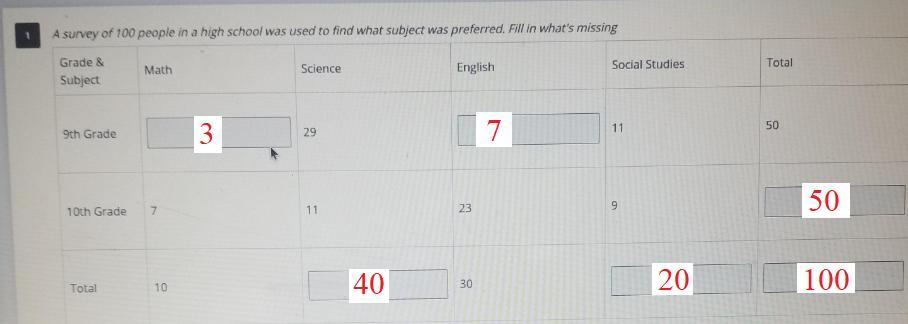
A survey of 100 people in high school was used to find what subject was preferred. Fill in whats missing
asambeis [7]

Question: What's the joint frequency a 9th grader liked math?

<h3>Answer: 3%</h3>

Explanation:

Check out the attached image below. I've filled in the table with the missing values. The upper left corner is 3 because 7+3 = 10 in the first column. You'll fill in the other values in a similar fashion. Once we filled out the table, we can answer all of these questions. There are 3 ninth graders who like math out of 100 people total. So the final answer is 3/100 = 0.03 = 3%.

-----------------------------------

Question: What's the marginal relative frequency of 9th graders surveyed?

<h3>Answer: 10%</h3>

Explanation:

Again, refer to the table to find that there are 10 ninth graders out of 100 total. So 10/100 = 0.10 = 10% is the answer.

-----------------------------------

Question: Given a student was in 10th grade, what's the likelihood the student preferred English?

<h3>Answer:  46%</h3>

Explanation:

We only focus on the 10th graders because of the "given". There are 23 people in this row who like English out of 50 total sophomores. So 23/50 = 0.46 = 46% of the tenth graders liked English.

-----------------------------------

Question: Given the subject was science, what's the likelihood the student was a freshman?

<h3>Answer: 72.5%</h3>

Explanation:

Focus on the science column only. There are 29 freshmen out of 40 students total. We get the percentage of 29/40 = 0.725 = 72.5%

4 0
2 years ago
Alisa says it is easier to compare the numbers in set a (45,000, 1,025,680) instead of set b (492,111, 409,867). 1.What is one w
DerKrebs [107]

Answer:

1. Set a has two numbers with different number of digits and set b has two number with same number of digits

2. Alissa conjecture is true

3. Her strategy is the number which has the greatest ten thousand place is the greatest number because hundred thousand place has same digit in both numbers

Step-by-step explanation:

* <em>Lets explain how we can solve the problem </em>

- Alisa says it is easier to compare the numbers in set

 a (45,000, 1,025,680) instead of set b (492,111, 409,867)

∵ Set a has two numbers one of them 5-digit and the other is 7-digit

∵ Set b has two numbers both of them 6-digit

∴ We can decide whether Alissa conjecture is true or not

1. Set a has two numbers with different number of digits and set b

   has two number with same number of digits

-  Lets look to set a there are two numbers

  45,000 and 1,025,680

∵ The first number formed fro 5 digits and the greatest place value

  is ten thousands

∵ The second number formed from 7 digits and the greatest place

   value is million

∴ The second number is greatest then the first number

- <u><em>She did that without looking to the digits and compare them</em></u>

- Lets look to set b there are two numbers

  492,111 and 409,867

∵ The first number formed from six digits and the greatest place

   value is hundred thousands

∵ The second number formed from six digits and the greatest place

   value is hundred thousands

∴ The two numbers have same number of digits

∴ We must start to compare the digits from greatest place value

- <u><em>She must compare the corresponding digits to find the greatest one</em></u>

2. Alissa conjecture is true because she can compare the number in

  set a by counting the number of digits but in set b she must

  compare the corresponding digits

∵ The greatest place value is hundred thousands and the two

  numbers have the same digit 4 in this place, so she must look

  to the ten thousand place

∵ The ten thousands digit in the first number is 9

∵ The ten thousands digit in the second number is 0

∵ 9 > 0

∴ The first number is greater than the second number

3. Her strategy is the number which has the greatest ten thousand

   place is the greatest number because hundred thousand place

   has same digit in both numbers

8 0
2 years ago
Read 2 more answers
Which statement describes the graph of the system of equations below?
insens350 [35]
1.5x + 0.2y = 2.68....multiply by 0.3
1.6x + 0.3y = 2.98...multiply by - 0.2
------------------------
0.45x + 0.06y = 0.804 (result of multiplying by 0.3)
- 0.32x - 0.06y = - 0.596 (result of multiplying by - 0.2)
----------------------add
0.13x = 0.208
x = 0.208/0.13
x = 1.6

1.5x + 0.2y = 2.68
1.5(1.6) + 0.2y = 2.68
2.4 + 0.2y = 2.68
0.2y = 2.68 - 2.4
0.2y = 0.28
y = 0.28/0.2
y = 1.4

solution (they intersect at) (1.6,1.4)
8 0
2 years ago
Read 2 more answers
Other questions:
  • Antonio runs 5 3/4 miles a day hes halfway through his run
    13·2 answers
  • Joelle was asked to find the missing endpoint of a segment when given an endpoint of –6 +3i and a midpoint of –13 + i. Her work
    15·2 answers
  • (-2.655) · (18.44)<br><br> What’s the answer
    7·2 answers
  • A puppy finds a rawhide bone and begins to pull it with a force, Ft. The free-body diagram is shown. A free body diagram with 4
    12·1 answer
  • A lot for sale is shaped like a trapezoid. The bases of the trapezoid represent the widths of the front and back yards. The widt
    10·1 answer
  • Bruce's speed when swimming in still water is 5 meters/second. He is swimming in a direction 25° east of north. The current is m
    7·1 answer
  • The total cost to rent a row boat is $18 times the number of hours the boat is used. Write an equation to model this situation i
    8·1 answer
  • Right angle FCD intersects Line A B and Ray C E at point C. AngleFCE is congruent to AngleECD. AngleECD is complementary to Angl
    6·2 answers
  • Which expression is equivalent to –21.8 – (–18.3)?
    6·2 answers
  • 1) The roots of the equation 9x2 + 3x – 4 = 0 are
    12·2 answers
Add answer
Login
Not registered? Fast signup
Signup
Login Signup
Ask question!