answer.
Ask question
Login Signup
Ask question
All categories
  • English
  • Mathematics
  • Social Studies
  • Business
  • History
  • Health
  • Geography
  • Biology
  • Physics
  • Chemistry
  • Computers and Technology
  • Arts
  • World Languages
  • Spanish
  • French
  • German
  • Advanced Placement (AP)
  • SAT
  • Medicine
  • Law
  • Engineering
UkoKoshka [18]
2 years ago
7

You exert a horizontal force on a heavy piano that rests on a carpeted floor. the piano doesn't budge. if the force you exert on

the piano is the "action", what force is its reaction?
Physics
1 answer:
Lerok [7]2 years ago
4 0
The force the piano exerts on you!
You might be interested in
Find the average power Pavg created by the force F in terms of the average speed vavg of the sled.
Katena32 [7]

Complete Question

The complete question is shown on the first and second uploaded image

Answer:

The power created  is  P_{avg} =  F  *  v_{avg}

Explanation:

From the question we are told that

    The that the average power is  mathematically represented as

            P_{avg} =  \frac{W }{\Delta  t  }

Where W is  is the Workdone which is  mathematically represented as

         W =  F  *  s

      Where F is  the applies force and  s  is the displacement  due to the force  

        So  

                P_{avg} =  \frac{F *s  }{\Delta  t  }

Now this  displacement can be represented mathematically as  

            s =  v_{avg} *  \Delta  t

Where v_{avg } is the average  velocity and \Delta  t is the time  taken  

So  

            P_{avg} =  \frac{F *v_{avg} *  \Delta  t    }{\Delta  t  }

=>         P_{avg} =  F  *  v_{avg}

3 0
2 years ago
29. 2072 Set C Q.No. 10c
Annette [7]

Answer:

90.2^{\circ}C

Explanation:

Considering the thermal conductivity of aluminium and brass as k_{al}=205 W/mK and k_{br}=109 W/mk respectively  

The temperature at the end of aluminium and brass are given as T_{al}=150^{\circ}C and T_{br}=20^{\circ}C respectively with length of rod L=1.3 m , Length of aluminium L_{al}=0.8 m, length of brass L_{br}=0.5 m and letting temperature at steady state be T

At steady state, thermal conductivity of both aluminium and brass are same hence

H_{br}=H_{al}

k_{al}A\frac {T_H-T}{L_{al}}= k_{br}A\frac {T-T_H}{L_{br}}

Upon re-arranging

T=\frac {k_{al}L_{al}T_{br}+k_{al}L_{br}T_{al}}{k_{br}L_{al}+k_{al}L_{br}}

(205)\frac {150-T}{0.8}=109\frac {T-20}{0.5}

T=\frac {(109*0.8*20)+(205*0.5*150)}{(109*0.8)+(205*0.5)}

T=90.2^{\circ}C

Therefore, the temperatures at which the metals are joined is 90.2^{\circ}C

6 0
2 years ago
A single crystal of aluminum is oriented for a tensile test such that its slip plane normal makes angle of 28.1 with the tensil
NISA [10]

Answer:

we have to find out the critical resolved shear stress. As it it given in the question

Ф = 28.1°and the possible values for λ are 62.4°, 72.0° and 81.1°.

a) Slip will occur in the direction where cosФ cosλ are maximum. Cosine for all possible λ values are given as follows.

cos(62.4°) = 0.46

cos(72.0°) = 0.31

cos(81.1°) = 0.15

Thus, the slip direction is at the angle of 62.4° along the tensile axis.

b) now the critical resolved shear stress can be find out by the following equation.

τ_{crss} = σ_{Y} ( cosФ cosλ)_{max}

now by putting values,

     = (1.95MPa)[ cos(28.1) cos(62.4)] = 0.80 MPa (114 Psi) 7.23

3 0
2 years ago
You are exploring a distant planet. When your spaceship is in a circular orbit at a distance of 630 km above the planet's surfac
NemiM [27]

Answer:

The horizontal range of the projectile = 26.63 meters

Explanation:

Step 1: Data given

Distance above the planet's surface = 630 km = 630000

The ship's orbal speed = 4900 m/s

Radius of the planet = 4.48 *10^6 m

Initial speed of the projectile = 13.6 m/s

Angle = 30.8 °

Step 2: Calculate g

g= GM /R² = (v²*(R+h)) /(R²)

⇒ with v= the ship's orbal speed = 4900 m/S

⇒ with R = the radius of the planet = 4.48 *10^6 m

⇒ with h = the distance above the planet's surface = 630000 meter

g = (4900² * ( 4.48*10^6+ 630000)) / ((4.48*10^6)²)

g = 6.11 m/s²

<u>Step 3:</u> Describe the position of the projectile

Horizontal component: x(t) = v0*t *cos∅

Vertical component: y(t) = v0*t *sin∅ -1/2 gt² ( will be reduced to 0 in time )

⇒ with ∅ = 30.8 °

⇒ with v0 = 13.6 m/s

⇒ with t= v(sin∅)/g = 1.14 s

Horizontal range d = v0²/g *2sin∅cos∅  = v0²/g * sin2∅

Horizontal range d =(13.6²)/6.11 * sin(2*30.8)

Horizontal range d =26.63 m

The horizontal range of the projectile = 26.63 meters

6 0
2 years ago
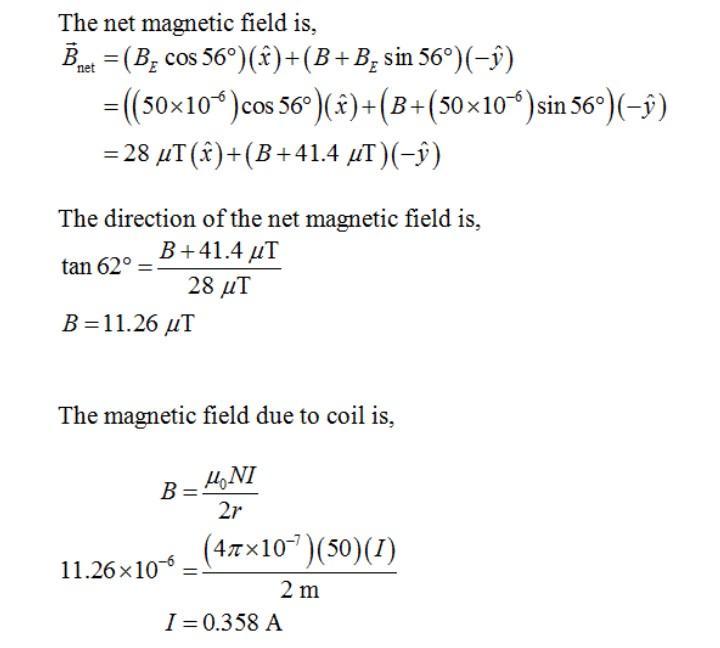
At the equator, the earth’s field is essentially horizontal; near the north pole, it is nearly vertical. In between, the angle v
Yanka [14]

Answer:

A current of 0.358A is required

Explanation:

Pls refer to attached document for more details

7 0
2 years ago
Other questions:
  • The force diagram represents a girl pulling a sled with a mass of 6.0 kg to the left with a force of 10.0 N at a 30.0 degree ang
    13·2 answers
  • Which statement best explains the relationship between the wavelengths and the frequencies of all the waves in the electromagnet
    12·1 answer
  • The potential energy of a pair of hydrogen atoms separated by a large distance x is given by u(x)=−c6/x6, where c6 is a positive
    7·2 answers
  • A system delivers 1275 j of heat while the surroundings perform 855 j of work on it. calculate ∆esys in j.
    8·1 answer
  • When Earth’s Northern Hemisphere is tilted toward the Sun during June, some would argue that the cause of our seasons is that th
    5·1 answer
  • A sleep time of 15.9 hours per day for a newborn baby is at the 10th percentile of the distribution of sleep times for all newbo
    13·1 answer
  • Two identical loudspeakers that are 5.00 m apart and face toward each other are driven in phase by the same oscillator at a freq
    11·1 answer
  • A spring stretches 0.018 m when a 2.8-kg object is suspendedfrom its end. How much mass should be attached to this spring sothat
    9·1 answer
  • A stiff wire bent into a semicircle of radius a is rotated with a frequency f in a uniform magnetic field, as suggested in Fig.
    13·1 answer
  • Consider a space shuttle which has a mass of about 1.0 x 10⁵ kg and circles the Earth at an altitude of about 200.0 km. Calculat
    10·1 answer
Add answer
Login
Not registered? Fast signup
Signup
Login Signup
Ask question!