answer.
Ask question
Login Signup
Ask question
All categories
  • English
  • Mathematics
  • Social Studies
  • Business
  • History
  • Health
  • Geography
  • Biology
  • Physics
  • Chemistry
  • Computers and Technology
  • Arts
  • World Languages
  • Spanish
  • French
  • German
  • Advanced Placement (AP)
  • SAT
  • Medicine
  • Law
  • Engineering
mash [69]
2 years ago
11

At the equator, the earth’s field is essentially horizontal; near the north pole, it is nearly vertical. In between, the angle v

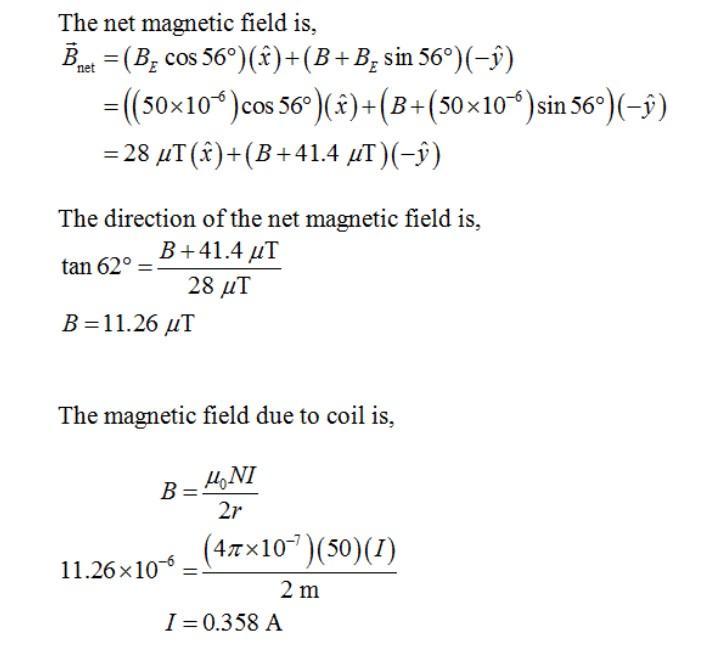
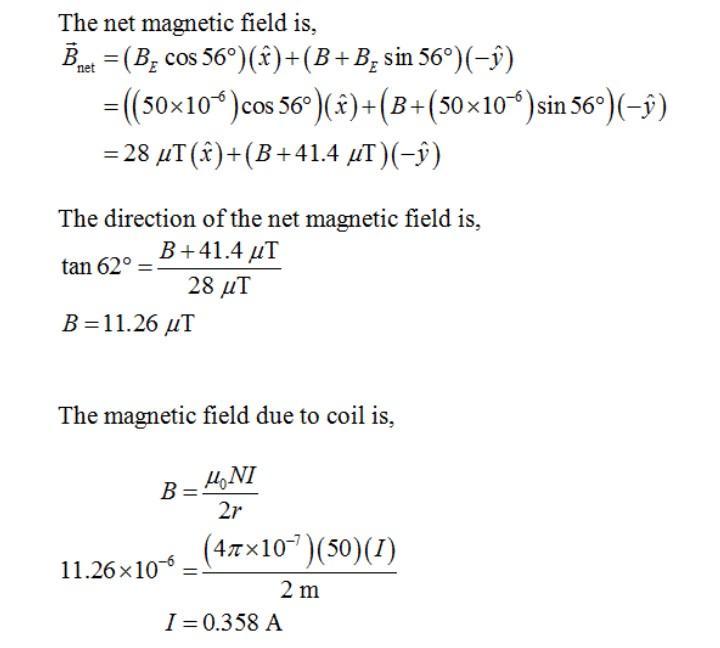
aries. As you move farther north, the dip angle, the angle of the earth’s field below horizontal, steadily increases. Green turtles seem to use this dip angle to determine their latitude. Suppose you are a researcher wanting to test this idea. You have gathered green turtle hatchlings from a beach where the magnetic field strength is 50 μT and the dip angle is 56∘. You then put the turtles in a 2.0 m diameter circular tank and monitor the direction in which they swim as you vary the magnetic field in the tank. You change the field by passing a current through a 50-turn horizontal coil wrapped around the tank. This creates a field that adds to that of the earth. What current should you pass through the coil, to produce a net field in the center of the tank that has a dip angle of 62∘ ?

Physics
1 answer:
Yanka [14]2 years ago
7 0

Answer:

A current of 0.358A is required

Explanation:

Pls refer to attached document for more details

You might be interested in
Consider the waveform expression. y (x, t) = ym sin (0.333x + 5.36 + 585t) The transverse displacement (y) of a wave is given as
Sonja [21]

Explanation:

The waveform expression is given by :

y(x,t)=y_m\ sin(0.333x+5.36+585t)...........(1)

Where

y is the position

t is the time in seconds

The general waveform equation is given by :

y(x,t)=y_m\ sin(kx+\phi+\omega t)..........(2)

Where

k=\dfrac{2\pi}{\lambda}

\omega=2\pi f

On comparing equation (1) and (2) we get :

0.333=\dfrac{2\pi}{\lambda}

\lambda=18.86\ m

585=2\pi f

f = 93.10 Hz

Time period, T=\dfrac{1}{f}

T=\dfrac{1}{0.010}

T = 0.010 s

Phase constant, \phi=5.36\ radian

Hence, this is the required solution.

8 0
2 years ago
If the humidity in a room of volume 450 m3 at 30 ∘C is 75%, what mass of water can still evaporate from an open pan?
Yuliya22 [10]
From tables,

SVP at 30°C = 4.24 kPa

From ideal gas expressions;
n = PV/RT = (4.24*1000*450)/(8.314*303) = 757.4 moles

Now, 75% of 757.4 moles will evaporate leaving 20%. Then, 25% of 757.5 moles...
25% of 757.4 moles = 25/100*757.4 = 189.35 moles
Mass of 189.35 moles = 189.35 moles*18 g/mol = 3408.3 g ≈ 3.4 kg
5 0
2 years ago
A simple generator has a square armature 6.0 cm on a side. The armature has 85 turns of 0.59-mm-diameter copper wire and rotates
FrozenT [24]

Answer:

f=15.5 Hz

Explanation:

Let's determine the internal resistance:

R=\frac{(p*L)}{A}

ρ = 1.68*10^-8 Ω m

L=0.060m*4*60 = 14.4m

A=\pi*r^2\\A= \pi*(5.9x10^-4m/2)^2=2.734*10^-7m^2

R=(1.68*10^-8)*(14.4m)/(2.734*10^-7m^2)= 0.884Ω

Since the bulb is rated at 12.0 V and 25.0 W,

Current

I=\frac{25W}{12.0v}=2.08 A

Therefore, voltage drop inside generator =

V=(2.08 A)*(0.88)=2.35v

Actual EMF required is

E_{mf}=12.0v+2.35v=14.35v

Note that this is an RMS value.  

The peak voltage is

v_{peak}=14.15v*\sqrt{2} =20.29v

For a generator, by Faraday's Law,

E_{(max)}=N*B*A*w

20.29v=(60)*(0.650T)*(0.06m)^2*ω

ω=144.5\frac{rad}{s}

f=ω/(2π)=

f=144.5 rad/s/(2π)

f=23.001 Hz

6 0
2 years ago
A wooden disk of mass m and radius r has a string of negligible mass is wrapped around it. If the disk is allowed to fall and th
Tju [1.3M]

Answer:

a = \frac{2}{3}g

T = \frac{mg}{3}

Explanation:

As the disc is unrolling from the thread then at any moment of the time

We have force equation as

mg - T = ma

also by torque equation we can say

TR = I\alpha

TR = \frac{1}{2}mR^2(\frac{a}{R})

T = \frac{1}{2}ma

Now we have

mg - \frac{1}{2}ma = ma

mg = \frac{3}{2}ma

a = \frac{2}{3}g

Also from above equation the tension force in the string is

T = \frac{1}{2}ma

T = \frac{mg}{3}

7 0
2 years ago
A star orbiting a black hole in a clockwise direction at a radial distance of 1.0 × 10⁶ km is acted upon by a counterclockwise f
snow_tiger [21]

Answer:

2.5 \times 10^{11} N-m upwards        

Explanation:

Torque is the vector cross product of the force and radial distance.

\tau = rF sin \theta

\tau = (1.0\times 10^6 \times 10^3) m \times 250 N\times sin 90^o \\\Rightarrow \tau= 2.5 \times 10^{11} N-m

The direction of the torque would be perpendicular to the direction of the force and radial distance. The direction of the force is counter-clockwise. The direction of the torque would be upwards.
4 0
2 years ago
Other questions:
  • A horse does 860 j of work in 420 seconds while pulling a wagon. what is the power output of the horse? round your answer to the
    12·2 answers
  • Which statement best explains the relationship between the wavelengths and the frequencies of all the waves in the electromagnet
    12·1 answer
  • Keisha finds instructions for a demonstration on gas laws. 1. Place a small marshmallow in a large plastic syringe. 2. Cap the s
    15·2 answers
  • Which of the following is NOT a good way to reduce fuel consumption?
    15·2 answers
  • Tech A says that tires are marked with a date code listing the date the tires should be discarded. Tech B says that any tires wi
    11·1 answer
  • A wave on a string is described by
    10·1 answer
  • Thermodynamic Properties: Two identical, sealed, and well-insulated jars contain different gases at the same temperature. Each c
    12·1 answer
  • A record player turntable initially rotating at 3313 rev/min is braked to a stop at a constant rotational acceleration. The turn
    12·1 answer
  • What is the direction of the magnetic field b⃗ net at point a? Recall that the currents in the two wires have equal magnitudes.
    5·1 answer
  • 2) A man squeezes a pin between his thumb and finger, as shown in Fig. 6.1.
    14·1 answer
Add answer
Login
Not registered? Fast signup
Signup
Login Signup
Ask question!
