answer.
Ask question
Login Signup
Ask question
All categories
  • English
  • Mathematics
  • Social Studies
  • Business
  • History
  • Health
  • Geography
  • Biology
  • Physics
  • Chemistry
  • Computers and Technology
  • Arts
  • World Languages
  • Spanish
  • French
  • German
  • Advanced Placement (AP)
  • SAT
  • Medicine
  • Law
  • Engineering
alukav5142 [94]
2 years ago
4

Compound j is optically active and has the molecular formula c6h10 and has a four carbon ring. on catalytic hydrogenation, j is

converted to k (c6h12) and k is optically inactive. propose structures for j and k. (draw a three-dimensional formula for each using dashes and wedges around chiral centers.) j (draw one of the enantiomers):

Chemistry
1 answer:
zheka24 [161]2 years ago
5 0
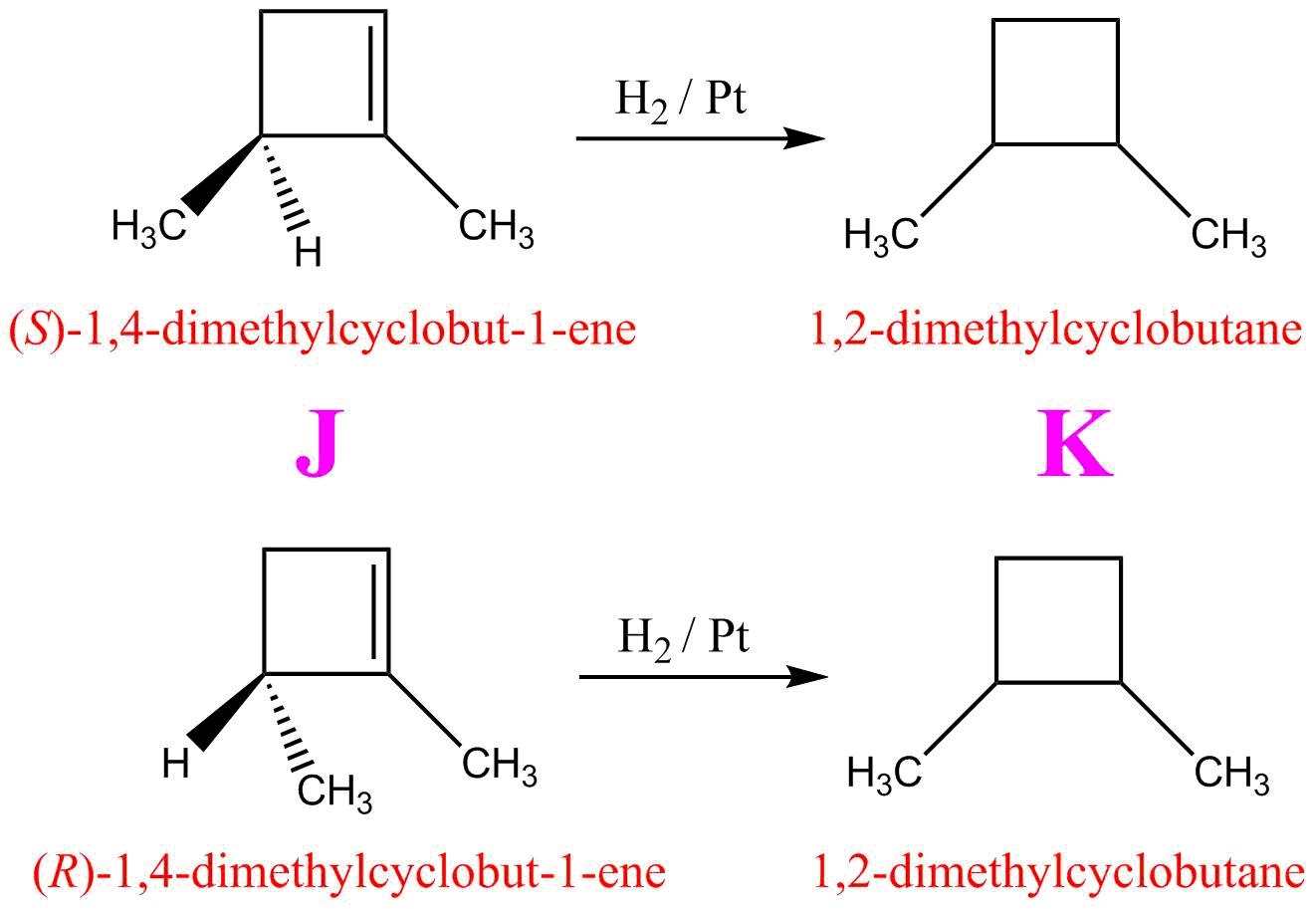
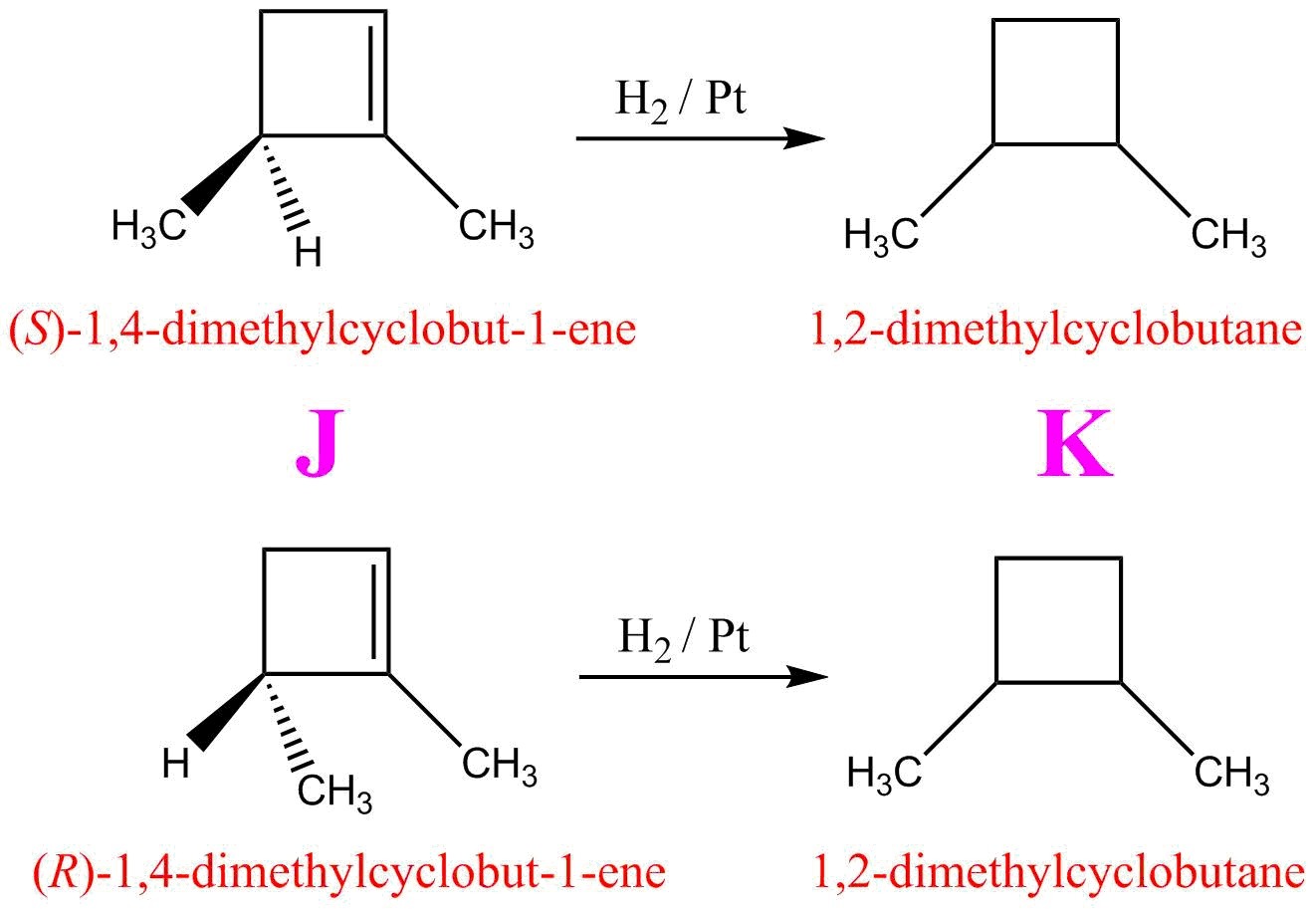
The two possible enantiomers for the starting material and the products are shown below,

Where;
               J  =  (S)-1,4-dimethylcyclobut-1-ene
Or,
               J  =  (R)-1,4-dimethylcyclobut-1-ene
And,
               K  =  1,2-dimethylcyclobutane

Both enantiomers have same molecular formula (C₆H₁₀) but different stereochemistry about chiral carbon.

Upon catalytic hydrogenation two hydrogen atoms are added across double bond resulting in the formation of cyclobutane. 

You might be interested in
To maximize the yield in a certain manufacturing process, a solution of a weak monoprotic acid that has a concentration between
stira [4]

Answer: C 115 ml

Explanation:

If you have a solution of a monoprotic acid, it means that it has the form HA (just one Hydrigen atom). Therefore, one molecule of acid is going to react with just one molecule of  NaOH.

So, if you have a solution of 100 ml of 0,2 HA acid, it is going to react with a 100 ml of 0,2 M NaOH solution. Beacause we know that the acid can be a little more concentrated than 0,2 M (0,2-0,3), it probably needs a little more than 100 ml of NaOH to react.  So, the answer is C.

in 100 ml of 0,2M acid you can find 0,002 mol of HA

in 100 ml of 0,3 M acid you can find 0,003 mol of HA

in 100 ml of 0,2 M NaOH you can find 0,002 mol of NaOH

the answer can not be 200 because in 200 ml of 0,2 M NaOH there are 0,004 mol of NaOH, which is more than 0,003 mol.
0 0
2 years ago
Consider the following data concerning the equation: H2O2 + 3I– + 2H+ → I3– + 2H2O [H2O2] [I–] [H+] rate I 0.100 M 5.00 × 10⁻⁴ M
otez555 [7]

Answer:

See explaination

Explanation:

Please kindly check attachment for the step by step solution of the given problem

4 0
2 years ago
The change in entropy, ΔS∘rxn , is related to the the change in the number of moles of gas molecules, Δngas . Determine the chan
kifflom [539]

Explanation:

Entropy of a reaction ΔS∘rxn is the degree of disoderliness in a system. Gases generally have a higher degree of disorder compared to liquids. Hence for the reaction 2H2(g)+O2(g) ⟶ 2H2O(l), the entropy decreases sice the reactants are in the gaseous state and the products is in the liquid state of matter

4 0
2 years ago
1.00-degree increase on the Celsius scale is equivalent to a 1.80-degree increase on the Fahrenheit scale. The temperature of a
castortr0y [4]
48.0°C×1.80 = 86.4°F
6 0
2 years ago
Nickel can be plated from aqueous solution according to the following half reaction. How long would it take (in min) to plate 29
andrey2020 [161]

Answer:

It take 3.5 *10² min

Explanation:

Step 1: Data given

Mass of the nickel = 29.6 grams

4.7A

Step 2: The balanced equation

Ni2+ (aq- +2e- → Ni(s)

Step 3: Calculate time

W = (ItA)/(n*F)

  ⇒ W = weight of plated metal in grams = 29.6

 ⇒ I = current in coulombs per second. = 4.7

 ⇒ t = time in seconds.

 ⇒ A = atomic weight of the metal in grams per mole. = 58.69

 ⇒ n = valence of dissolved metal in solution in equivalents per mole.  = 2

 ⇒ F = Faraday's constant in coulombs per equivalent. F = 96,485.309               coulombs/equivalent.

29.6 = (4.7 * t * 58.69)/(2*96485309)

t = 20707 seconds

t =345 minutes = 3.5 * 10² min

It take 3.5 *10² min

7 0
2 years ago
Other questions:
  • Determine whether each of the examples or phrases describes an essential amino acid, a nonessential amino acid, or both essentia
    10·2 answers
  • What is the frequency of UV light that has an energy of 2.39 x 10^-18 J?
    12·1 answer
  • In this scenario a battery is used to supply chemical potential energy. The potential energy is transformed and produces kinetic
    7·2 answers
  • Draw the alcohol needed to form isobutyl benzoate
    9·2 answers
  • Mendeleev placed thallium (Tl) in the same group as lithium (Li), sodium (Na), potassium (K), rubidium (Rb), and cesium (Cs). Ho
    11·1 answer
  • How many joules are required for melting 12.8g of ice at 0 degrees Celsius?
    8·1 answer
  • The following questions refer to the gas-phase decomposition of ethylene chloride. C2H5Cl ® products Experiment shows that the d
    12·1 answer
  • A glass cup of orange juice is found to have pOH of 11.40. Calculate the concentration of the hydrogen ions in the juice.​
    15·1 answer
  • How much energy is required to vaporize 1.5 KG of aluminum
    8·1 answer
  • If you weighed out 203 mg of the green chloro complex and dissolved it in 24.14 mL of acidic solvent, the molarity of your stock
    14·1 answer
Add answer
Login
Not registered? Fast signup
Signup
Login Signup
Ask question!
