answer.
Ask question
Login Signup
Ask question
All categories
  • English
  • Mathematics
  • Social Studies
  • Business
  • History
  • Health
  • Geography
  • Biology
  • Physics
  • Chemistry
  • Computers and Technology
  • Arts
  • World Languages
  • Spanish
  • French
  • German
  • Advanced Placement (AP)
  • SAT
  • Medicine
  • Law
  • Engineering
satela [25.4K]
2 years ago
11

Which of the following solutions will have the highest electrical conductivity?. A.0.065M Na3PO4. B.0.075M (NH4)2CO3. C.0.10M Li

Br. D.0.10M NaI. E.0.10M KF. Can someone please explain it to me.
Chemistry
1 answer:
Galina-37 [17]2 years ago
5 0

Answer: option A, 0.065 M Na₃PO₄


Explanation:


1) First, notice that the solutes of every solution are ionic compounds with a high dissociation constant.


2) Then, you can assume full dissociation.


3) Also, lacking other information, and since conductity is the measure of the motion of charges (ions in the case of electrolytes), you can assume that for those solutions is valid the statement that "in many cases, conductivity is linked directly to the total dissolved solids".


4) Then, calculate the number of ions dissolved in each case to conclude which is the highest one and, with that, predict which electrolyte will conduct more electricity. Assume 1 liter for all of them, and use


M = n / V ⇒ n = M × V ⇒ n = M × 1 liter


5) A.0.065M Na₃PO₄.


Na₃PO₄ → 3Na⁺ + PO₄³⁻


1 mol → 4 moles


0.065 mol → 4×0.065 moles = 0.26 moles


6) B.0.075M (NH₄)₂CO₃.


(NH₄)₂CO₃ → 2NH₄⁺ + CO₃²⁻


1 mol → 3 moles


0.075 mol → 3×0.075 mol = 0.225 mol


7) C.0.10M LiBr.


LiBr → Li⁺ + Br⁻


1 mol → 2 mol


0.10 mol → 2×0.10mol = 0.20 mol


8) D.0.10M NaI.


NaI → Na⁺ + I⁻


1 mol → 2 mol


0.10 mol → 2×0.10 mol = 0.20 mol


9) E.0.10M KF.


KF → K⁺ + F⁻


1 mol → 2 mol


0.10 mol → 2×0.10 mol = 0.20 mol


10) Therefore the solution with more ions is the 0.065 M Na₃PO₄, with 0.26 moles, and that is the predicted solution with the highest electrical conductivity.


You might be interested in
The side chain (r group) of the amino acid serine is ch2oh. The side chain of the amino acid leucine is ch2ch(ch3)2. Where would
wel

The answer is leucine would be in the interior, and serine would be on the exterior of the globular protein.

The side chain (R group) of the amino acid serine is CH₂OH. The side chain of the amino acid leucine is CH₂CH(CH₃)₂. In globular protein, leucine found in the interior, and serine found on the exterior. The nature of side chain decides the amino acid position in the globular protein , as CH₂CH(CH₃)₂ this is hydrophobic and CH₂OH is hydrophlic.

8 0
2 years ago
Imagine that a new polyatomic anion called "platoate" is invented. What would an acid of "platoate" be named?
o-na [289]
<h3>Answer:</h3>

                   Platoic Acid

<h3>Explanation:</h3>

                        While naming Carboxylic Acids we know that when the Carboxylic Acid looses proton it is converted into corresponding conjugate base called as Carboxylate.

Examples:

                        HCOOH           →           HCOO⁻  +  H⁺

                     Formic acid                     Formate Ion

                    H₃CCOOH           →           H₃CCOO⁻  +  H⁺

                     Acetic acid                       Acetate Ion

                    H₅C₂COOH           →           H₅C₂COO⁻  +  H⁺

                 Propanoic acid                       Propanoate Ion

Therefore, if the conjugate base is Platoate then the corresponding acid will be Platoic Acid means we will replace the -ate by -ic acid <em>i.e.</em>

                   RCOO⁻  +  H⁺        →            RCOOH

                   Platoate Ion                         Platoic Acid

8 0
2 years ago
Read 2 more answers
Convert 2.0 M of Phenobarbital sodium (MW: 254 g/mole) solution in water into % w/v and ratio strengths.
Travka [436]

Answer:

The concentration is 50,8 % w/v and radio strengths = 1,96.

Explanation:

Phenobarbital sodium is a medication that could treat insomnia, for example.

2,0 M of Phenobarbital sodium means 2 moles in 1L.

The concentration units in this case are %w/v that means 1g in 100 mL and ratio strengths that means  1g in <em>r</em> mL. Thus, 2 moles must be converted in grams with molar weight -254 g/mole- and liters to mililiters -1 L are 1000mL-. So:

2 moles × \frac{254 g}{1 mole}= 508 g of Phenobarbital sodium.

1 L ×\frac{1000 mL}{ 1 L} = 1000 mL of solution

Thus, % w/v is:

\frac{508 g}{1000 mL} × 100 = 50,8 % w/v

And radio strengths:

\frac{1000 mL}{508 g}  = 1,96. Thus, you have 1 g in 1,96 mL

I hope it helps!

5 0
2 years ago
Marie and Calvin dissolved 10 grams of KNO3 in 100 grams of water at 25oC. Next they added 5 grams more. Calvin told Marie that
PSYCHO15rus [73]
Hello!

Calvin told Marie that they could continue to add solute until the reached 40 grams because the solution was still unsaturated.

Unsaturated solutions are those in which the solvent (in this case water) can still dissolve more solute (in this case KNO₃) at the given pressure and temperature. This can be seen visually when adding more solute doesn't result in the presence of grains of solids that settle in the bottom of the flask. That happens because the rate of dissolving is higher than the rate of crystallization. 

Have a nice day!
8 0
2 years ago
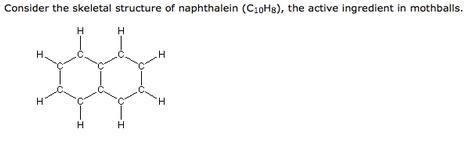
Consider the skeletal structure of naphthalein (C10H8), the active ingredient in mothballs. How many double bonds must be added
Greeley [361]

Answer:

four (4)

Explanation:

Naphthalein is an organic compound with formula C 10H 8. It is the simplest polycyclic aromatic hydrocarbon, and is a white crystalline solid with a characteristic odor that is detectable at concentrations as low as 0.08 ppm by mass. As an aromatic hydrocarbon, naphthalene's structure consists of a fused pair of benzene rings. It is best known as the main ingredient of traditional mothballs.

The molecule is planar, like benzene. Unlike benzene, the carbon–carbon bonds in naphthalene are not of the same length. The bonds C1−C2, C3−C4, C5−C6 and C7−C8 are about 1.37 Å (137 pm) in length, whereas the other carbon–carbon bonds are about 1.42 Å (142 pm) long. This difference, established by X-ray diffraction is consistent with the valence bond model in naphthalene and in particular, with the theorem of cross-conjugation. This theorem would describe naphthalene as an aromatic benzene unit bonded to a diene but not extensively conjugated to it (at least in the ground state), which is consistent with two of its three resonance structures.

Because of this resonance, the molecule has bilateral symmetry across the plane of the shared carbon pair, as well as across the plane that bisects bonds C2-C3 and C6-C7, and across the plane of the carbon atoms. Thus there are two sets of equivalent hydrogen atoms: the alpha positions, numbered 1, 4, 5, and 8, and the beta positions, 2, 3, 6, and 7. Two isomers are then possible for mono-substituted naphthalenes, corresponding to substitution at an alpha or beta position. Bicyclo[6.2.0]decapentaene is a structural isomer with a fused 4–8 ring system.

Therefore four (4) double bonds will be added to give each carbon atom an octet structure.

8 0
2 years ago
Other questions:
  • When 200 grams of water cools from 50.°C to 25°C, the total amount of heat energy released by the water is?
    7·1 answer
  • A hydrate of CoCl2 with a mass of 6.00 g is heated strongly. after cooling the mass the anhydrate is 3.27g
    14·2 answers
  • Five darts strike near the center of the target. Who ever threw the darks is?
    9·1 answer
  • You are asked to identify compound X (a white, crystalline solid), which was extracted from a plant seized by customs inspectors
    15·1 answer
  • 15. An apparatus consists of a 4.0 dm3
    14·2 answers
  • What type of ossification occurs to form an immovable joint
    15·1 answer
  • The pyruvate dehydrogenase complex catalyzes the oxidative decarboxylation of pyruvate to form acetyl‑CoA. E1 , E2 , and E3 are
    13·1 answer
  • For many purposes we can treat methane (CH) as an ideal gas at temperatures above its boiling point of - 161. °C. Suppose the te
    7·1 answer
  • a sample of mass 6.814grams is added to another sample weighing 0.08753 grams. the subsequent mixture is then divided into exact
    15·1 answer
  • A 25.0 mL sample of 0.25 M potassium carbonate (K2CO3) solution is added to 30.0 mL of a 0.40 M barium nitrate (Ba(NO3)2) soluti
    8·1 answer
Add answer
Login
Not registered? Fast signup
Signup
Login Signup
Ask question!