answer.
Ask question
Login Signup
Ask question
All categories
  • English
  • Mathematics
  • Social Studies
  • Business
  • History
  • Health
  • Geography
  • Biology
  • Physics
  • Chemistry
  • Computers and Technology
  • Arts
  • World Languages
  • Spanish
  • French
  • German
  • Advanced Placement (AP)
  • SAT
  • Medicine
  • Law
  • Engineering
Len [333]
2 years ago
5

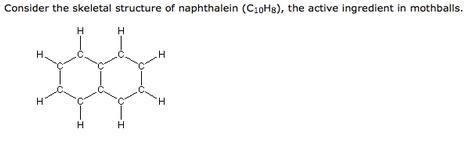
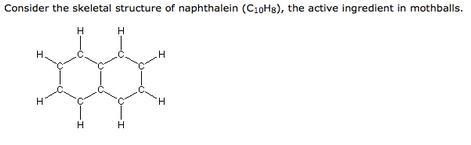
Consider the skeletal structure of naphthalein (C10H8), the active ingredient in mothballs. How many double bonds must be added

to give each carbon atom an octet?

Chemistry
1 answer:
Greeley [361]2 years ago
8 0

Answer:

four (4)

Explanation:

Naphthalein is an organic compound with formula C 10H 8. It is the simplest polycyclic aromatic hydrocarbon, and is a white crystalline solid with a characteristic odor that is detectable at concentrations as low as 0.08 ppm by mass. As an aromatic hydrocarbon, naphthalene's structure consists of a fused pair of benzene rings. It is best known as the main ingredient of traditional mothballs.

The molecule is planar, like benzene. Unlike benzene, the carbon–carbon bonds in naphthalene are not of the same length. The bonds C1−C2, C3−C4, C5−C6 and C7−C8 are about 1.37 Å (137 pm) in length, whereas the other carbon–carbon bonds are about 1.42 Å (142 pm) long. This difference, established by X-ray diffraction is consistent with the valence bond model in naphthalene and in particular, with the theorem of cross-conjugation. This theorem would describe naphthalene as an aromatic benzene unit bonded to a diene but not extensively conjugated to it (at least in the ground state), which is consistent with two of its three resonance structures.

Because of this resonance, the molecule has bilateral symmetry across the plane of the shared carbon pair, as well as across the plane that bisects bonds C2-C3 and C6-C7, and across the plane of the carbon atoms. Thus there are two sets of equivalent hydrogen atoms: the alpha positions, numbered 1, 4, 5, and 8, and the beta positions, 2, 3, 6, and 7. Two isomers are then possible for mono-substituted naphthalenes, corresponding to substitution at an alpha or beta position. Bicyclo[6.2.0]decapentaene is a structural isomer with a fused 4–8 ring system.

Therefore four (4) double bonds will be added to give each carbon atom an octet structure.
You might be interested in
The halogens, alkali metals, and alkaline earth metals have __________ valence electrons, respectively.
natima [27]
The valence electrons are as follows for these groups of elements:

Halogen- SEVEN  (halogens are group 7 elements that need one electron for the octet rule to be achieved)

Alkali Metals - ONE  (these are group one elements that lose a single electron to form an octet and cation)

Alkaline Earth Metals - TWO (group two elements that lose two electrons to form 2+ cations)

8 0
2 years ago
A student is given a sample of CuSO4(s) that contains a solid impurity that is soluble and colorless. The student wants to deter
DochEvi [55]

Answer:

The impurity which is present in the solution of copper sulphate (CuSO4) is determined by the an instrument known as spectrophotometer.

Explanation:

Spectrophotometer is a device or an instrument which is used to determine the concentration of a chemical by measuring the detection of light intensity that is coming from the solution. If the solution of copper sulphate is checked through spectrophotometer, we can can determined or measure the amount of copper sulphate and the impurity in the solution.

3 0
2 years ago
Which of the following statements is true about energy quantization at the atomic level? Electrons in the outermost orbits are t
MAVERICK [17]
<h2>Answer:</h2>

The correct answer is option C which is, "Electrons in the orbit closest to the nucleus have the least amount of energy".

<h3>Explanation:</h3>
  • There are different orbitals around the nucleus on which the electrons moves around the nucleus.
  • These orbitals have a specific energy, due to which they are known as energy levels.
  • The energy level near to the nucleus has least amount of the energy and the energy of the orbitals increase as the distance of the orbitals increase to the nucleus.
8 0
2 years ago
Functional groups create ____________ sites in molecules. The polar part of a molecule that can hydrogen bond to water is said b
zhenek [66]

Functional groups create reactive sites in molecules.

The polar part of a molecule that can hydrogen bond to water is said be hydrophilic.

Pi (π) bonds create active sites and will react with electron-deficient species.

A electronegative heteroatom like nitrogen, oxygen, or a halogen makes a carbon atom electrophilic.

(carbon will have less electronic density, which is attracted by the more electronegative heretoatoms, and it will tend to attract electron rich chemical species, and in this situation we say that the carbon atom is electrophilic).

The nonpolar part of a molecule that is not attracted to water is said to be hydrophobic.

A lone pair on a heteroatom makes it basic and nucleophilic.

(the heteroatom with the lone pair will tend to attract electron poor chemical species, and in this situation we say that the heteroatom is nucleophilic).

5 0
2 years ago
14. What is the pH of a 0.24 M solution of sodium propionate, NaC3H502, at 25°C? (For
Murrr4er [49]

Answer:

9.1

Explanation:

Step 1: Calculate the basic dissociation constant of propionate ion (Kb)

Sodium propionate is a strong electrolyte that dissociates according to the following equation.

NaC₃H₅O₂ ⇒ Na⁺ + C₃H₅O₂⁻

Propionate is the conjugate base of propionic acid according to the following equation.

C₃H₅O₂⁻ + H₂O ⇄ HC₃H₅O₂ + OH⁻

We can calculate Kb for propionate using the following expression.

Ka × Kb = Kw

Kb = Kw/Ka = 1.0 × 10⁻¹⁴/1.3 × 10⁻⁵ = 7.7 × 10⁻¹⁰

Step 2: Calculate the concentration of OH⁻

The concentration of the base (Cb) is 0.24 M. We can calculate [OH⁻] using the following expression.

[OH⁻] = √(Kb × Cb) = √(7.7 × 10⁻¹⁰ × 0.24) = 1.4 × 10⁻⁵ M

Step 3: Calculate the concentration of H⁺

We will use the following expression.

Kw = [H⁺] × [OH⁻]

[H⁺] = Kw/[OH⁻] = 1.0 × 10⁻¹⁴/1.4 × 10⁻⁵ = 7.1 × 10⁻¹⁰ M

Step 4: Calculate the pH of the solution

We will use the definition of pH.

pH = -log [H⁺] = -log 7.1 × 10⁻¹⁰ = 9.1

5 0
2 years ago
Other questions:
  • The ionization energy for a hydrogen atom is 1.31×10⁶ J/mol. What is the ionization energy for He+?
    5·2 answers
  • Solar energy travels to the Earth in many forms, such as ultraviolet radiation, infrared radiation, and visible rays. These vari
    9·1 answer
  • A sample of a certain material has a mass of 2.03 × 10⁻³ g. Calculate the volume of the sample, given that the density is 9.133
    12·2 answers
  • When uranium-235 atoms undergo fission, ________ is/are produced?
    11·1 answer
  • How many moles are there in 3.612 X 10^24 molecules of phosgene (COCL2)
    14·2 answers
  • The density of mercury is 13.6 g/cm3 . What volume (in quarts) is occupied by 100. g of Hg? (1 L = 1.06 qt)
    11·1 answer
  • A redox reaction employed in an electrochemical cell has a negative . Which statement is true? a) E∘cell is positive b) K&gt;1 E
    7·1 answer
  • Which is an issue that governments must consider before passing conservation policies? urbanization implications cost to impleme
    12·2 answers
  • The diagram below shows the different phase transitions that occur in matter. Three bars are shown labeled Solid, Liquid, and Ga
    11·2 answers
  • Suppose a metal will eject electrons from its surface when struck by yellow light. What will happen if the surface is struck wit
    12·1 answer
Add answer
Login
Not registered? Fast signup
Signup
Login Signup
Ask question!