answer.
Ask question
Login Signup
Ask question
All categories
  • English
  • Mathematics
  • Social Studies
  • Business
  • History
  • Health
  • Geography
  • Biology
  • Physics
  • Chemistry
  • Computers and Technology
  • Arts
  • World Languages
  • Spanish
  • French
  • German
  • Advanced Placement (AP)
  • SAT
  • Medicine
  • Law
  • Engineering
Alisiya [41]
2 years ago
7

14. What is the pH of a 0.24 M solution of sodium propionate, NaC3H502, at 25°C? (For

Chemistry
1 answer:
Murrr4er [49]2 years ago
5 0

Answer:

9.1

Explanation:

Step 1: Calculate the basic dissociation constant of propionate ion (Kb)

Sodium propionate is a strong electrolyte that dissociates according to the following equation.

NaC₃H₅O₂ ⇒ Na⁺ + C₃H₅O₂⁻

Propionate is the conjugate base of propionic acid according to the following equation.

C₃H₅O₂⁻ + H₂O ⇄ HC₃H₅O₂ + OH⁻

We can calculate Kb for propionate using the following expression.

Ka × Kb = Kw

Kb = Kw/Ka = 1.0 × 10⁻¹⁴/1.3 × 10⁻⁵ = 7.7 × 10⁻¹⁰

Step 2: Calculate the concentration of OH⁻

The concentration of the base (Cb) is 0.24 M. We can calculate [OH⁻] using the following expression.

[OH⁻] = √(Kb × Cb) = √(7.7 × 10⁻¹⁰ × 0.24) = 1.4 × 10⁻⁵ M

Step 3: Calculate the concentration of H⁺

We will use the following expression.

Kw = [H⁺] × [OH⁻]

[H⁺] = Kw/[OH⁻] = 1.0 × 10⁻¹⁴/1.4 × 10⁻⁵ = 7.1 × 10⁻¹⁰ M

Step 4: Calculate the pH of the solution

We will use the definition of pH.

pH = -log [H⁺] = -log 7.1 × 10⁻¹⁰ = 9.1

You might be interested in
Matt did an experiment to study the solubility of two substances. He poured 100 mL of water at 20 °C into each of two beakers la
Black_prince [1.1K]

Part 1 : Answer is only B substance is soluble in water.

In this experiment undissolved mass of each substance was measured. According to the given data, undissolved mass of substance B at 20 °C is 10 g while A is 50 g. Since, the initial added mass of each substance is 50 g, we can see that substance A is not soluble in water since the undissolved mass is 50 g.

Part 2 : Substance A is not soluble in water and substance B is soluble in water.

According to the given data, the undissolved mass of substance A remains as same as initial added mass, 50 g throughout the temperature range from 20 ° to 80 °C. Hence, we can conclude that substance A is not soluble in water.

But, according to the data, undissolved mass of substance B at 20 °C is 10 g. That means, 40 g of substance B was dissolved in water. When the temperature increases the undissolved mass of substance B decreases. Hence, we can conclude that substance B is soluble in water and solubility increases with temperature.


4 0
2 years ago
Read 2 more answers
An iron atom has a mass of ×9.2710−23g and a cooking pot has a mass of 0.500kg
morpeh [17]

The number of iron atoms in a cooking pot that has a mass of 0.500 kg can be solve by dividing it by the mass of the iron atom.

Number of iron atoms = ( 0.5 kg) (1000g / 1kg) ( 1 iron atom / 9.27 x 10^-23 g)

<span>Number of iron atoms = 5.39 x 10 ^24 iron atoms</span>

6 0
2 years ago
Read 2 more answers
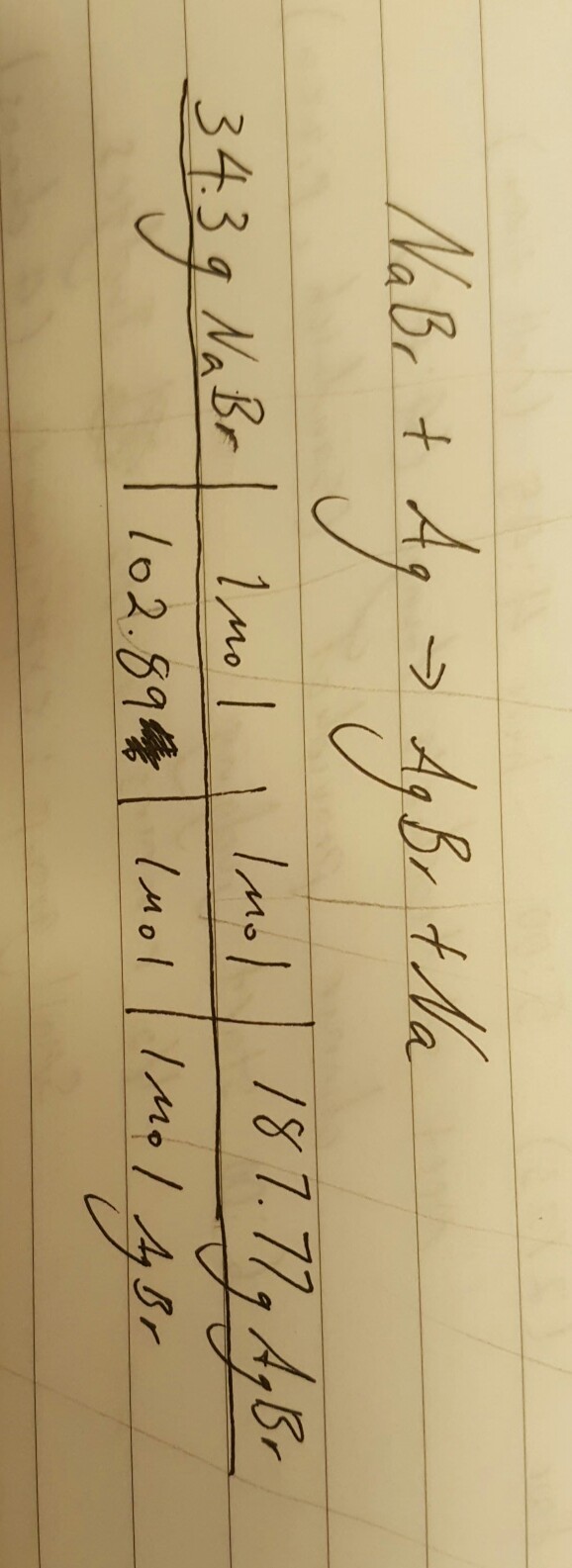
What mass of AgBr can be produced starting with 34.3G of NaBr? (Stoichiometry method)
olga nikolaevna [1]
The equation is already balanced so the mole ratio is just 1/1 and from the question you could conclude that the equation is a single displacement

5 0
2 years ago
A hydrogen filled balloon has a bolume of 8.3 L at 36 C and 751 torr. How many moles of hydrogen are inside the balloon?
alina1380 [7]

Answer:

0.33 mol

Explanation:

Given data:

Volume of balloon = 8.3 L

Temperature = 36°C

Pressure = 751 torr

Number of moles of hydrogen = ?

Solution:

Temperature = 36°C (27 +273 = 300 K)

Pressure = 751 torr (751/760= 0.988 atm)

Formula:

The given problem will be solve by using general gas equation,

PV = nRT

P= Pressure

V = volume

n = number of moles

R = general gas constant = 0.0821 atm.L/ mol.K  

T = temperature in kelvin

PV  = nRT

0.988 atm × 8.3 L  = n × 0.0821 atm.L/ mol.K  × 300 K

8.2 atm.L = n × 24.63 atm.L/ mol

n = 8.2 atm.L / 24.63 atm.L/ mol

n = 0.33 mol

8 0
2 years ago
How many molecules are in 79g of fe2o3
horrorfan [7]
Convert grams —> mols and then mols —> atoms

We know that there are 6.02 x 10^23 atoms/mol

And we know that there are about 160 grams of fe2o3 per mol

So (79g fe2o3)/(160 g/mol) = .49 mol fe2o3

Now we use avogadro’s number to do

(.49 mol fe2o3)/(6.02 x 10^23 atoms/mol) = the answer.

I’ll leave the easy math to you.
7 0
2 years ago
Other questions:
  • How many grams of Cl are in 38.0 g of each sample of chlorofluorocarbons (CFCs)?
    15·1 answer
  • What is the name of a hydrocarbon that has the formula CH3(CH2)4CCH?
    11·1 answer
  • An air bubble with a volume of 5.0 mL is released at the bottom of a lake where the pressure is 3.0 atm. When it reaches the sur
    15·2 answers
  • Why are weight and mass used synonymously on Earth?
    6·2 answers
  • Consider the reaction: 2clf3(g) + 2nh3(g) → n2(g) + 6hf(g) + cl2(g) when calculating the δh°rxn, why is the δhf° for n2 not impo
    9·1 answer
  • Draw the alcohol needed to form isobutyl benzoate
    9·2 answers
  • The table shows the amount of radioactive element remaining in a sample over a period of time.
    5·1 answer
  • Explain the observed pattern of how the sizes and charges of atoms change with the addition and subtraction of electrons. ( NEED
    10·1 answer
  • 3. Scott and James work at a grocery store. After the grocery store closed, they were playing a game with a shopping cart and Sc
    6·1 answer
  • PLEASE HELP! WILL DO BRAINLIEST! What do scientists call all of the compounds that contain carbon and are found in living things
    7·2 answers
Add answer
Login
Not registered? Fast signup
Signup
Login Signup
Ask question!