answer.
Ask question
Login Signup
Ask question
All categories
  • English
  • Mathematics
  • Social Studies
  • Business
  • History
  • Health
  • Geography
  • Biology
  • Physics
  • Chemistry
  • Computers and Technology
  • Arts
  • World Languages
  • Spanish
  • French
  • German
  • Advanced Placement (AP)
  • SAT
  • Medicine
  • Law
  • Engineering
Amiraneli [1.4K]
2 years ago
4

Consider the decomposition of no2. 2no2(g) → 2no(g) + o2(g) at 650 k, the rate constant is 1.66 sec-1. at 700k, the constant is

7.39 sec-1. calculate the activation energy.
Chemistry
1 answer:
JulsSmile [24]2 years ago
5 0

Activation energy can be calculated using the formula:

ln\frac{K_{1}}{K_{2}}=\frac{E_{a}}{8.314}[\frac{1}{T_{2}}-\frac{1}{T_{1}}]  

At T₁=650 K, the rate constant, K₁ = 1.66 sec-1.  

At T₂=700 K, the constant, K₂ =7.39 sec-1.

Putting the values in the above equation,

ln\frac{1.66}{7.39}=\frac{E_{a}}{8.314}[\frac{1}{700}-\frac{1}{650}]  

Eₐ=1.12 ×10⁵ J mol⁻¹

or

Eₐ=112 KJ mol⁻¹

You might be interested in
A 1.87 L aqueous solution of KOH contains 155 g of KOH . The solution has a density of 1.29 g/mL . Calculate the molarity ( M ),
lbvjy [14]

Answer:

[KOH] = 1.47 M

[KOH] = 1.22 m

KOH = 6.86 % m/m

Explanation:

Let's analyse the data

1.87 L is the volume of solution

Density is 1.29 g/mL → Solution density

155 g of KOH → Mass of solute

Moles of solute is (mass / molar mass) = 2.76 moles.

Molarity is mol/L → 2.76 mol / 1.87 L = 1.47 M

Let's determine, the mass of solvent.

Molality is mol of solute / 1kg of solvent

We can use density to find out the mass of solution

Mass of solution - Mass of solute = Mass of solvent

Density = Mass / volume

1.29 g/mL = Mass / 1870 mL

Notice, we had to convert L to mL, cause the units of density.

1.29 g/mL . 1870 mL = Mass → 2412.3 g

2412.3 g - 155 g = 2257.3 g of solvent

Let's convert the mass of solvent to kg

2257.3 g / 1000 = 2.25kg

2.76 mol / 2.25kg = 1.22 m (molality)

% percent by mass = mass of solute in 100g of solution.

(155 g / 2257.3 g) . 100g = 6.86 % m/m

5 0
2 years ago
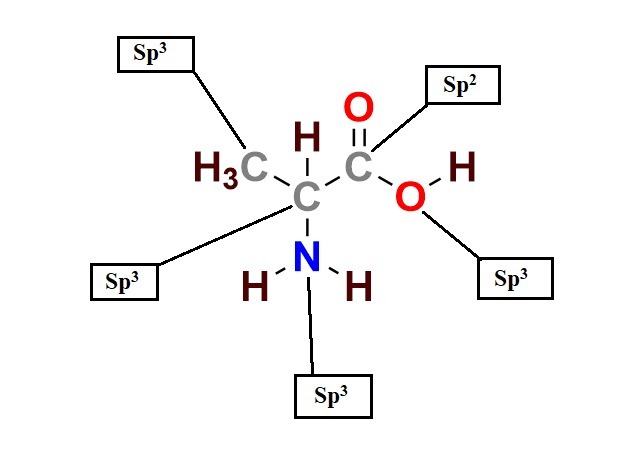
Consider the structure of the amino acid alanine. indicate the hybridization about each interior atom.
OLEGan [10]
The structure of Alanine is shown below,
Except the carbon atom of carbonyl group which is Sp² Hybridized, all remaining atoms are Sp³ Hybridized. The hybridization of each element is depicted in a box below,

5 0
2 years ago
Read 2 more answers
The concentration of ozone in a sample of air that has a partial pressure of O3 of 0.33 torr and a total pressure of air of 695
Goryan [66]

Answer:

0.047 %

Explanation:

Step 1: Given data

  • Partial pressure of ozone (pO₃): 0.33 torr
  • Total pressure of air (P): 695 torr

Step 2: Calculate the %v/v of ozone in the air

Air is a mixture of gases. We can find the %v/v of ozone (a component) in the air (mixture) using the following expression.

<em>%v/v = pO₃/P × 100%</em>

%v/v = 0.33 torr/695 torr × 100%

%v/v = 0.047 %

8 0
2 years ago
Which of the following statements concerning hydrocarbons is/are correct?
Alona [7]

Answer:

1.  Saturated hydrocarbons may be cyclic or acyclic molecules.

2.  An unsaturated hydrocarbon molecule contains at least one double bond.

Explanation:

Hello,

In this case, hydrocarbons are defined as the simplest organic compounds containing both carbon and hydrogen only, for that reason we can immediately discard the third statement as ethylenediamine is classified as an amine (organic chain containing NH groups).

Next, as saturated hydrocarbons only show single carbon-to-carbon bonds and carbon-to-hydrogen bonds, they may be cyclic (ring-like-shaped) or acyclic (not forming rings), so first statement is true

Finally, since we can find saturated hydrocarbons which have single carbon-to-carbon and carbon-to-hydrogen bonds only and unsaturated hydrocarbons which could have double or triple bonds between carbons and carbon-to-hydrogen bonds, the presence of at least one double bond makes the hydrocarbon unsaturated.

Therefore, first and second statements are correct.

Best regards.

6 0
2 years ago
3. In what grade level do students grow the quickest?
Vadim26 [7]

Answer:

Independent Variable: Grade Level

Dependent Variable: Growth in height

Hypothesis: Students in [Insert the grade level you believe will grow the quickest here] will experience the quickest growth in height.

Explanation:

Independent variables are the factors in which you manipulate to gain your results, in this case you would be changing the grade level you would observe to see the height.

Dependent variables are the factors that respond to changes in the independent variables. You don't control these events, you simply observe them. In this case, you merely observe the growth in height in accordance to the different grade levels you observe.

For the hypothesis, you would create your own hypothesis based on a guess you have. You create a hypothesis not based on the data, but on what you believe will be correct before doing the experiment. It doesn't have to be the correct answer, but just your thoughts.

3 0
2 years ago
Other questions:
  • A sample of a gas occupies a volume of 752 ml at 25°c. what volume will the gas occupies if the temperature increases to 50°c, i
    5·1 answer
  • How much heat is required to increase the temperature of 100.0 grams of iron from 15.0oC to 40.2oC? (The specific heat of iron i
    10·2 answers
  • What mass of lif is contained in 18.66 g of a 20.0% by mass solution of lif in water?
    10·1 answer
  • How does the equilibrium change to counter the removal of A in this reaction? A + B ⇌ AB
    5·2 answers
  • Which statement about the spectrophotometric analysis of Red 40 dye is TRUE?
    8·1 answer
  • In the following list, only ________ is not an example of a chemical reaction. the production of hydrogen gas from water the tar
    11·1 answer
  • Classify each of these soluble solutes as a strong electrolyte, a weak electrolyte, or a nonelectrolyte. Solutes Formula Hydroch
    5·2 answers
  • Which statement accurately compares ionic and covalent bonding?
    8·2 answers
  • Latent heat of vaporization is used to (1 Point) (a) overcome the forces of attraction between molecules in solid-state. (b) inc
    12·1 answer
  • Aspirin synthesis involves the addition of an acetyl group to salicylic acid in a condensation reaction with an alcohol. The ace
    8·1 answer
Add answer
Login
Not registered? Fast signup
Signup
Login Signup
Ask question!