answer.
Ask question
Login Signup
Ask question
All categories
  • English
  • Mathematics
  • Social Studies
  • Business
  • History
  • Health
  • Geography
  • Biology
  • Physics
  • Chemistry
  • Computers and Technology
  • Arts
  • World Languages
  • Spanish
  • French
  • German
  • Advanced Placement (AP)
  • SAT
  • Medicine
  • Law
  • Engineering
Keith_Richards [23]
2 years ago
7

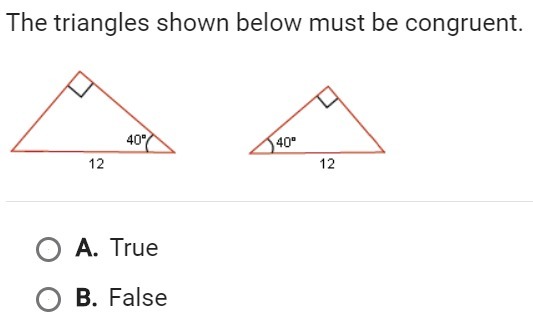
The triangles shown below must be congruent.

Mathematics
2 answers:
n200080 [17]2 years ago
8 0

true by the angle side angle theorem

Alik [6]2 years ago
3 0

Answer:

Option A is correct.

Yes, it is true that the triangles shown are congruent.

Step-by-step explanation:

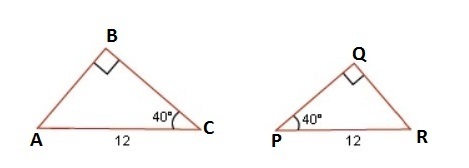
Labelled the diagram as shown below in the attachment:

In triangle ABC and triangle PQR

\angle ABC \cong \angle PQR = 90^{\circ}  [Angle]  

\angle ACB \cong \angle QPR = 40^{\circ}   [Angle]

AC \cong PR = 12 units   [Side]

AAS(Angle-Angle-Side) postulates states that the two angles and the non- included side of one triangle are congruent to the two angles and the non-included side of the other triangle., then the triangles are congruent.

Then, by AAS

\triangle ABC \cong \triangle PQR

Therefore, the given triangles shown must be congruent.


You might be interested in
Doug has a bag full of crayons. There are 6 red crayons, 7 blue ones, and 4 green crayons. Doug wants to color a blue sky. What
larisa86 [58]

Answer:

Blue 7/17 = Nearly 0.41

Red 6/17= Nearly 0.35

4/17= Nearly 0.23

Step-by-step explanation:

The Probability is 13/17 if im wrong then sorry i havent done this in a while

8 0
2 years ago
jack puts 1/3 pound of birdseed into his feeder every time he fills it. how many can jack fill his bird feeder with 4 pounds of
Flura [38]

Answer: Jack can fill his feeder 12 times with 4 pounds of birdseed.

Step-by-step explanation:

You need to analize the information given in the exercise, You know that every time Jack fills the feeder, he put \frac{1}{3} pounds into it.

Then, in order to solve this exercise, let "x" represents the number of times that Jack can fill his  feeder with 4 pounds of birdseed.

Keeping on mind the data provided in the exercise, you can set up de following proportion:

\frac{1}{\frac{1}{3}} = \frac{x}{4}

Finally, you must solve for "x" in order to find its value.

You get that this  is:

3= \frac{x}{4}\\\\(3)(4)=x\\\\x=12

Therefore, you can conclude that Jack can fill his feeder 12 times with 4 pounds of birdseed.

4 0
2 years ago
A segment has endpoints A (-1, 1) and B (8, 4) . If the segment is divided into four equal parts, the coordinates of the point c
riadik2000 [5.3K]

Line is divided into 4 equal parts.

we have to find a point which is closest to point A.

So that means required point P(x,y) is at 1 unit away from A(-1,1) and 3 unit away from B(8,4)

Now we just need to use section formula to get the coordinate of required point using m1=1 and m2=3

\left ( \frac{m_1x_2+m_2x_1}{m_1+m_2}  , \frac{m_1y_2+m_2y_1}{m_1+m_2} \right )

= \left ( \frac{1*8+3*(-1)}{1+3}  , \frac{1*4+3*1}{1+3} \right )

= \left ( \frac{8-3}{4}  , \frac{4+3}{4} \right )

= \left ( \frac{5}{4}  , \frac{7}{4} \right )

So the final answer is \left ( \frac{5}{4}  , \frac{7}{4} \right ).

6 0
2 years ago
Read 2 more answers
Rip van Winkle fell asleep for a very long time. When he fell asleep, his beard was 8 millimeters long, and each passing week it
S_A_V [24]

Answer:

L(w) = 8 mm + (2 mm/wk)(wk)

Step-by-step explanation:

L(w) = length of beard as a function of time in weeks

L(w) = 8 mm + (2 mm/wk)(wk)

7 0
2 years ago
Read 2 more answers
A has the coordinates (–4, 3) and B has the coordinates (4, 4). If DO,1/2(x, y) is a dilation of △ABC, what is true about the im
fomenos
A dilation is a transformation D_{o,k}(x,y), with center O and a scale factor of k that is not zero, that maps O to itself and any other point P to P'. The center O is a fixed point, P' is the image of P, points O, P and P' are on the same line.

In a dilation of D_{o, \frac{1}{2} }(x,y), the scale factor, \frac{1}{2} is mapping the original figure to the image in such a way that the distances from O to the vertices of the image are half the distances from O to the original figure. Also the size of the image is half the size of the original figure.

Therefore, <span>If D_{o, \frac{1}{2} }(x,y) is a dilation of △ABC, the truth about the image △A'B'C'</span> are:

<span>AB is parallel to A'B'.

D_{o, \frac{1}{2} }(x,y)=( \frac{1}{2}x,  \frac{1}{2}y)

The distance from A' to the origin is half the distance from A to the origin.</span>
3 0
2 years ago
Read 2 more answers
Other questions:
  • A percent decrease can never be more than 50 percent.is this:truefalse
    14·1 answer
  • Which inequality represents this situation?
    13·2 answers
  • chris can run at a constant speed of 12 km/h. How ling will it take him to run from his home to the park, a distance of 0.8 km?
    13·2 answers
  • 1. Find the exponential model of best fit for the points (−3,5),(1,12),(5,72),(7,137). Explain how you got your answer. Round va
    11·1 answer
  • 6x^2-2.4=0<br><br> show all answers<br><br> I need the answer desperatly
    11·1 answer
  • At present the sum of Monica's age and daughter's age is 44 years. . After 2 years Monica's age will be three times that if her
    6·2 answers
  • Which statements are true regarding triangle LMN? Check all that apply.
    12·2 answers
  • An electrical engineer has on hand two boxes of resistors, with five resistors in each box. The resistors in the first box are l
    15·1 answer
  • Determine which equations have the same solution set as StartFraction 2 Over 3 EndFraction minus x plus StartFraction 1 Over 6 E
    9·2 answers
  • Apolline is mowing lawns for a summer job. For every mowing job, she charges an initial fee plus a constant fee for each hour of
    11·1 answer
Add answer
Login
Not registered? Fast signup
Signup
Login Signup
Ask question!