answer.
Ask question
Login Signup
Ask question
All categories
  • English
  • Mathematics
  • Social Studies
  • Business
  • History
  • Health
  • Geography
  • Biology
  • Physics
  • Chemistry
  • Computers and Technology
  • Arts
  • World Languages
  • Spanish
  • French
  • German
  • Advanced Placement (AP)
  • SAT
  • Medicine
  • Law
  • Engineering
makvit [3.9K]
2 years ago
4

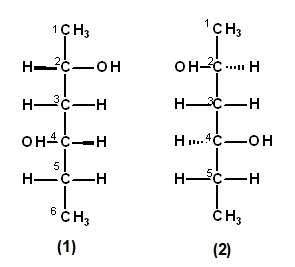
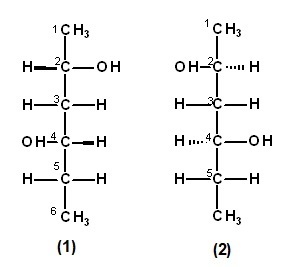
What are the stereochemical configurations of the two diastereomers of (2s,4s)-2,4-hexanediol?

Chemistry
1 answer:
sergeinik [125]2 years ago
6 0

The diastereomerism is the -cis, -trans configuration of molecule.

The R-, S- nomenclature is used to define the aerial position of the functional groups present in a chiral center (the -C molecule at which the four functional groups present around are different) of a molecule. In 2, 4- hexanediol there are two chiral center where the alcohol groups (-OH) are present.

Now the rotation of the stereo centers are analysed by the priority of the functional group. In 2, 4-hexanediol at 2, 4 position the four substituents are -OH, -H, -CH₃ and -C₄H₉O. The priority of the oxygen atom is always to be taken as 1st then -C₄H₉O.

The priority of the group can be shown as -OH > -C₄H₉O > -CH₃ > -H. Thus the rotation will be from -OH to -H which is clockwise. The clockwise rotation is designated as -R configuration but if the -H atom is placed at the horizontal position as present in the figure the configuration will be -S.

Thus the two possible diastereomers of the compound is shown in the figure.  

You might be interested in
The electron in a ground-state H atom absorbs a photon of wavelength 97.20 nm. To what energy level does it move?
Lunna [17]

Answer:

E = h v = 6.626 x 10^{-34} x 97.20 x 10^{-9} = 6.44 x 10^{-41} J = 4.01 x 10^{-22} eV

n = Energy Level = -E^{0} / E = -13.6 / 4.01 x 10^{-22} = 3.39 x 10^{22} = 1.84 x 10^{11} energy level...

7 0
2 years ago
A diamond can make permanent marks on glass. It can also cut glass. Most other materſals cannot do this.Which property of a diam
Kaylis [27]
Probably a. hardness
7 0
2 years ago
A gas is heated from 263.0 K to 298.0 K and the volume is increased from 24.0 liters to 35.0 liters by moving a large piston wit
Triss [41]

Answer:

The final pressure is approximately 0.78 atm

Explanation:

The original temperature of the gas, T₁ = 263.0 K

The final temperature of the gas, T₂ = 298.0 K

The original volume of the gas, V₁ = 24.0 liters

The final volume of the gas, V₂ = 35.0 liters

The original pressure of the gas, P₁ = 1.00 atm

Let P₂ represent the final pressure, we get;

\dfrac{P_1 \cdot V_1}{T_1} = \dfrac{P_2 \cdot V_2}{T_2}

P_2 = \dfrac{P_1 \cdot V_1 \cdot T_2}{T_1 \cdot V_2}

P_2 = \dfrac{1 \times 24.0 \times 298}{263.0 \times  35.0} = 0.776969038566

∴ The final pressure P₂ ≈ 0.78 atm.

4 0
2 years ago
Complete ionic equation K2CO3(aq)+2CuF(aq) → Cu2CO3(s)+2KF(aq) Examine each of the chemical species involved to determine the io
Fudgin [204]

Answer:

2K+(aq) + CO3²¯(aq) + Ca^2+(aq) + 2F¯(aq) —› Cu2CO3(s) + 2K+(aq) + 2F¯(aq)

Explanation:

K2CO3(aq) + 2CuF(aq) → Cu2CO3(s) + 2KF(aq)

The complete ionic equation for the above equation can be written as follow:

In solution, K2CO3 and CuF will dissociate as follow:

K2CO3(aq) —› 2K+(aq) + CO3²¯(aq)

CuF(aq) —› Ca^2+(aq) + 2F¯(aq)

Thus, we can write the complete ionic equation for the reaction as shown below:

K2CO3(aq) + 2CuF(aq) —›

2K+(aq) + CO3²¯(aq) + Ca^2+(aq) + 2F¯(aq) —› Cu2CO3(s) + 2K+(aq) + 2F¯(aq)

8 0
2 years ago
the hydrogen gas generated when calcium metal reacts with water is collected over water at 20 degrees C. The volume of the gas i
Gala2k [10]

Answer:

There is 0.0677 grams of H2 gas obtained

Explanation:

Step 1: Data given

The total pressure (988 mmHg) is the sum of the pressure of the collected hydrogen + the vapor pressure of water (17.54 mmHg).  

ptotal = p(H2)+ p(H2O)

p(H2) = ptotal - pH2O = 988 mmHg - 17.54 mmHg = 970.46 mmHg

Step 2: Calculate moles of H2 gas

Use the ideal gas law to calculate the moles of H2 gas

PV = nRT

n = PV / RT

 ⇒ with p = pressure of H2 in atm = 970.46 mmHg * (1 atm /760 mmHg) = 1.277 atm

⇒ V = volume of H2 in L = 641 mL x (1 L / 1000 mL) = 0.641 L

⇒ n = the number of moles of H2 = TO BE DETERMINED

⇒ R = the gas constant = 0.08206 L*atm/K*mol

⇒ T = the temperature = 20.0 °C = 293.15 Kelvin

n = (1.277)(0.641) / (0.08206)(298.15) = 0.0335 moles H2

Step 3: Calculate mass of H2

Mass of H2 = moles H2 ¨molar H2

0.0335 moles H2 * 2.02 g/mol H2  = 0.0677g H2

There is 0.0677 grams of H2 gas obtained
7 0
2 years ago
Other questions:
  • In the adjoining figure, the circles with the + sign represent protons and the empty circles represent neutrons. Determine which
    6·2 answers
  • Radioactive isotopes are used as contrast dyes to study soft tissues such as the gastrointestinal tract. The radiocontrast dyes
    7·2 answers
  • 1.00-degree increase on the Celsius scale is equivalent to a 1.80-degree increase on the Fahrenheit scale. The temperature of a
    13·1 answer
  • 50 POINTSSSSS PLZ HELPPPPPP NEED TO SHOW WORK!!!!
    5·1 answer
  • Which is most likely true about electronegativity?
    12·1 answer
  • The Lewis structures of four compounds are given. In the first molecule sufur is the central atom. There are two oxygen atoms bo
    11·1 answer
  • The mole fraction of oxygen molecules in dry air is 0.2095. What volume of dry air at 1.00 atm and 25°C is required for burning
    9·1 answer
  • imagine you have four food dyes to test A, B, C and D imagine that you are going to investigate which food dye diffuses more qui
    7·1 answer
  • Montrel takes a trip to Central America during the winter. He finds out that the temperature in Central America is about the sam
    5·1 answer
  • How many grams are in 2.0 x 10⁻⁵ moles of uranium?
    14·1 answer
Add answer
Login
Not registered? Fast signup
Signup
Login Signup
Ask question!