answer.
Ask question
Login Signup
Ask question
All categories
  • English
  • Mathematics
  • Social Studies
  • Business
  • History
  • Health
  • Geography
  • Biology
  • Physics
  • Chemistry
  • Computers and Technology
  • Arts
  • World Languages
  • Spanish
  • French
  • German
  • Advanced Placement (AP)
  • SAT
  • Medicine
  • Law
  • Engineering
kenny6666 [7]
2 years ago
7

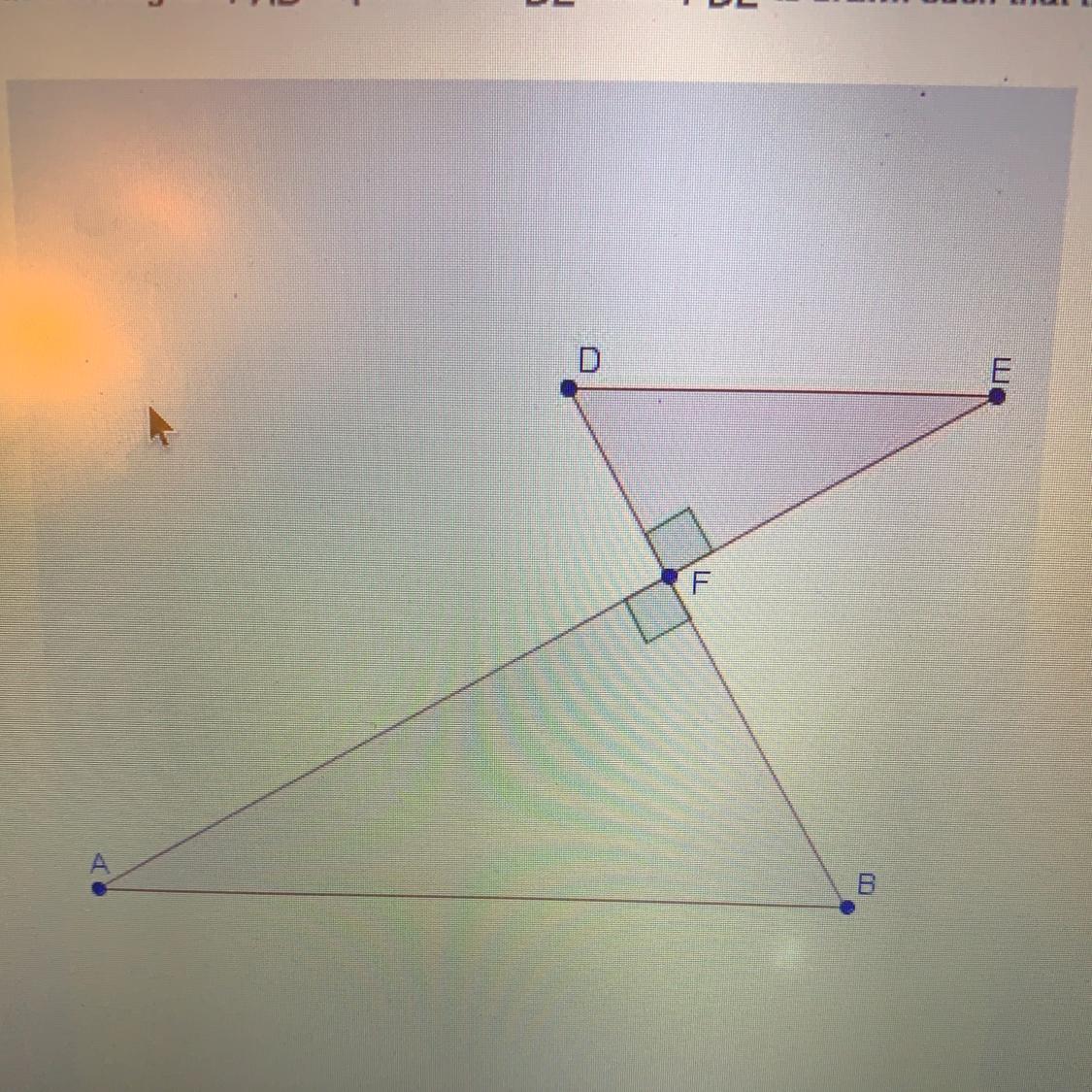
In the diagram, AB is parallel to DE. Also, DE is drawn such that the length of DE is half the length of AB. If sin A = 0.5, the

n what is sin E?
A) 2
B) 1
C) 0.5
D) 0.25
E) 0.1

Random answers will be reported!

Mathematics
2 answers:
Jlenok [28]2 years ago
4 0

Answer:

Option C. 0.5

Step-by-step explanation:

In the given diagram, AB is parallel to DE, and line AE is the transverse.

So ∠DEF ≅ ∠FAB [ Alternate angles ]

and ∠EFD ≅ AFB ≅ 90° [ Vertically opposite angles ]

So, Third angle of the triangles will also be equal.

Since angles DEF and FAB are equal so their sine values will also be equal.

Therefore, sinA = sinE = 0.5

Option C). 0.5 will be the answer.

Anika [276]2 years ago
3 0

I believe it is C, there is a geometric law that states that the opposite angles across a line with both going into parallel lines will be the same angle. Rather confusing but a video online would likely explain it better than anyone could here.

You might be interested in
Use rounding to estimate the product of 5,555 and 4,444 round both numbers to the nearest thousand to find answer
Dimas [21]

Step-by-step explanation:

Given that the first number is

5,555 and

the second number is 4,444

the product of 5,555 and4,444= 24686420

to the nearest thousand 5,555= 6000

to the nearest thousand 4,444= 5000

Therefore the product of 6000 and 5000 is

=6000x5000

=30000000

4 0
2 years ago
Find the coefficient of variation for each of the two sets of data, then compare the variation. Round results to one decimal pla
svp [43]

Here is  the correct computation of the question given.

Find the coefficient of variation for each of the two sets of data, then compare the variation. Round results to one decimal place. Listed below are the systolic blood pressures (in mm Hg) for a sample of men aged 20-29 and for a sample of men aged 60-69.

Men aged 20-29:      117      122     129      118     131      123

Men aged 60-69:      130     153      141      125    164     139

Group of answer choices

a)

Men aged 20-29: 4.8%

Men aged 60-69: 10.6%

There is substantially more variation in blood pressures of the men aged 60-69.

b)

Men aged 20-29: 4.4%

Men aged 60-69: 8.3%

There is substantially more variation in blood pressures of the men aged 60-69.

c)

Men aged 20-29: 4.6%

Men aged 60-69: 10.2 %

There is substantially more variation in blood pressures of the men aged 60-69.

d)

Men aged 20-29: 7.6%

Men aged 60-69: 4.7%

There is more variation in blood pressures of the men aged 20-29.

Answer:

(c)

Men aged 20-29: 4.6%

Men aged 60-69: 10.2 %

There is substantially more variation in blood pressures of the men aged 60-69.

Step-by-step explanation:

From the given question:

The coefficient of variation can be determined by the relation:

coefficient \ of  \ variation = \dfrac{standard \ deviation}{mean}*100

We will need to determine the coefficient of variation both men age 20 - 29 and men age 60 -69

To start with;

The coefficient of men age 20 -29

Let's first find the mean and standard deviation before we can do that ;

SO .

Mean = \dfrac{\sum \limits^{n}_{i-1}x_i}{n}

Mean = \frac{117+122+129+118+131+123}{6}

Mean = \dfrac{740}{6}

Mean = 123.33

Standard deviation  = \sqrt{\dfrac{\sum (x_i- \bar x)^2}{(n-1)} }

Standard deviation =\sqrt{\dfrac{(117-123.33)^2+(122-123.33)^2+...+(123-123.33)^2}{(6-1)} }

Standard deviation  = \sqrt{\dfrac{161.3334}{5}}

Standard deviation = \sqrt{32.2667}

Standard deviation = 5.68

The coefficient \ of  \ variation = \dfrac{standard \ deviation}{mean}*100

coefficient \ of  \ variation = \dfrac{5.68}{123.33}*100

Coefficient of variation = 4.6% for men age 20 -29

For men age 60-69 now;

Mean = \dfrac{\sum \limits^{n}_{i-1}x_i}{n}

Mean = \frac{   130 +    153    +  141  +    125 +   164  +   139}{6}

Mean = \dfrac{852}{6}

Mean = 142

Standard deviation  = \sqrt{\dfrac{\sum (x_i- \bar x)^2}{(n-1)} }

Standard deviation =\sqrt{\dfrac{(130-142)^2+(153-142)^2+...+(139-142)^2}{(6-1)} }

Standard deviation  = \sqrt{\dfrac{1048}{5}}

Standard deviation = \sqrt{209.6}

Standard deviation = 14.48

The coefficient \ of  \ variation = \dfrac{standard \ deviation}{mean}*100

coefficient \ of  \ variation = \dfrac{14.48}{142}*100

Coefficient of variation = 10.2% for men age 60 - 69

Thus; Option C is correct.

Men aged 20-29: 4.6%

Men aged 60-69: 10.2 %

There is substantially more variation in blood pressures of the men aged 60-69.
4 0
2 years ago
Margaret and Bethany have a lemonade stand for one week each summer.
Monica [59]

Answer:

6.00

Step-by-step explanation:

5 0
2 years ago
In the diagram below, BD is parallel to XY. What is the value of y?
tankabanditka [31]
Interior angles are 180, so 180-70= 110.
Your answer is B.
7 0
2 years ago
Read 2 more answers
The graphs below have the same shape. The equation of the blue graph is f(x) = 2x. Which of these is the equation of the red gra
Allisa [31]
The main thing you want to ask yourself is "What is the difference between the two graphs?"

As we can see, the graphs look identical in every way except that g(x) is lower than f(x).

This means that the graph is shifted down a certain amount.

If we look at the y-intercepts of the two functions, we see that f(x) has a y-intercept of 1, and g(x) has a y-intercept of -1.

This means that f(x) is two units lower than g(x).

The y-intercept of a function can be changed by adding or subtracting a number to the original function (in this case 2^{x}).

Because the graph f(x) is 2 lower than the graph of g(x), we can find g(x) by subtracting 2 from f(x).

Therefore, g(x) = 2^{x} - 2.
4 0
2 years ago
Other questions:
  • Vivian electronically transferred $398.65 from her checking account to Luther's checking account. In what column of the check re
    14·2 answers
  • A professional baseball team won 84 games this season.The team won 14 more games than it lost.There were no ties.How many did it
    5·1 answer
  • The dimension of a rectangular pool are 24.5 feet by 13 feet. The depth of the water is 4 feet. Each cubic foot contains 7.48 ga
    11·2 answers
  • Amy got a $1,000 loan from her bank and she had to repay $1,1550 what are the principal and interest amounts in this transaction
    13·2 answers
  • The thickness of a flange on an aircraft component is uniformly distributed between 0.95 and 1.05 millimeters. Determine the foll
    6·1 answer
  • A luxury resort is offering an incentive discount. If you book your room six months in advance, you will save 15% off the price
    6·1 answer
  • The Polk Company reported that the average age of a car on U.S. roads in a recent year was 7.5 years. Suppose the distribution o
    15·2 answers
  • A town has a population of 14,000 and grows 5% every year. What will be the population after 14 years, to the nearest whole numb
    6·1 answer
  • Two random samples are taken from private and public universities
    14·1 answer
  • If Lara purchased 6 cups of blue paint for $48, what is the unit price per cup of blue paint? NEED TO BE ANSWERED TODAY
    7·1 answer
Add answer
Login
Not registered? Fast signup
Signup
Login Signup
Ask question!
