answer.
Ask question
Login Signup
Ask question
All categories
  • English
  • Mathematics
  • Social Studies
  • Business
  • History
  • Health
  • Geography
  • Biology
  • Physics
  • Chemistry
  • Computers and Technology
  • Arts
  • World Languages
  • Spanish
  • French
  • German
  • Advanced Placement (AP)
  • SAT
  • Medicine
  • Law
  • Engineering
Stolb23 [73]
2 years ago
15

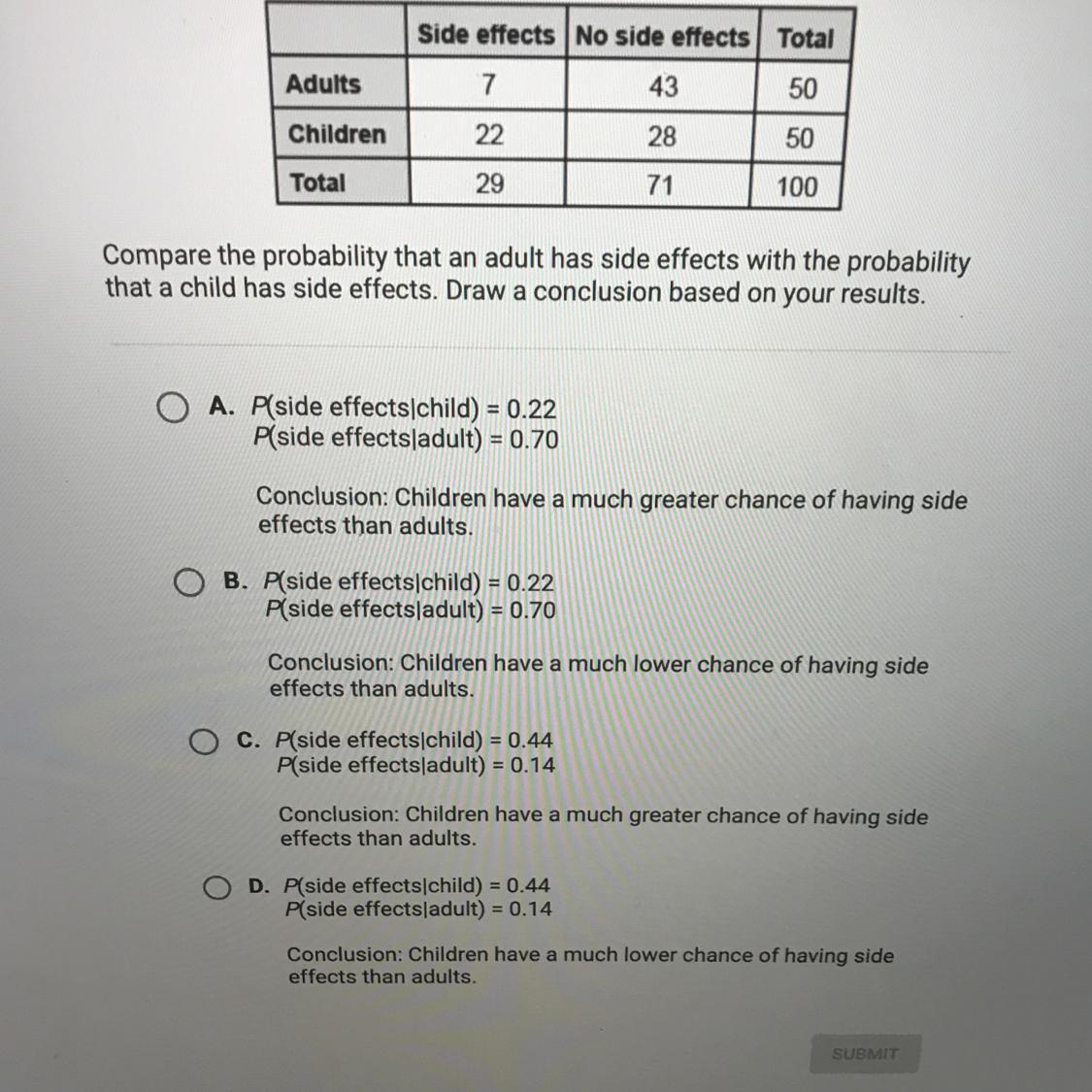
A Medical company tested a new drug on 100 people for possible side effects. This table shows the results...

Mathematics
2 answers:
pychu [463]2 years ago
8 0

Answer:

p(side effects|child) = 0.44

p(side effects|adult) = 0.14

Conclusion: children have a much greater chance of having side effects than adults.

Step-by-step explanation:

i just did it on apex. good luck!

Sav [38]2 years ago
6 0

Answer:

p(side effects/child) = 0.44

p(side effects/adult) = 0.14

Conclusion: Children have a much greater chance of having side effects than adults

~apex

You might be interested in
A ball is drawn at random from a container that holds 8 yellow balls numbered 1 to 8, 6 orange balls numbered 1 to 6, and 10 gra
Margarita [4]
A)

total of balls = 8+6+10= 24 balls 

3/24= .125 and it is 12.5 % that one of the orange balls is 5 because it is an odd number.

B) 

4/24 =.167 0r 16.7% that of the gray balls is numbered 8.


6 0
2 years ago
Write an equation for the cubic polynomial function whose graph has zeroes at 2, 3, and 5.
TiliK225 [7]

we know that

For a polynomial, if x=a is a zero of the function, then (x−a) is a factor of the function. The term multiplicity, refers to the number of times that its associated factor appears in the polynomial.

So

In this problem

If the cubic polynomial function has zeroes at 2, 3, and 5

then

the factors are

(x-2)\\ (x-3)\\ (x-5)

Part a) Can any of the roots have multiplicity?

The answer is No

If a cubic polynomial function has three different zeroes

then

the multiplicity of each factor is one

For instance, the cubic polynomial function has the zeroes

x=2\\ x=3\\ x=5

each occurring once.

Part b) How can you find a function that has these roots?

To find the cubic polynomial function multiply the factors and equate to zero

so

(x-2)*(x-3)*(x-5)=0\\ (x^{2} -3x-2x+6)*(x-5)=0\\ (x^{2} -5x+6)*(x-5)=0\\ x^{3} -5x^{2} -5x^{2} +25x+6x-30=0\\ x^{3}-10x^{2} +31x-30=0

therefore

the answer Part b) is

the cubic polynomial function is equal to

x^{3}-10x^{2} +31x-30=0

7 0
2 years ago
Read 2 more answers
Jane builds a ramp made of a triangular prism and a rectangular prism. What is the volume
Alex787 [66]

Answer:

Correct option: third one ->  11.5 m3

Step-by-step explanation:

To find the volume of the ramp, first we need to find the volume of the rectangular prism and the volume of the triangular prism:

V_rectangular = 4m * 2m * 1m = 8 m3

V_triangular = (2m * 3.5m * 1m) / 2 = 3.5 m3

Now, to find the volume of the ramp, we just need to sum both volumes:

V_total = V_rectangular + V_triangular = 8 + 3.5 = 11.5 m3

Correct option: third one.

6 0
2 years ago
Read 2 more answers
The area of the rectangle is 64.8 square centimeters. What is the perimeter of the rectangle? One group of ten tenths and one gr
9966 [12]

Answer:

(a) Perimeter = 32.2\ cm

(b) 100

Step-by-step explanation:

Solving (a):

Given

Shape: Rectangle

Area = 64.8

Required

Calculate the perimeter.

Area is calculated as:

Area = L * W

Where

L = Length and W = Width

Substitute 64.8 for Area

64.8 = L * W

Make L the subject:

L = \frac{64.8}{W}

Perimeter is calculated as:

P = 2 * (L + W)

Substitute 64.8/W for L

P = 2 * (\frac{64.8}{W} + W)

P = \frac{129.6}{W} + 2W

To solve further, we take the derivative of P and set it to 0, afterwards.

dP = -\frac{129.6}{W^2} + 2

Set to 0

0 = -\frac{129.6}{W^2} + 2

Collect Like Terms

\frac{129.6}{W^2} = 2

Cross Multiply:

2W^2= 129.6

Divide through by 2

W^2 = 64.8

Take square roots

W = \sqrt{64.8

W = 8.05

Recall that:

L = \frac{64.8}{W}

So:

L= \frac{64.8}{8.05}\\

L= 8.05

The perimeter is:

Perimeter = 2 * (8.05 + 8.05)

Perimeter = 2 * (16.10)

Perimeter = 32.2\ cm

Solving (b):

Given

((1 Group of 10 tenths) and (1 group of 8 tenths))/(6 groups of 3 tenths)

Required

Solve

Tenths = \frac{1}{10}

So, the expression becomes:

((1 Group of 10 * \frac{1}{10}) and (1 group of 8 * \frac{1}{10}))/(6 groups of 3 * \frac{1}{10})

This gives:

((1 Group of \frac{10}{10}) and (1 group of \frac{8}{10}))/(6 groups of \frac{3}{10})

Group means product, so the expression becomes:

\frac{(1 * \frac{10}{10} \ and\ 1 * \frac{8}{10})}{6 * \frac{3}{10}}

And, as used here means addition

\frac{(1 * \frac{10}{10} +  1 * \frac{8}{10})}{6 * \frac{3}{10}}

Simplify:

\frac{(1 * 1 +  1 * 0.80)}{6 *0.30}

\frac{(1 +  0.80)}{1.80}

\frac{1.80}{1.80}

= 1.00

7 0
2 years ago
In choice situations of this type, subjects often exhibit the "center stage effect," which is a tendency to choose the item in t
victus00 [196]

Complete Question

The complete question is shown on the first uploaded image

Answer:

a

The probability that he or she would choose the pair of socks in the center position is   p =\frac{1}{5}

The correct answer choice is

X has a binomial distribution with parameters n=100 and p=1/5  

b

The mean is  \mu = 20

The standard deviation is \sigma=4

c

The probability, P =0.0002

d

The correct answer is

The experiment supports the center stage effect. If participants were truly picking the socks at random, it would be highly unlikely for 34 or more to choose the center pair.

Using the R the probability Pe = 0.0003

The probabilities P \approx Pe

Step-by-step explanation:

Since the person selects his or her desired pair of socks at random , then the probability that the person would choose the pair of socks in the center position from all the five identical pair is mathematically evaluated as

                  p =\frac{1}{5}

                    =0.2

The mean of this distribution is mathematical represented as

           \mu = np

substituting the value

         \mu = 100 * 0.2

             \mu = 20

The standard deviation is mathematically represented as

         \sigma = \sqrt{np (1-p)}

substituting the value

           = \sqrt{100 * 0,2 (1-0.2)}

           \sigma=4

Applying normal approximation the probability that 34 or more subjects would choose the item in the center if each subject were selecting his or her preferred pair of socks at random would be mathematically represented as

               P=P(X \ge 34 )

By standardizing the normal approximation we have that

              P(X \ge 34) \approx P(Z \ge z)

Now z is mathematically evaluated as

               z = \frac{x-\mu}{\sigma }

Substituting values

             z = \frac{34-20}{4}

               =3.5

So  using the z table the P(Z \ge 3.5) is  0.0002

The probability P and Pe that 34 or more subject would choose the center pair is very small  So

The correct answer is

The experiment supports the center stage effect. If participants were truly picking the socks at random, it would be highly unlikely for 34 or more to choose the center pair.
 

6 0
2 years ago
Other questions:
  • A woman at a point A on the shore of a circular lake with radius r=4 wants to arrive at the point C diametrically opposite A on
    6·1 answer
  • The results of a survey show that the percent of adults in a certain town who want to change the name of the town is in the inte
    10·2 answers
  • Allan is ordering a set of rational numbers that includes positive values, negative values, fractions, and decimal numbers. How
    11·3 answers
  • Best Company sells personalized mugs for $18 each plus a fixed fee of $26 for shipping and handling for the entire order. The Cu
    10·2 answers
  • Mr. kasberg rides his bike at 6 mph to the bus station. he then rides the bus to work, averaging 30 mph. if he spends 20 minutes
    9·1 answer
  • Juan wants to change the shape of his vegetable garden from a square to a rectangle, but keep the same area so he can grow the s
    14·2 answers
  • If you know that a < b, and both a and b are positive numbers, then what must be true about the relationship between the oppo
    9·2 answers
  • Write an expression for cos 68° using sine
    12·1 answer
  • A little girl is watching planes take off of the runway from a building's rooftop 40 meters away from the airport. If the height
    8·1 answer
  • Apply the distributive property to factor out the greatest common factor of all three terms. 24c+36d+18
    12·1 answer
Add answer
Login
Not registered? Fast signup
Signup
Login Signup
Ask question!
