answer.
Ask question
Login Signup
Ask question
All categories
  • English
  • Mathematics
  • Social Studies
  • Business
  • History
  • Health
  • Geography
  • Biology
  • Physics
  • Chemistry
  • Computers and Technology
  • Arts
  • World Languages
  • Spanish
  • French
  • German
  • Advanced Placement (AP)
  • SAT
  • Medicine
  • Law
  • Engineering
Zarrin [17]
2 years ago
4

If all of the chloride in a 4.106-g sample of an unknown metal chloride is precipitated as AgCl with 70.90 mL of 0.2010 M AgNO3,

what is the percentage of chloride in the sample?
Chemistry
1 answer:
REY [17]2 years ago
8 0

The chloride is precipitated as following:

AgNO₃ + Cl⁻ → AgCl + NO₃⁻

molar concentration = number of moles / solution volume

number of moles = molar concentration × solution volume

number of moles of AgNO₃ = 0.2010 × 70.90

number of moles of AgNO₃ = 14.25 mmoles

from the equation

if        1 mmole of AgNO₃ is needed to precipitate 1 mmole of chloride

then  14.25 mmoles of AgNO₃ are needed to precipitate X mmoles of

chloride

X = 14.25 mmoles of choride

mass = number of moles × molecular weight

mass of chloride = 14.25 × 35.5

mass of chloride = 505.9 mg = 0.5059 g

if in     4.106 g of sample we have 0.5059 g of chloride

then in  100 g of sample we have X g of chloride

X = (100 × 0.5059) / 4.106 = 12.32 % chloride

You might be interested in
A girl stands on a bathroom scale. In metric units, the scale indicates that her weight is 42
gogolik [260]

Explanation:

The scale is pushing back up against her feet with the same amount of force but in negative direction.

This can be explain using Newton's third law of motion which states that "action and reaction are equal and opposite".

As the girl weight pulls down on the scale in a positive way with a force of 42N, the scale pulls back with an equal amount of force upward in another direction.

The net force here is zero this is why the scale is not damaged by her weight.

Learn more:

Force brainly.com/question/12978926

#learnwithBrainly

7 0
2 years ago
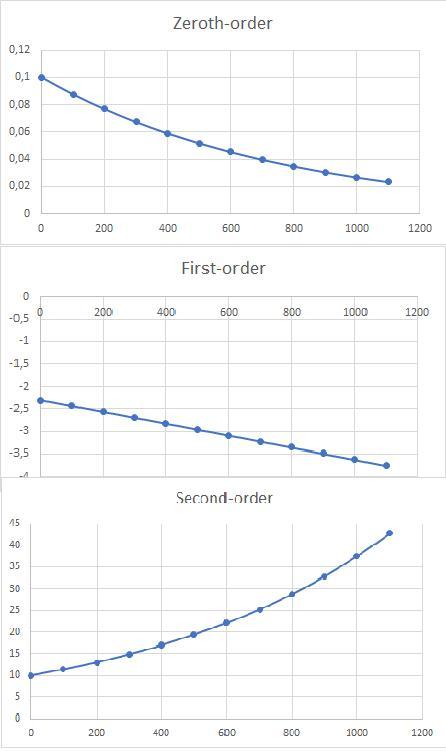
3. The following data of decomposition reaction of thionyl chloride (SO2Cl2) were collected at a certain temperature and the con
KonstantinChe [14]

Answer:

a) First-order.

b) 0.013 min⁻¹

c) 53.3 min.

d) 0.0142M

Explanation:

Hello,

In this case, on the attached document, we can notice the corresponding plot for each possible order of reaction. Thus, we should remember that in zeroth-order we plot the concentration of the reactant (SO2Cl2 ) versus the time, in first-order the natural logarithm of the concentration of the reactant (SO2Cl2 ) versus the time and in second-order reactions the inverse of the concentration of the reactant (SO2Cl2 ) versus the time.

a) In such a way, we realize the best fit is exhibited by the first-order model which shows a straight line (R=1) which has a slope of -0.0013 and an intercept of -2.3025 (natural logarithm of 0.1 which corresponds to the initial concentration). Therefore, the reaction has a first-order kinetics.

b) Since the slope is -0.0013 (take two random values), the rate constant is 0.013 min⁻¹:

m=\frac{ln(0.0768)-ln(0.0876)}{200min-100min} =-0.0013min^{-1}

c) Half life for first-order kinetics is computed by:

t_{1/2}=\frac{ln(2)}{k}=\frac{ln(2)}{0.013min^{-1}}  =53.3min

d) Here, we compute the concentration via the integrated rate law once 1500 minutes have passed:

C=C_0exp(-kt)=0.1Mexp(-0.013min^{-1}*1500min)\\\\C=0.0142M

Best regards.

6 0
2 years ago
Calculate the grams of sugar present in a 355 mL can of soda if the water in the can weighs 355 g and the density of the soda is
LenKa [72]
Mass of sugar=Mass of solution - mass of water

=1.07X355 - 355
= 24.85g
7 0
2 years ago
How is platinum used to help regulate the release of harmful gases from cars?
FromTheMoon [43]
<span>platinum is used in catalytic converters so it causes harfull gas.</span>
7 0
2 years ago
Read 2 more answers
A solution with [ OH] of 5 x 10⁻³ has a pH of
CaHeK987 [17]

Answer:

11·699

Explanation:

Given the concentration of hydroxide ion in the solution is 5 × 10^{-3} M

Assuming the temperature at which it is asked to find the pH of the solution be 298 K

<h3>At 298 K the dissociation constant of water is 10^{-14} </h3><h3>∴ pH + pOH = 14 at 298 K</h3><h3>pOH of the solution = -log( concentration of hydroxide ion )</h3>

∴ pOH of the given solution = - log(5 × 10^{-3} = -0·699 + 3 = 2·301

   pH of the given solution = 14 - 2·301 = 11·699

∴ pH of the solution = 11·699                                  

8 0
2 years ago
Other questions:
  • In the correct lewis structure for the nitrate ion, no3 –­, nitrogen has how many covalent bonds?
    7·1 answer
  • Write a balanced half-reaction describing the oxidation of gaseous dihydrogen to aqueous hydrogen cations.
    12·2 answers
  • A balloon contains 7.36 g of oxygen gas (O2). How many oxygen molecules are in the balloon?
    8·1 answer
  • When C2H5Cl(g) is burned in oxygen, chlorine gas is produced in addition to carbon dioxide and water vapor. 5145 kJ of heat are
    8·1 answer
  • The infrared spectrum above represents the absorption of certain wavelengths of radiation by molecules of CO2. Which of the foll
    9·1 answer
  • In the top row labeled Before Collision, the left billiard ball labeled 3 meters per second approaches the right billiard ball l
    14·2 answers
  • A student made a graph to show the chemical equilibrium position of a reaction.
    9·1 answer
  • How many chloride ions are in 0.486 moles of chloride ions?​
    11·1 answer
  • A student measured the mass of some sodium chloride for a lab. the lab called for 6.25 g (the accurate measurement ) , but the s
    11·1 answer
  • When aqueous solutions of AgNO3 and KI are mixed, AgI precipitates. The balanced net ionic equation is ________. When aqueous so
    6·1 answer
Add answer
Login
Not registered? Fast signup
Signup
Login Signup
Ask question!