answer.
Ask question
Login Signup
Ask question
All categories
  • English
  • Mathematics
  • Social Studies
  • Business
  • History
  • Health
  • Geography
  • Biology
  • Physics
  • Chemistry
  • Computers and Technology
  • Arts
  • World Languages
  • Spanish
  • French
  • German
  • Advanced Placement (AP)
  • SAT
  • Medicine
  • Law
  • Engineering
sasho [114]
2 years ago
9

3. The following data of decomposition reaction of thionyl chloride (SO2Cl2) were collected at a certain temperature and the con

centration of SO2Cl2 were monitored as shown in the table.
SO2Cl2 (g) SO2 (g) + Cl2 (g)


Time (min) Conc. of SO2Cl2 (mol/L)

0 0.1000

100 0.0876

200 0.0768

300 0.0673

400 0.0590

500 0.0517

600 0.0453

700 0.0397

800 0.0348

900 0.0305

1000 0.0267

1100 0.0234


a) Determine graphically whether the kinetics of the reaction is zero order, first order or second order with respect to SO2Cl2 and then write the rate equation.

b) Determine the rate constant (k) of the reaction.

c) Determine the half-life (t½) for the reaction.

d) What will be the concentration of SO2Cl2 left in the reaction mixture at 1500 minutes?

​

Chemistry
1 answer:
KonstantinChe [14]2 years ago
6 0

Answer:

a) First-order.

b) 0.013 min⁻¹

c) 53.3 min.

d) 0.0142M

Explanation:

Hello,

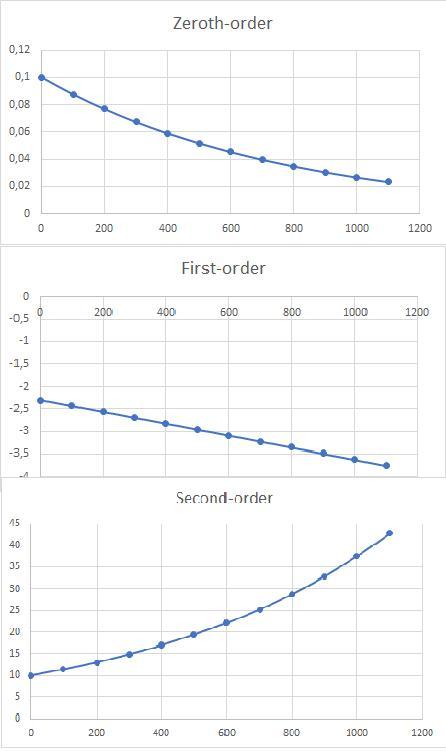
In this case, on the attached document, we can notice the corresponding plot for each possible order of reaction. Thus, we should remember that in zeroth-order we plot the concentration of the reactant (SO2Cl2 ) versus the time, in first-order the natural logarithm of the concentration of the reactant (SO2Cl2 ) versus the time and in second-order reactions the inverse of the concentration of the reactant (SO2Cl2 ) versus the time.

a) In such a way, we realize the best fit is exhibited by the first-order model which shows a straight line (R=1) which has a slope of -0.0013 and an intercept of -2.3025 (natural logarithm of 0.1 which corresponds to the initial concentration). Therefore, the reaction has a first-order kinetics.

b) Since the slope is -0.0013 (take two random values), the rate constant is 0.013 min⁻¹:

m=\frac{ln(0.0768)-ln(0.0876)}{200min-100min} =-0.0013min^{-1}

c) Half life for first-order kinetics is computed by:

t_{1/2}=\frac{ln(2)}{k}=\frac{ln(2)}{0.013min^{-1}}  =53.3min

d) Here, we compute the concentration via the integrated rate law once 1500 minutes have passed:

C=C_0exp(-kt)=0.1Mexp(-0.013min^{-1}*1500min)\\\\C=0.0142M

Best regards.

You might be interested in
Examine the block from the periodic table for the element nitrogen, chemical symbol N. Using your knowledge of the periodic tabl
vodka [1.7K]
I believe that the answer is A) All Nitrogen atoms have 7 protons
4 0
2 years ago
Read 2 more answers
Describe two shortcomings of the pennium model for isotopes
umka21 [38]

let me know when u find out plz because i would like to know as well its one of my chemistry qustions in an assiment. :)

3 0
2 years ago
Which of the following are benefits of Earth's atmosphere? Select all that apply Exchanges gases with the hydrosphere, recycling
VikaD [51]
Let's evaluate each choice. For the first choice, this is correct. Hydrosphere consist of all the water's in the Earth's surface. It interacts with the atmosphere through reaeration, so that water cycle continues on. The second option is correct, this is known as the greenhouse effect. The third option is incorrect, because the opposite is true, which makes the fourth option correct. The fifth option is incorrect because the atmosphere has nothing to do with the Earth's crust. <em>So, the answers are: A, B, and D.</em>
5 0
2 years ago
In the human body hydrochloric acid is responsible for the low ph of the contents of the
natulia [17]
The wording makes this question difficult, but HCl is found in stomach acid. Hope this helps!
4 0
2 years ago
Complete the statements by writing the number from the graph.
natima [27]

Answer: The substance is in the gas phase only in region 5

The substance is in both the liquid and the solid phase in region 2

The substance is in only the liquid phase in region 3

The melting point is the temperature at region 2

The boiling point is the temperature at region 4

Explanation:
6 0
2 years ago
Read 2 more answers
Other questions:
  • jan is holding an ice cube. what causes the ice to melt? thermal energy from the ice is transferred to the air. thermal energy f
    12·2 answers
  • A 63 kg object needs to be lifted 7 meters in a matter of 5 seconds. Approximately how much horsepower is required to achieve th
    14·2 answers
  • Suppose that a metal oxide of formula m2o3 were soluble in water. what would be the major product or products of dissolving the
    7·1 answer
  • How many moles of chromium(iii) nitrate are produced when chromium reacts with 0.85 moles of lead(iv) nitrate to produce chromiu
    11·1 answer
  • Which of the following statements are True about the experimental process used in the Diels Alder reaction?
    15·1 answer
  • Which equation is derived from the combined gas law? StartFraction V subscript 1 over T subscript 1 EndFraction equals StartFrac
    13·2 answers
  • Fusion and fission reactions are both nuclear reactions that can be used to produce energy. However, while fission reactions are
    15·1 answer
  • Helium is a very important element for both industrial and research applications. In its gas form it can be used for welding, an
    14·1 answer
  • Which best protects animal species that are endangered due to overhunting?
    7·2 answers
  • This is the chemical formula for acetic acid (the chemical that gives the sharp taste to vinegar): An analytical chemist has det
    15·1 answer
Add answer
Login
Not registered? Fast signup
Signup
Login Signup
Ask question!