answer.
Ask question
Login Signup
Ask question
All categories
  • English
  • Mathematics
  • Social Studies
  • Business
  • History
  • Health
  • Geography
  • Biology
  • Physics
  • Chemistry
  • Computers and Technology
  • Arts
  • World Languages
  • Spanish
  • French
  • German
  • Advanced Placement (AP)
  • SAT
  • Medicine
  • Law
  • Engineering
Fittoniya [83]
2 years ago
6

Plastically deforming a metal specimen near room temperature generally leads to which of the following property changes? 5. (a)

An increased tensile strength and a decreased ductility (b) A decreased tensile strength and an increased ductility c) An increased tensile strength and an increased ductility (d) A decreased tensile strength and a decreased ductility
Engineering
2 answers:
algol132 years ago
8 0

Answer:

The answer is (a) An increased tensile strength and a decreased ductility.

Explanation:

When a metal specimen is plastically deformed near room temperature, it implies that the metal specimen is being cold worked (it is undergoing cold working), or it’s shape is being changed without applying heat. Cold working generally leads to an increase in tensile strength and yield strength, and a decrease in ductility.

andrezito [222]2 years ago
4 0

Answer:

Option a) An increased tensile strength and decreased ductility.

Explanation:

Plastic deformation is when the material once reshaped under applied stress is not able to regain its original shape and is deformed permanently even after the removal of the applied force on a metal specimen at room temperature.

This process is irreversible and is done at microscopic level by the use of dislocation defects. At room temperatures instead of being removed, these accumulate and acts as pin points thus enhancing the tensile strength of the metal followed by a reduction in its ductility.

You might be interested in
Evan notices a small fire in his workplace. Since the fire is small and the atmosphere is not smoky he decides to fight the fire
Norma-Jean [14]

Answer:

not calling the firemean

Explanation:

7 0
2 years ago
A system consisting of 3 lb of water vapor in a piston–cylinder assembly, initially at 350°F and a volume of 71.7 ft3, is expand
Alla [95]

Answer:

isobaric expansion = 281.09 Btu

isothermal compression= 72 Btu

Explanation:

The first law of thermodynamics is:

Q_{AB}=W_{AB}+deltaU_{AB}

where:

Q=heat transferred

W= work

U=internal energy  

W_{AB}=P*(V_{B}-V_{A})

U_{AB}=n*C_{v}(T_{2}-T_{1})

P=pressure, V= volume, T= temperature, n =  moles, Cv= specific heat at constant volume.

In a isobaric process heat transferred is:

Q=P*(V_{B}-V_{A})+n*C_{v}(T_{2}-T_{1})

For an isothermal process (T2-T1 = 0) so

Q=P*(V_{B}-V_{A})= W_{AB}

From the data we know that the energy transferred to the system in the isothermal compression by work was 72 Btu that is the heat transferred to the system.

For the first process

Q=P*(V_{B}-V_{A})+n*C_{v}(T_{2}-T_{1})

we have to properties at the beginning of the process : temperature (350°F) and specific volume (V/mass)

specific-volume=\frac{71.7 ft^{3}}{3Lb}=23.9\frac{ft^{3}}{Lb}

we use this information in the appropriate unit to find the pressure in thermodynamic tables.

T1= 176°C

v1= 1.49 m^3/kg

P=1.37 bar

in the second state we have

P=1.37 bar =137000Pa

v_{2}=\frac{85.38ft^{3}}{3Lb}= 28.46\frac{ft^{3}}{Lb}

with thee properties we check in the thermodynamic tables

T2= 255°C

n=mass/Mw = 3Lb*\frac {1kg}{2.2Lb}*\frac{1000gr}{1kg}*\frac{1mol}{18gr}=75.75 mol

we usually find Cp on tables for water but from the Mayer relation we have:

C_{v}=C_{p}+R

Cp for water vapor is: 33.12 J/mol*K

R=8.314 J/mol*K

Cv= 41.434 J/mol*K

replacing in the equation for Q

Q=137000 Pa*(2.41m^{3}-2.030m^{3})+75.75mol*41.434\frac{ J}{mol*K}*(528.15-449.81 K)=296569J

296569J =281.09 Btu

5 0
2 years ago
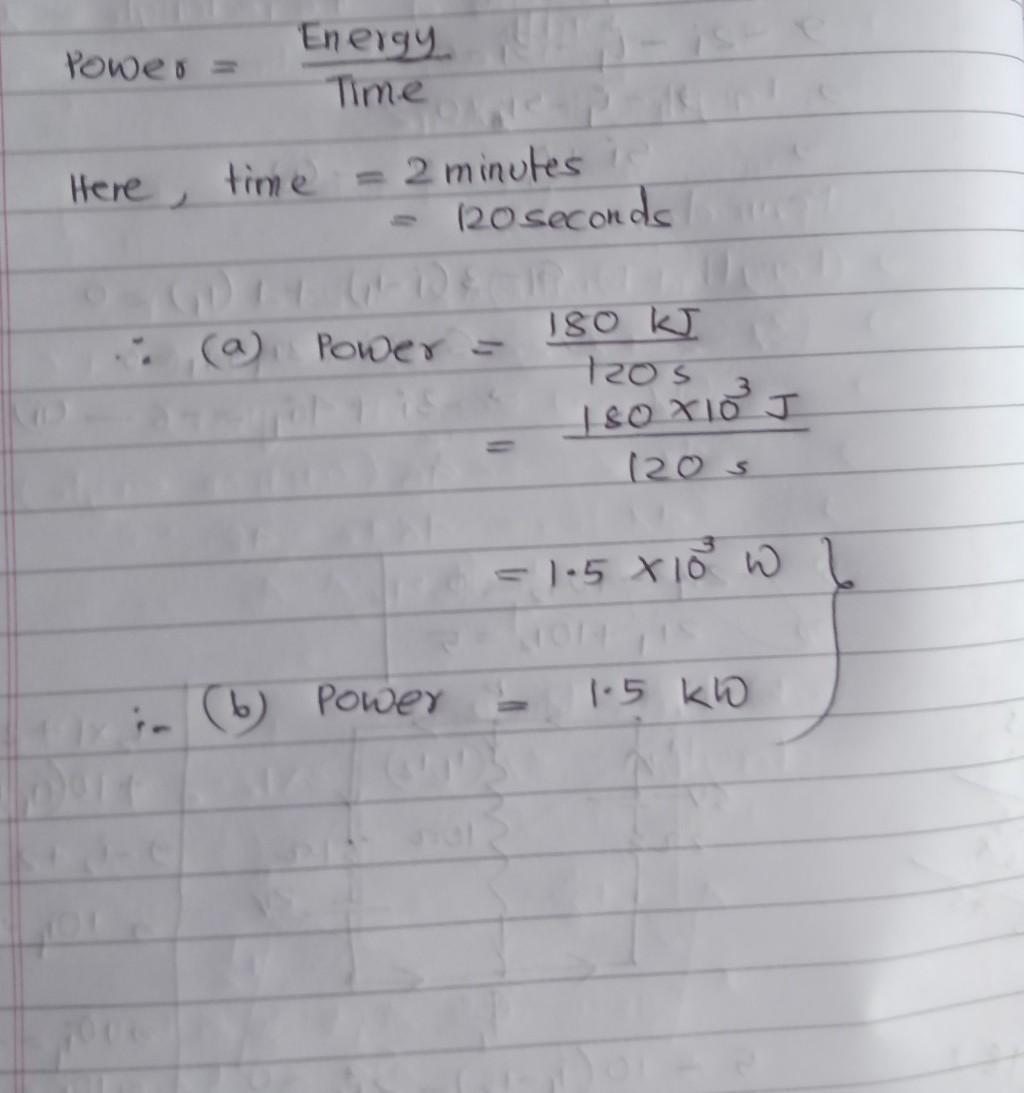
The electrical energy used by an air conditioner for 2 minutes is 180 kJ. Calculate the power of this air conditioner in the fol
ELEN [110]

Answer:

I hope it is correct.....

5 0
2 years ago
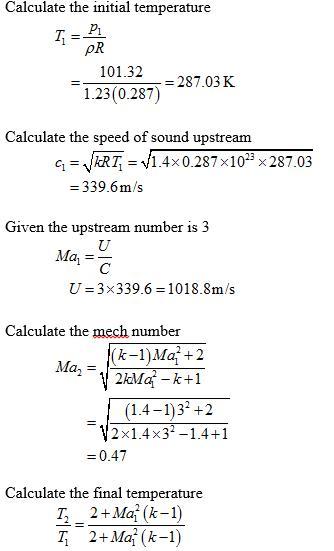
Consider a normal shock wave in air. The upstream conditions are given by M1=3, p1 = 1 atm, and r1 = 1.23 kg/m3. Calculate the d
mart [117]

Answer and Explanation:

The answer is attached below

7 0
2 years ago
Universal Containers has a junction object called "Job Production Facility". With 2 master-detail relationships to the Job and P
alexdok [17]

Answer:

C. The user will not be able to see the junction object records or the field values.

Explanation:

For the profile of the user to give access permission such as create and read to the job without granting access permission to the production facility object, the value of the field or records of the junction object will not be seen by the user. This is one of the necessary criteria or principle for the universal container with a junction object.

3 0
2 years ago
Other questions:
  • We are undergoing a period of rapid technology change with cloud computing, artificial intelligence, robotics, mobile devices, w
    12·1 answer
  • Air at 40°C flows over a long, 25-mm-diameter cylinder with an embedded electrical heater. In a series of tests, measurements we
    11·1 answer
  • An uninsulated, thin-walled pipe of 100-mm diameter is used to transport water to equipment that operates outdoors and uses the
    9·1 answer
  • air at 600 kPa, 330 K enters a well-insulated, horizontal pipe having a diameter of 1.2 cm and exits at 120 kPa, 300 K. Applying
    10·1 answer
  • Water enters a circular tube whose walls are maintained at constant temperature at specified flow rate and temperature. For full
    8·1 answer
  • The velocity distribution for laminar flow between parallel plates is given by u umax = 1 − ( 2y h ) 2 Where h is the distance s
    15·1 answer
  • What ratio between differential gain and common-mode gain is called​
    9·1 answer
  • 140-character statement that completes this sentence: I pledge to not text and drive because...
    12·1 answer
  • The rate of flow through an ideal clarifier is 8000m3 /d, the detention time is 1h and the depth is 3m. If a full-length movable
    5·1 answer
  • George is replacing a burned out resistor in a circuit board. The board has a 10, a 20, and a 40 on resistor, all in parallel. W
    5·1 answer
Add answer
Login
Not registered? Fast signup
Signup
Login Signup
Ask question!