answer.
Ask question
Login Signup
Ask question
All categories
  • English
  • Mathematics
  • Social Studies
  • Business
  • History
  • Health
  • Geography
  • Biology
  • Physics
  • Chemistry
  • Computers and Technology
  • Arts
  • World Languages
  • Spanish
  • French
  • German
  • Advanced Placement (AP)
  • SAT
  • Medicine
  • Law
  • Engineering
bazaltina [42]
2 years ago
3

A container ship is 240 m long and 22 m wide. Assume that the shape is like a rectangular box. How much mass does the ship carry

as load if it is 10 m down in the water and the mass of the ship itself is 30 000 tonnes?
Engineering
1 answer:
liraira [26]2 years ago
6 0

Answer:

22800 tonne

Explanation:

Given:

Length of the container, L = 240 m

Width of the container, B = 22 m

Depth inside the water, H = 10 m

Mass of the ship, m = 30000 tonnes

Now,

Total immersed volume of the ship = LBH = 240 × 22 × 10 = 52800 m³

From the Archimedes principle, we have

Total mass of the ship (i.e mass of the ship along with the load carried)

= Mass of the volume of water displaced by ship

= 52800 × Density of water

also,

Density of water = 1000 kg/m³

thus,

Total mass of the ship (i.e mass of the ship along with the load carried)

= 52800 × 1000 kg

also,

1 tonne = 1000 kg

thus,

Total mass of the ship (i.e mass of the ship along with the load carried)

= 52800 tonne

Therefore,

the load carried by the ship = Total mass of the ship  - mass of ship

or

the load carried by the ship = 52800 - 30000 = 22800 tonne

You might be interested in
A platinum resistance temperature sensor has a resistance of 120 Ω at 0℃ and forms one arm of a Wheatstone bridge. At this tempe
oksian1 [2.3K]

Answer : 9.36ohms/ temperature

Explanation:

Expression for the variation of resistance of platinum with temperature

Rt= Ro(1+*t)

Rt= resistance @ t°C

Ro= resistance @ 0°C

*= temperature coefficient of resistance

Calculate the change in resistance by putting 120ohms for Ro,

0.0039/K for *

20°C for t

Using this formula:

Rt = Ro(1+*t)

Rt- Ro = Ro*t

= (120ohms)(0.0039/K)(20°C)

= 9.36ohms/K

8 0
2 years ago
An 80-L vessel contains 4 kg of refrigerant-134a at a pressure of 160kPa. Determine (a) the temperature, (b) the quality, (c) th
makvit [3.9K]

Answer:

temperature -15.6 C, quality x=0.646, enthalpy h=667.20 KJ, volume of vapor phase Vg= 79.8 L

Explanation:

property table for R-134a

https://www.ohio.edu/mechanical/thermo/property_tables/R134a/R134a_PresSat.html

at 160 KPa , temperature = -15.66 C

quality x=mass of vapour/ total mass of liq-vap mixture

alternaternately: x=(v-vf)/(vg-vf)    

v=total volume i.e. volume of container"80L"   80L=0.08 cubic meter

vf=vol of liquid phase  vg=vol of vapor phase vf, vg values at 160Kpa

x=(0.08-0.0007437)/(0.1235-0.0007437)=0.646

enthalpy

h=hf+xhfg          hf, hfg values at 160Kpa

h=hf+xhfg=31.2+0.646(209.9)=166.80 KJ/Kg

for 4Kg R-134a h=m(166.80 KJ/Kg )=667.20 KJ

volume of vapor phase

vg at 160Kpa=0.1235 cubic meter for quality=1.

in this case quality=0.646 , so it will occupy 64.6% space of the vapor phase at quality=1.

vol. of vapor phase=0.646*0.1235=0.0798 cubic meter=79.8 L

7 0
2 years ago
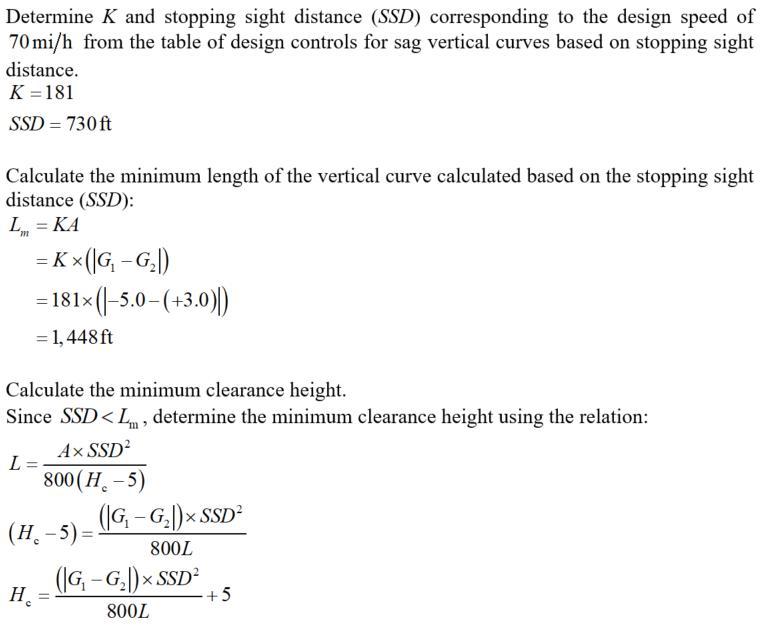
An overpass is being built over the PVI of an existing equal-tangent sag curve. The sag curve has a 70 mi/h design speed and G1=
vivado [14]

Answer: Resultant elevation will be 30.98 ft

8 0
2 years ago
a 250 pound person would use a type 1 ladder even if they were carrying a load with them true or faults​
Marysya12 [62]

Answer:True

Explanation:

6 0
2 years ago
Read 2 more answers
Finally you will implement the full Pegasos algorithm. You will be given the same feature matrix and labels array as you were gi
Diano4ka-milaya [45]

Answer:

In[7] def pegasos(feature_matrix, labels, T, L):

   """

   .

   let learning rate = 1/sqrt(t),

   where t is a counter for the number of updates performed so far       (between 1   and nT inclusive).

Args:

       feature_matrix - A numpy matrix describing the given data. Each row

           represents a single data point.

       labels - A numpy array where the kth element of the array is the

           correct classification of the kth row of the feature matrix.

       T -  the maximum number of times that you should iterate through the feature matrix before terminating the algorithm.

       L - The lamba valueto update the pegasos

   Returns: Is defined as a  tuple in which the first element is the final value of θ and the second element is the value of θ0

   """

   (nsamples, nfeatures) = feature_matrix.shape

   theta = np.zeros(nfeatures)

   theta_0 = 0

   count = 0

   for t in range(T):

       for i in get_order(nsamples):

           count += 1

           eta = 1.0 / np.sqrt(count)

           (theta, theta_0) = pegasos_single_step_update(

               feature_matrix[i], labels[i], L, eta, theta, theta_0)

   return (theta, theta_0)

In[7] (np.array([1-1/np.sqrt(2), 1-1/np.sqrt(2)]), 1)

Out[7] (array([0.29289322, 0.29289322]), 1)

In[8] feature_matrix = np.array([[1, 1], [1, 1]])

   labels = np.array([1, 1])

   T = 1

   L = 1

   exp_res = (np.array([1-1/np.sqrt(2), 1-1/np.sqrt(2)]), 1)


   pegasos(feature_matrix, labels, T, L)

Out[8] (array([0.29289322, 0.29289322]), 1.0)

Explanation:

In[7] def pegasos(feature_matrix, labels, T, L):

   """

   .

   let learning rate = 1/sqrt(t),

   where t is a counter for the number of updates performed so far       (between 1   and nT inclusive).

Args:

       feature_matrix - A numpy matrix describing the given data. Each row

           represents a single data point.

       labels - A numpy array where the kth element of the array is the

           correct classification of the kth row of the feature matrix.

       T -  the maximum number of times that you should iterate through the feature matrix before terminating the algorithm.

       L - The lamba valueto update the pegasos

   Returns: Is defined as a  tuple in which the first element is the final value of θ and the second element is the value of θ0

   """

   (nsamples, nfeatures) = feature_matrix.shape

   theta = np.zeros(nfeatures)

   theta_0 = 0

   count = 0

   for t in range(T):

       for i in get_order(nsamples):

           count += 1

           eta = 1.0 / np.sqrt(count)

           (theta, theta_0) = pegasos_single_step_update(

               feature_matrix[i], labels[i], L, eta, theta, theta_0)

   return (theta, theta_0)

In[7] (np.array([1-1/np.sqrt(2), 1-1/np.sqrt(2)]), 1)

Out[7] (array([0.29289322, 0.29289322]), 1)

In[8] feature_matrix = np.array([[1, 1], [1, 1]])

   labels = np.array([1, 1])

   T = 1

   L = 1

   exp_res = (np.array([1-1/np.sqrt(2), 1-1/np.sqrt(2)]), 1)


   pegasos(feature_matrix, labels, T, L)

Out[8] (array([0.29289322, 0.29289322]), 1.0)

6 0
2 years ago
Other questions:
  • Small droplets of carbon tetrachloride at 68 °F are formed with a spray nozzle. If the average diameter of the droplets is 200 u
    10·1 answer
  • Determine the amount of gamma and alpha phases in a 10-kg, 1060 steel casting as it is being cooled to the following temperature
    6·1 answer
  • On the reality television show "Survivor," two tribes compete for luxuries such as food and shelter. During such challenges, one
    12·1 answer
  • You work in Madison, Wisconsin. It is January and the area has been hit with bad weather. Another weather front is expected to a
    9·1 answer
  • Consider the following class definitions: class smart class superSmart: public smart { { public: public: void print() const; voi
    6·1 answer
  • In this module you learned about searching, sorting and algorithms in C++ and how to implement these elements in your C++ progra
    6·1 answer
  • Five Kilograms of continuous boron fibers are introduced in a unidirectional orientation into of an 8kg aluminum matrix. Calcula
    9·1 answer
  • A rectangular beam having b=300 mm and d=575 mm, spans 5.5 m face to face of simple supports. It is reinforced for flexure with
    14·1 answer
  • 5. Which of these materials in a shop contain metals and toxins and can pollute the environment? A) Antifreeze B) Solvents C) Ba
    9·2 answers
  • Dalton needs to prepare a close-out report for his project. Which part of the close-out report would describe
    6·1 answer
Add answer
Login
Not registered? Fast signup
Signup
Login Signup
Ask question!