answer.
Ask question
Login Signup
Ask question
All categories
  • English
  • Mathematics
  • Social Studies
  • Business
  • History
  • Health
  • Geography
  • Biology
  • Physics
  • Chemistry
  • Computers and Technology
  • Arts
  • World Languages
  • Spanish
  • French
  • German
  • Advanced Placement (AP)
  • SAT
  • Medicine
  • Law
  • Engineering
Marrrta [24]
2 years ago
8

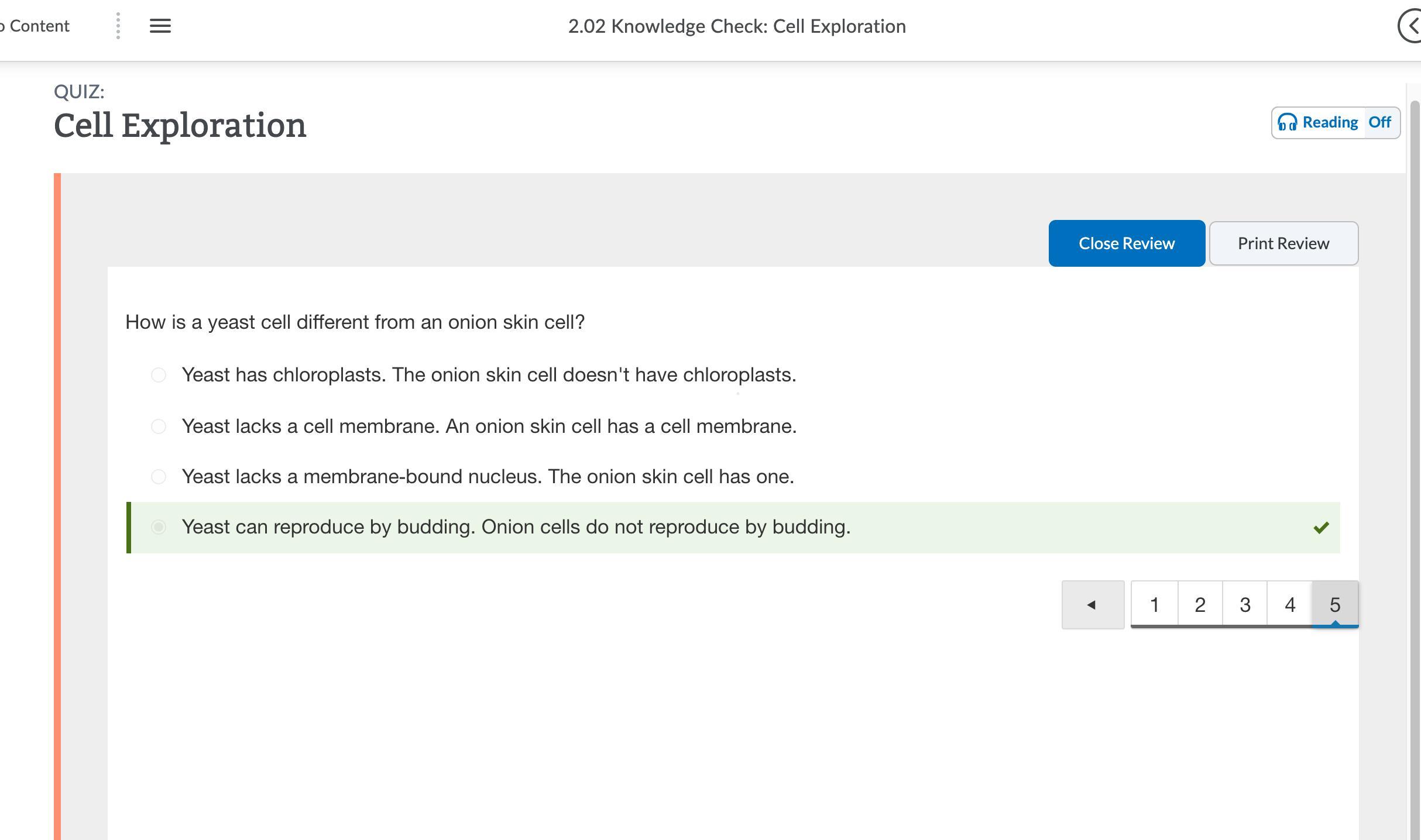
How is a yeast cell different from an onion skin cell? Yeast can reproduce by budding. Onion cells do not reproduce by budding.

Yeast lacks a membrane-bound nucleus. The onion skin cell has one. Yeast has chloroplasts. The onion skin cell doesn't have chloroplasts. Yeast lacks a cell membrane. An onion skin cell has a cell membrane.

Chemistry
2 answers:
Jlenok [28]2 years ago
7 0

Answer:

Yeast cell is different from an onion skin cell in that Yeast can reproduce by budding while onion skin cells do not reproduce by budding.

Explanation:

  • Reproduction is one of the characteristics of living organisms. All living organisms undertake reproduction to give rise to new organisms.
  • There are two major types of reproduction namely asexual and sexual reproduction.
  • Asexual reproduction is a form of reproduction that does not involve the fusion of gametes among organisms. Examples of asexual reproduction are budding in yeast and vegetative propagation in plants such as onions.
  • Sexual reproduction, on the other hand, involves the fusion of gametes from male and female organisms which results in the formation of an embryo that develops to the fetus which becomes the offspring.
  • Therefore, we could say that yeast cells reproduce asexually through budding while onions reproduce asexually through vegetative propagation.
Natali [406]2 years ago
4 0

Answer:

The answer is:

Yeast can reproduce by budding. Onion cells do not reproduce by budding.

I had the same quiz.

You might be interested in
Making the simplistic assumption that the dissolved NaCl(s) does not affect the volume of the solvent water, determine the const
shtirl [24]

Answer:

  • m = 1,000/58.5
  • b = - 1,000 / 58.5

1) Variables

  • molarity: M
  • density of the solution: d
  • moles of NaCl: n₁
  • mass of NaCl: m₁
  • molar mass of NaCl: MM₁
  • total volume in liters: Vt
  • Volume of water in mililiters: V₂
  • mass of water: m₂

2) Density of the solution: mass in grams / volume in mililiters

  • d = [m₁ + m₂] / (1000Vt)

3) Mass of NaCl: m₁

    Number of moles = mass in grams / molar mass

    ⇒ mass in grams = number of moles × molar mass

        m₁ = n₁ × MM₁


4) Number of moles of NaCl: n₁

   Molarity = number of moles / Volume of solution in liters

   M = n₁ / Vt

   ⇒ n₁ = M × Vt


5) Substitue in the equation of m₁:

   m₁ = M × Vt × MM₁


6) Substitute in the equation of density:

    d = [M × Vt × MM₁ + m₂] / (1000Vt)


7) Simplify and solve for M

  • d = M × Vt × MM₁ / (1000Vt) + m₂/ (1000Vt)
  • d = M × MM₁ / (1000) + m₂/ (1000Vt)

Making the simplistic assumption that the dissolved NaCl(s) does not affect the volume of the solvent water means 1000Vt = V₂  

  • d = M × MM₁ / (1000) + m₂/ V₂

        m₂/ V₂ is the density of water: 1.00 g/mL

  • d = M × MM₁ / (1000) + 1.00 g/mL
  • M × MM₁ / (1000) = d - 1.00 g/mL
  • M = [1,000/MM₁] d - 1,000/ MM₁

8) Substituting MM₁ = 58.5 g/mol

  • M = [1,000/58.5] d - [1,000/ 58.5]

Comparing with the equation Molarity = m×density + b, you obtain:

  • m = 1,000/58.5
  • b = - 1,000/58.5
7 0
2 years ago
Read 2 more answers
Complete these equations for the ionization of an Arrhenius acid or base in water. Include the states of the products.. 1.) HI(a
Nezavi [6.7K]
To complete these equations for the ionization of an Arrhenius acid or base in water, here is my answer. 

For the first equation, HI(aq), that would be H3O + (aq) + I - (aq)

For the second equation, LiOH(s), it would be Li + (aq) + OH - (aq)

Hope this helps your homework.


4 0
2 years ago
Which diatomic molecule is formed when the two atoms share six electrons
Leviafan [203]

The diatomic molecule that is formed when two atoms share six electrons is N2.

The atomic number of nitrogen is 7 and its electronic configuration is 2,5. This implies that, nitrogen has 5 electrons in its outermost shell. To attain the octet structure, it needs 3 electrons more. To form a diatomic molecule, two nitrogen atoms come together and each donate three electrons, which are equally shared between the two, thus, each ends up having 8 electrons in its outermost shell.

3 0
2 years ago
Read 2 more answers
As Danny was pouring cereal for his breakfast, he noticed that the cereal box says that the cereal contains 5 milligrams of iron
Vinil7 [7]

Answer:

Correct, because B it is reported to the nearest miligram

Explanation:

4.6 rounded up is 5

6 0
2 years ago
Many free radicals combine to form molecules that do not contain any unpaired electrons. The driving force for the radical–radic
Alexxandr [17]

Answer:

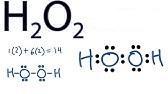
In the attached image the Lewis equation is shown where it is shown how two oxygens react with two hydrogens to meet the octet of the electrons.

Explanation:

Hydrogen peroxide is one of the most named chemicals since it is not only sold as "hydrogen peroxide" in pharmacies but it is also one of the great weapons of immune defense cells to defend ourselves against anaerobic bacteria.

The disadvantage of this compound is that when dividing it forms free oxygen radicals that are considered toxic or aging for our body.
4 0
2 years ago
Other questions:
  • If 7.50 g of the unknown compound contained 0.250 mol of c and 0.500 mol of h, how many moles of oxygen, o, were in the sample?
    14·1 answer
  • Carbon dioxide dissolves in water to form carbonic acid. this acid lowers the ph of the water and makes the water corrosive. wha
    12·1 answer
  • The lower the ph of a solution, the ______.
    15·2 answers
  • What mass of ZnCO3 contains 3.11×10²² O atoms
    10·2 answers
  • Two objects are moving at the same speed. Which (if any) of the following statements about them are true? Check all that apply.
    14·1 answer
  • A flask of volume 2.0 liters, provided with a stopcock, contains oxygen at 20 oC, 1.0 ATM (1.013X10⁵ Pa). The system is heated t
    12·1 answer
  • A swimmer enters a gloomier world (in one sense) on diving to greater depths. Given that the mean molar absorption coefficient o
    10·1 answer
  • Every single-celled organism is able to survive because it carries out *
    5·1 answer
  • An athlete has 15% body fat by mass. What is the weight of fat, in pounds, of a 74 kg-athlete?
    13·1 answer
  • We would like to make a golden standard kilogram in the shape of circular cylinder. The density of gold is 19.32 g/cm3. a) Find
    9·1 answer
Add answer
Login
Not registered? Fast signup
Signup
Login Signup
Ask question!