answer.
Ask question
Login Signup
Ask question
All categories
  • English
  • Mathematics
  • Social Studies
  • Business
  • History
  • Health
  • Geography
  • Biology
  • Physics
  • Chemistry
  • Computers and Technology
  • Arts
  • World Languages
  • Spanish
  • French
  • German
  • Advanced Placement (AP)
  • SAT
  • Medicine
  • Law
  • Engineering
Maslowich
2 years ago
11

Josie wants to develop genetically altered plants to help increase plants’ growth and resilience. Which level of education would

best prepare Josie for work in this scientific field?
a high school education
an associate’s degree
a master’s degree
an apprenticeship
Business
2 answers:
Verdich [7]2 years ago
6 0
A master’s degree....
Anuta_ua [19.1K]2 years ago
6 0
A masters degree
( just answered this)
You might be interested in
Archoid's Flowering Plants provides the following information for the month of May: Actual Budget Tulips Geraniums Tulips Gerani
gogolik [260]

Answer:

Contribution margin= $15

Explanation:

Giving the following information:

Sales May in units:

Budget:

Tulips= 4,950

Geraniums= 3,300

Actual:

Tulips= 4,420

Geraniums= 4,080

Contribution margin:

Budget:

Tulips= $11

Geraniums= $21

Actual:

Tulips= $12

Geraniums= $19

We need to calculate the budgeted contribution margin per composite unit.

First, we need to calculate the percentage of sales for each plant.

Total units= 8250 units

Tulips= 4950/8250= 0.6

Geranius= 3300/8250= 0.4

Contribution margin= (0.6*11)+(0.4*21)= $15

4 0
2 years ago
A good measure of average should be:
ella [17]

Answer:b

Explanation:

8 0
2 years ago
Please describe the circumstances of the following case study and recommend a course of action. Explain your approach to the pro
Cloud [144]

Answer:

In this case, an analyst is presented with recommending the best option between internal production and external acquisition of  goods (outsourcing) for resale.  Through relevant quantitative and qualitative analyses it will be decided whether the company should make or buy the engines or vacuums.  To make 50,000 units of the engines, production costs will be incurred as given in the question.

After considering the qualitative factors, including availability of production capacity, space, and labor, the next would be to undertake a  costs /benefits quantitative analysis of making the engines in-house versus buying from outside for resale.  The outcomes are then compared to understand their financial effects.  The option that makes better financial sense or that is more profitable should be chosen because the payoff outweighs the other and the company's assets and stockholders will be better off with the more profitable option, either in the direction of making more profits or reducing the cost profile.

In any make or buy decision situation, the costs that are relevant are the costs that change with the option.  Any costs that do not change with a chosen option is disregarded.  This include items like depreciation and other indirect fixed costs.

b) Computations:

1. To make:

Description                    Cost per Month

Direct Materials                    $75,000

Direct Labor                        $100,000

Variable factory overhead $375,000 ($7.50 x 50,000)

Total variable costs =        $550,000

Selling price =                 $7,500,000 ($150 x 50,000)

Contribution =                $6,950,000

Fixed factory overhead     $150,000 (150% of $100,000)

Net Income                    $6,800,000

2. To buy:

Cost of goods  - $3,000,000

Selling price       $7,500,000

Contribution      $4,500,000

Fixed costs            $112,500 (75% of $150,000)

Net Income       $4,387,500

c) The company should go ahead and produce the engines internally.  This is far more profitable, all quantitative factors considered.

Explanation:

In arriving at a decision in a make or buy decision situation, only relevant costs that change with the option should be analysed.  Fixed indirect costs and depreciation should not be considered.

From the above quantitative analyses, the company will make a contribution (profit) of $6.95 million instead of $4.5 million if it chooses to make the engines internally.

Even a review of the bottomline (after factoring in the fixed costs) shows that the company would make a net income of $6.8 million by producing the engines in-house.  The net income above the buy option is more than $2 million.

7 0
2 years ago
For both companies compute the (a) profit margin ratio, (b) total asset turnover, (c) return on total assets, and (d) return on
VikaD [51]

Answer:

A) Profit Margin, Barco = 23.8%, Kyan = 22.1%

B) Asset Turnover, Barco = 1.83, Kyan = 1.84

C) ROA, Barco = 44%, Kyan = 41%

D) ROE, Barco = 66%, Kyan = 61%

E) Price-Earnings Ratio, Barco = 17.12 times, Kyan = 16.67 times

F) Dividend yield, Barco = 5.1%, Kyan = 5.2%

2B) Barco is the good investment.

Explanation:

Requirement A to Requirement F - See Images Below

2B) Barco company's share is the best from the two companies. From the Return on Asset, Return on Equity, and Price-earnings ratio, it is clear that Barco company's share is an upper hand. For example, P/E ratio of Barco is 17.12 times while Kyan's P/E ratio is 16.67 times. Therefore, I would recommend Barco company's stock should be the better investment.

7 0
2 years ago
A friend of yours is considering two cell phone service providers. Provider A charges $120 per month for the service regardless
erma4kov [3.2K]

Answer / Explanation:

To properly answer this question, we will first define some key terms which includes:

Surplus: This can be refereed to as an amount exceeding a particular requirement after it has been met.

Demand: This can be refereed to as the quantity of goods and serves a consumer or an individual is willing and pay for per time.

Now that we understand the basic concept above, we now refer back to the narrative of the question to try and answer t hem.

(a) With Provider A, the cost of an extra minute is $0. With Provider B, the cost of an extra minute is $1.

(b) With Provider A, my friend will purchase 150 minutes [= 150 – (50)(0)]. With Provider B, my friend would purchase 100 minutes [= 150 – (50)(1)].

(c) With Provider A, she would pay $120. With Provider B, he would pay $100.

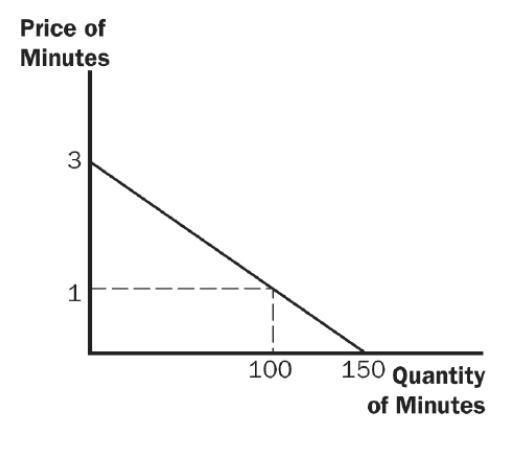
(d) The figure below shows the friend’s demand. With Provider A, she buys 150 minutes and her consumer surplus is equal to (1/2)(3)(150) – 120 = 105. With Provider B, her consumer surplus is equal to (1/2)(2)(100) = 100

(e) I would recommend Provider A because she receives greater consumer surplus when buying from that provider.

7 0
2 years ago
Other questions:
  • The company's adjusted trial balance as follows includes the following accounts balances: Cash, $15,000; Equipment, $85,000; Acc
    8·1 answer
  • At the end of January, Mineral Labs had an inventory of 895 units, which cost $12 per unit to produce. During February the compa
    14·1 answer
  • Omicore Softworks, a software development firm, undertook a project that involved developing a bespoke accounting software for a
    7·1 answer
  • The seabury Corporation has a current ratio of 3.5 and an acid-test ratio of 2.8. The Corporations current assets consist of cas
    13·1 answer
  • Suppose an investment broker offers to sell you a financial asset for $850. You will receive only one payment of $1,000 five yea
    10·2 answers
  • Louis owns an import business. After traveling to France on numerous occasions, he developed a taste for fine French wines. A ra
    15·1 answer
  • Egrane, Inc.'s monthly bank statement showed the ending balance of cash of $14,800. The bank reconciliation for the period showe
    11·1 answer
  • A large company contracts with Jillian to paint three large paintings for the
    11·1 answer
  • Bronn tells Jaime, "I really like your armor." Jaime responds, "I will sell it to you for $800." Bronn states, "Sure, and throw
    6·1 answer
  • Bethany works for FastFashion Inc. which has set the same sales target for all employees in their 550 stores across the globe. T
    6·1 answer
Add answer
Login
Not registered? Fast signup
Signup
Login Signup
Ask question!