answer.
Ask question
Login Signup
Ask question
All categories
  • English
  • Mathematics
  • Social Studies
  • Business
  • History
  • Health
  • Geography
  • Biology
  • Physics
  • Chemistry
  • Computers and Technology
  • Arts
  • World Languages
  • Spanish
  • French
  • German
  • Advanced Placement (AP)
  • SAT
  • Medicine
  • Law
  • Engineering
zalisa [80]
2 years ago
12

Select the correct statement below:

Chemistry
1 answer:
uranmaximum [27]2 years ago
5 0

<u>Answer:</u> The correct answer is Option D.

<u>Explanation:</u>

Valence electrons are defined as the electrons which are present in the outermost shell of the atom. Outermost shell has the highest value of 'n' that is principal quantum number.

For the given options:

  • <u>Option A:</u>

Phosphorus is the 15th element of the periodic table having electronic configuration 1s^22s^22p^63s^23p^3

Number of valence electrons = 2 + 3 = 5

The '3s' orbital is fully filled and all the three '3p' orbitals are half filled for the given element.

So, the given statement is not correct.

  • <u>Option B:</u>

Aluminium is the 13th element of the periodic table having electronic configuration 1s^22s^22p^63s^23p^1

Number of valence electrons = 2 + 1 = 3

The '3s' orbital is fully filled and one of all the three '3p' orbitals is half filled and rest are empty for the given element.

So, the given statement is not correct.

  • <u>Option C:</u>

Calcium is the 20th element of the periodic table having electronic configuration 1s^22s^22p^63s^23p^64s^2

Number of valence electrons = 2

The '4s' orbital is fully filled and all the three '4p' orbitals are half filled for the given element. '4s' sub-shell has only one orbital.

So, the given statement is not correct.

  • <u>Option D:</u>

Sodium is the 11th element of the periodic table having electronic configuration 1s^22s^22p^63s^1

Number of valence electrons = 1

The '3s' orbital is half filled and all the three '3p' orbitals are half filled for the given element.

So, the given statement is not correct.

Hence, the correct answer is Option D.

You might be interested in
Four balloons, each with a mass of 10.0 g, are inflated to a volume of 20.0 L, each with a different gas: helium, neon, carbon m
weeeeeb [17]
On temperature 25°C (298,15K) and pressure of 1 atm each gas has same amount of substance:
n(gas) = p·V ÷ R·T = 1 atm · 20L ÷ <span>0,082 L</span>·<span>atm/K</span>·<span>mol </span>· 298,15 K
n(gas) = 0,82 mol.
1) m(He) = 0,82 mol · 4 g/mol = 3,28 g.
d(He) = 10 g + 3,28 g ÷ 20 L = 0,664 g/L.
2) m(Ne) = 0,82 mol · 20,17 g/mol = 16,53 g.
d(Ne) = 26,53 g ÷ 20 L = 1,27 g/L.
3) m(CO) = 0,82 mol ·28 g/mol = 22,96 g.
d(CO) = 32,96 g ÷ 20L = 1,648 g/L.
4) m(NO) = 0,82 mol ·30 g/mol = 24,6 g.
d(NO) = 34,6 g ÷ 20 L = 1,73 g/L.
6 0
2 years ago
Read 2 more answers
What is the maximum volume of a 0.788 M CaCl2 solution that can be prepared using 85.3 g CaCl2
LekaFEV [45]
Molar mass CaCl₂ = 111.0 g/mol

number of moles:

n = mass of solute / molar mass

n = 85.3 / 111.0

n = 0.7684 moles of CaCl₂

M = n / V

0.788 M = <span>0.7684 / V
</span>
V = 0.7684 / 0.788

V = 0.97512 L

hope this helps!


3 0
2 years ago
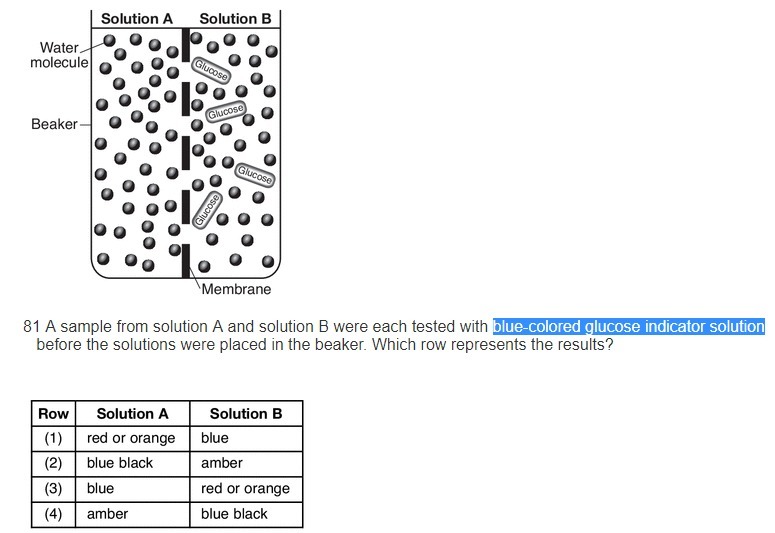
A sample from solution a and solution b were each tested with blue colored glucose indicator solution before the solutions were
vova2212 [387]
With the given problem you gave here, I can't answer the question because I need more details. Luckily, I found a similar problem that's provided with a diagram and a table shown in the attached picture.

This test is called the Benedict's test which is used as test for presence of sugars. If the solution contains sugar, like glucose, the solution would turn from blue to red. If not, it would stay blue. <em>Therefore, the correct results would be that in row 3.</em>

3 0
2 years ago
CuSO4(aq) + 2NaOH(aq) Cu(OH)2(s) + Na2SO4(aq)
REY [17]
Your answer is right.

Important elements to consider:

- to use the balanced equation (which you did)
- divide the masses of each compound by the correspondant molar masses (which you did)
- compare the theoretical proportions with the current proportions

Theoretical: 2 mol of Na OH : 1 mol of CuSO4
Then 4 mol of NaOH need 2 mol of CUSO4.

Given that you have more than 2 mol of of CUSO4 you have plenty of it and the NaOH will consume first, being this the limiting reagent.

6 0
2 years ago
Which statement is true of a reversible reaction at equilibrium?
Vedmedyk [2.9K]

Answer:

D.

The concentration of reactants and the concentration of products are constant.

Explanation:

pls mark as brainliest

7 0
2 years ago
Read 2 more answers
Other questions:
  • In what unit is formula mass expressed?
    5·1 answer
  • What is the mass of a solution that has a density of 0.775 g/ml and a volume of 50.0ml?
    8·1 answer
  • Given a compound with a mw of 169 amu having 13.60% na, 8.29% n, 35.51% c, 4.77% h, and 37.85% o, determine the number of each a
    11·2 answers
  • How many grams of h2 gas can be produced by the reaction of 63.0 grams of al(s) with an excess of dilute hydrochloric acid in th
    12·2 answers
  • Draw the structure of (z)-3-methylhept-3-ene. be sure the stereochemistry is drawn clearly.
    7·1 answer
  • How does a conductivity apparatus test whether a solution has ionic or covalent substances in it? It fails to light up except in
    8·2 answers
  • A new potential heart medicine, code-named X-281, is being tested by a pharmaceutical company, Pharma-pill. As a research techni
    13·1 answer
  • What are the empirical formulas of a) ethylene glycol, a radiator antifreeze, molecular formula C2H6O2 b) peroxodisulfuric acid,
    12·1 answer
  • In recent years, assistive technologies have been developed to give people
    12·1 answer
  • Hypothesis and Observations
    13·1 answer
Add answer
Login
Not registered? Fast signup
Signup
Login Signup
Ask question!