answer.
Ask question
Login Signup
Ask question
All categories
  • English
  • Mathematics
  • Social Studies
  • Business
  • History
  • Health
  • Geography
  • Biology
  • Physics
  • Chemistry
  • Computers and Technology
  • Arts
  • World Languages
  • Spanish
  • French
  • German
  • Advanced Placement (AP)
  • SAT
  • Medicine
  • Law
  • Engineering
patriot [66]
2 years ago
14

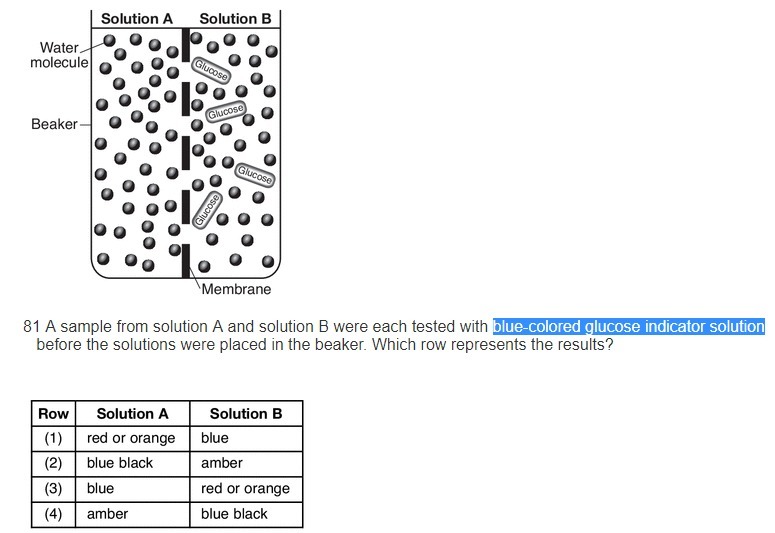
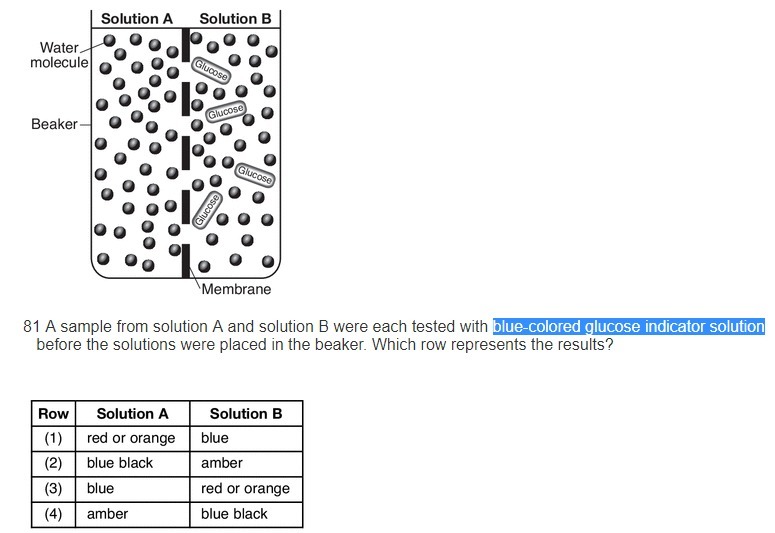
A sample from solution a and solution b were each tested with blue colored glucose indicator solution before the solutions were

placed in the beaker which row represents the results

Chemistry
1 answer:
vova2212 [387]2 years ago
3 0
With the given problem you gave here, I can't answer the question because I need more details. Luckily, I found a similar problem that's provided with a diagram and a table shown in the attached picture.

This test is called the Benedict's test which is used as test for presence of sugars. If the solution contains sugar, like glucose, the solution would turn from blue to red. If not, it would stay blue. <em>Therefore, the correct results would be that in row 3.</em>

You might be interested in
Phosphorous acid, h3po3(aq), is a diprotic oxyacid that is an important compound in industry and agriculture. calculate the ph f
Varvara68 [4.7K]

Answer:

Explanation:

(a)

Before the addition of KOH :-

Given pKa1 of H3PO3 = 1.30

we know , pKa1 = - log10Ka1

Ka1 = 10-pKa1

Ka1 = 10-1.30

Ka1 = 0.0501

similarly pKa2 = 6.70 ,therefore Ka2 = 1.99 x 10⁻⁷

because Ka1 >> Ka2 , therefore pH of diprotic acid i.e H3PO3 can be calculated from first dissociation only .

ICE table is :-

H3PO3 (aq) <-------------> H+ (aq) + H2PO3-(aq)

I 2.4 M 0 M 0 M

C - x + x + x

E (2.4 - x )M x M x M

x = degree of dissociation

Now expression of Ka1 is :

Ka1 = [ H+ ] [ H2PO3-] / [ H3PO3]

0.0501 = x2 / 2.4 - x

on solving for x by using quadratic formula , we have

x = 0.32

Now [ H+ ] = [ H2PO3-] = 0.32 M

pH = - log [H+]

pH = - log 0.32

pH = - ( - 0.495)

pH = 0.495

Hence pH before the addition of KOH = 0.495

(b)

After the addition of 25.0 mL of 2.4 M KOH :-

Number of moles of KOH = 2.4 M x 0.025 L = 0.06 mol

Number of moles of H3PO3 = 2.4 M x 0.050 L = 0.12 mol

Now 0.06 moles of KOH is equal to the half of the moles required for the first equivalent point . therefore pH at this point is equal to pKa1 .

Hence pH = 1.30 M

(c)

After the addition of 50.0 mL of 2.4 M KOH :-

Number of moles of KOH = 2.4 M x 0.050 L = 0.12 mol

Number of moles of H3PO3 = 2.4 M x 0.050 L = 0.12 mol

because Number of moles of H3PO4 = Number of moles of KOH

therefore , this point is the first equivalence point

and pH = pKa1 + pKa2 / 2

pH = 1.30 + 6.70 / 2

pH = 4.00

Hence pH = 4.00

(d)

After the addition of 75.0 mL of 2.4 M KOH :-

Number of moles of KOH = 2.4 M x 0.075 L = 0.18 mol

Number of moles of H3PO3 = 2.4 M x 0.050 L = 0.12 mol

This is the half way of the second equivalence point , therefore pH is equal to pKa2 .

Hence pH = 6.70
5 0
2 years ago
What is the conjugate acid of each of the following? What is the conjugate base of each?
Lilit [14]

Answer:

a. H₂O (conjugate acid) ; b. OH⁻ (conjugate base), H₃O⁺ (conjugate acid) ; c. H₂CO₃ (conjugate acid), CO₃⁻² (conjugate base) ; d. NH₄⁺ (conjugate strong acid) e. H₂SO₄ (conjugate acid), SO₄⁻² (conjugate base) ; f. No conjugate acid either base;  g. H₂S (conjugate acid), S⁻² (conjugate base);

h. H₄N₂ (conjugate base)

Explanation:

a.  OH⁻  +  H⁺  ⇄ H₂O

The hydroxide acts like a Bronsted Lory base, so it can catch a proton. Water will be the conjugate acid.

b. H₂O, is an amphoterus compound. It can act as an acid or a base. If it is a base, the conjugate acid is the H₃O⁺. If it is an acid, the conjugate base is the OH⁻.

c. HCO₃⁻  +  H⁺  ⇄  H₂CO₃

HCO₃⁻  +  H₂O  ⇄ CO₃⁻²  +  H₃O⁺

The bicarbonate is also amphoteric. When it catches the proton, the carbonic acid is the conjugate acid, cause it works as a base.

When the HCO₃⁻ (acid) release the proton, the conjugate base is the carbonate.

d. Ammonia is a weak base, so the conjugate strong acid is the ammonium.

NH₃ + H₂O  ⇄  NH₄⁺  +  OH⁻

e. Another amphoteric compound. The acid sulfate acts an acid and a base.

(like bicarbonate). When it is a base, the conjugate acid is the sulfuric acid, when it is an acid, the conjugate base is the sulfate.

HSO₄⁻  +  H₂O  ⇄  SO₄⁻²  +  H₃O⁺

HSO₄⁻  +  H⁺  ⇄  H₂SO₄

f. H₂O₂ does not recieve H⁺ or OH⁻, and it does not release H⁺. It is a neutral compound and it doesn't act as a base or acid.

g. HS⁻ is amphoterous.

HS⁻  +  H⁺  ⇄  H₂S

HS⁻  +  H₂O  ⇄  S⁻²  +  H₃O⁺

Same case as bicarbonate or acid sulfate.

h. H₅N₂⁺  +  H₂O  ⇄  H₄N₂  + H₃O⁺

Hidrazinium acts an acid, so, the conjugate base will be the hidrazine.


3 0
2 years ago
On a separate sheet of paper, write the formulas for the missing components of these neutralization reactions.
Fofino [41]
The  formula  of  the  missing  component  are  a   follows

HBr  +  KOH  ------>  KBr  +  H2O

H2SO4  +  2NH4OH--------> (NH4)2SO4  +  2H2O

2HNO3     +  Mg(OH)2  --------->  Mg(NO3)2  +  2  H2O
4 0
2 years ago
Read 2 more answers
One mole of an ideal gas in a closed system, initially at 25°C and 10 bar, is first expanded adiabatically, then heated isochori
Igoryamba

Answer:

P_2=0.398bar=39800Pa

T_2=118.7K\\

Q=-3729.9J

W=-61753.24J

ΔU_T=0J

ΔH_T=0J

Explanation:

Hello,

At the first state, the molar volume is:

v_1=\frac{RT}{P_1} =\frac{8.314\frac{Pa*m^3}{molK}*298.15}{1x10^6Pa}=2.48x10^{-3}m^3

The volume in both the second and third state:

v_2=v_3=\frac{RT}{P_1} =\frac{8.314\frac{Pa*m^3}{molK}*298.15}{1x10^5Pa}=2.48x10^{-2}m^3

Now, as it is about an adiabatic process, one remembers the following relationships:

PV^\alpha =K\\TV^{\alpha-1}\\\alpha=\frac{Cp}{Cv}=\frac{7/2R}{5/2R}=1.4

- Next, for the aforesaid volumes and the first pressure, one computes the second pressure as:

P_2=\frac{P_1V_1^\alpha }{V_2^\alpha} =\frac{10bar*(2.48x10^{-3}m^3)^{1.4}}{(2.48x10^{-2}m^3)^{1.4}} =0.398bar=39800Pa

- And the temperature:

T_2=\frac{T_1V_1^{\alpha-1}}{V_2^{\alpha-1}} =\frac{298.15K*(2.48x10^{-3}m^3)^{1.4-1}}{(2.48x10^{-2}m^3)^{1.4-1}} =118.7K\\

- Q:

It is clear that the heat for the first process is 0 as it is adiabatic, but for the second one, it is computed as:

Q_2=nCv(T_2-T_1)=1mol*\frac{5}{2}(8.314\frac{J}{mol*K})*(118.7K-298.15K)=-3729.9J

Then the total heat:

Q=Q_1+Q_2=0-3729.9J=-3729.9J

- The work for the first process is:

W_1=\frac{P_2V_2-P_1V_1}{1-\alpha }=\frac{39800Pa*2.48x10^{-3}m^3-1x10^6Pa*2.48x10^{-2}m^3}{0.4} \\W_1=-61753.24J

It is clear that the second process is isochoric, so the work here is zero, thus, the total work is:

W=W_1+W_2=-61753.24J+0J=-61753.24J

- For the two processes, ΔU becomes the same value since the system returns to the initial temperature, so ΔU total is 0, thus, for each process, one's got:

U_1=nCv(T_2-T_1)=1mol*\frac{5}{2}(8.314\frac{J}{mol*K})*(118.7K-298.15K)=-3729.9J\\U_2=nCv(T_3-T_2)=1mol*\frac{5}{2}(8.314\frac{J}{mol*K})*(298.15K-118.7K)=3729.9J\\

- Finally, the total enthapy is also 0 due to same aforesaid reason, thus, each enthalpy is:

H_1=nCp(T_2-T_1)=1mol*\frac{7}{2}(8.314\frac{J}{mol*K})*(118.7K-298.15K)=-5221.86J\\H_2=nCv(T_3-T_2)=1mol*\frac{7}{2}(8.314\frac{J}{mol*K})*(298.15K-118.7K)=5221.86J\\

Best regards.

8 0
2 years ago
Which air mass has formed immediately north of Antarctica in the image?
hammer [34]

Answer:

Maritime Polar

5 0
2 years ago
Read 2 more answers
Other questions:
  • Consider the equation: 2NO2(g) N2O4(g). Using ONLY the information given by the equation which of the following changes would in
    15·2 answers
  • When elemental sodium is added to water, the sodium atoms ionize spontaneously. uncharged na becomes na+. this means that the na
    5·1 answer
  • How much heat is required to convert 422 g of liquid h2o at 23.5 °c into steam at 150 °c?
    11·2 answers
  • Mass in grams of 6.25 mol of copper (II) nitrate?
    11·2 answers
  • Sodium thiosulfate (Na2S2O3), photographer’s
    6·2 answers
  • A student is given a sample of CuSO4(s) that contains a solid impurity that is soluble and colorless. The student wants to deter
    10·1 answer
  • Which of these tasks falls under the responsibility of a forensic scientist?
    7·1 answer
  • HELPP 20+ POINTS!!!
    12·1 answer
  • Air is a ________ mixture??​
    10·2 answers
  • A student obtained an unknown metal sample that weighed 65.3 g and at a temperature of 99.8oC, he placed it in a calorimeter con
    11·1 answer
Add answer
Login
Not registered? Fast signup
Signup
Login Signup
Ask question!