answer.
Ask question
Login Signup
Ask question
All categories
  • English
  • Mathematics
  • Social Studies
  • Business
  • History
  • Health
  • Geography
  • Biology
  • Physics
  • Chemistry
  • Computers and Technology
  • Arts
  • World Languages
  • Spanish
  • French
  • German
  • Advanced Placement (AP)
  • SAT
  • Medicine
  • Law
  • Engineering
Firdavs [7]
2 years ago
11

Given a compound with a mw of 169 amu having 13.60% na, 8.29% n, 35.51% c, 4.77% h, and 37.85% o, determine the number of each a

tom present in the compounds formula?

Chemistry
2 answers:
Arisa [49]2 years ago
5 0
1) Percent composition

<span>Na: 13.60%,
N:     8.29%
C:    35.51%
H:      4.77%
O:   37.85%
     -------------
       100.02%

2) Convert mass percent to molar composition

For that, divide the percent of each element by its atomic mass.

</span>
<span>Na: 13.60 / 22.99 = 0.5916
N:     8.29 / 14.01 = 0.5917
C:    35.51 / 12.01 = 2.9567
H:      4.77 / 1.01 = 4.7228
O:   37.85 / 16.00 = 2.3656

3) Divide each number by the smallest one:

</span>
<span><span>Na:  0.5916 / 0.5916 = 1.0
N:     0.5917 / 0.5916 = 1.0
C:    2.9567 / 0.5916 = 5.0
H:      4.7228 / 0.5916 = 8.0
O:   2.3656</span> / 0.5916 = 4.0

4) State the empirical formula: Na N C5 H8 O4

5) Calculate the mass of the empirical formula:

Multiplicate the number of each atoms times the atomic mass corresponding atomic mass of the atom.

1 * 22.99 + 1 * 14.01 + 5 * 12.01 + 8 * 1.01 + 4 * 16.00 = 169.13

6) Divide the molar mass by the mass of the empirical formula:

169 / 169.13 = 1

7) Conclusion: the molecular formula is Na N C5 H8 O4, so the number of atoms present in the compound formula are:

Na: 1
N: 1
C: 5
N: 8
O: 4
</span>

ASHA 777 [7]2 years ago
4 0

<em>The number of atoms making up the compound is </em>

<em>Na = 1, N = 1, C = 5, H = 8 and O = 4 </em>

<em></em>

\boxed{\boxed{\bold{Further~explanation}}}

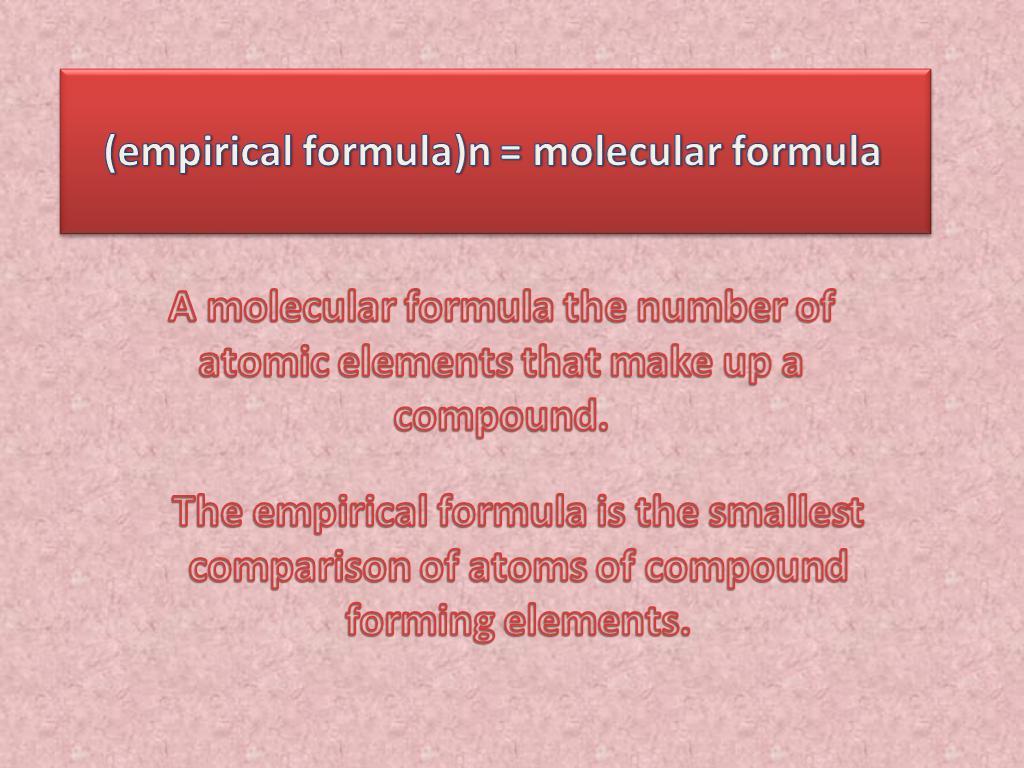
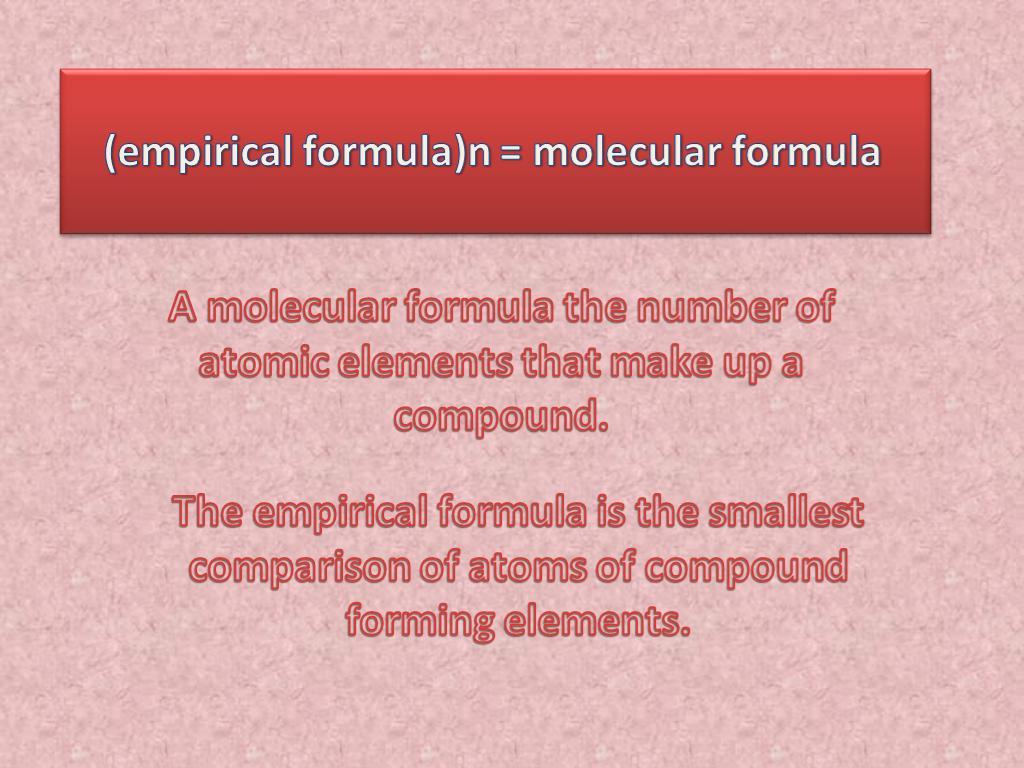
The empirical formula is the smallest comparison of atoms of compound forming elements.

A molecular formula is a formula that shows the number of atomic elements that make up a compound.

(empirical formula) n = molecular formula

The principle of determining empirical formula and molecular formula

  • Determine the mass ratio of the constituent elements of the compound.
  • Determine the mole ratio by dividing the elemental mass with the relative atomic mass obtained by the empirical formula
  • Determine molecular formulas by looking for values of n

Percentage of elements A and B in AxBy compounds:

% A in AₓBy = (x x Ar A / Mr AₓBy) x% AₓBy

% B in AₓBy = (y x Ar B / Mr AₓBy) x% AₓBy

It is known about the% mass of each element

To find the empirical formula, we look for its mole ratio (% mass/ its relative atomic mass)

Na = 13.6 / 23 = 0.5913

N = 8.29 / 14 = 0.5921

C = 35.51 / 12 = 2.9592

H = 4.77 / 1 = 4.77

O = 37.85 / 16 = 2.3656

To simplify the comparison as an integer, we divide by the mole ratio of the smallest element

Na = 0.5913 / 0.5913 = 1

N = 0.5921 / 0.5913 = 1

C = 2.9592 / 0.5913 = 5

H = 4.77 / 0.5913 = 8

O = 2,3656 / 0,5913 = 4

So the empirical formula:

NaNC5H8O4

We look for the molecular formula to get the number of atoms making up the compound

(NaNC5H8O4) n = Mr compound

(1.23 + 14.1 + 5.12 + 8.1 + 4.16) n = 169

(169) n = 169

n = 1

So that the empirical formula and molecular formula are the same so that the number of atoms making up the compound is

Na = 1, N = 1, C = 5, H = 8 and O = 4

\boxed{\boxed{\bold{Learn~more}}}

the molar mass of a substance

brainly.com/question/837939

Determine the empirical and molecular formulas

brainly.com/question/9255428

Determine the molecular formula of the compound

brainly.com/question/11558543

Keywords: empirical formula, molecular formula, mass, mole
You might be interested in
What is the molality of sodium chloride in solution that is 13.0% by mass sodium chloride and that has a density of 1.10 g/ml?
8090 [49]
Answer is: molality od sodium chloride is 2,55 mol/kg.
V(solution) = 100 ml.
m(solution) = d(solution) · V(solution).
m(solution) = 1,10 g/ml · 100 ml.
m(solution) = 110 g.
ω(NaCl) = 13,0% = 0,13.
m(NaCl) = ω(NaCl) · m(solution).
m(NaCl) = 0,13 · 110 g.
m(NaCl) = 14,3 g.
n(NaCl) = m(NaCl) ÷ M(NaCl).
n(NaCl) = 14,3 g ÷ 58,5 g/mol.
n(NaCl) = 0,244 mol.
m(H₂O) = 110 g - 14,3 g.
m(H₂O) = 95,7 g = 0,0957 kg.
b(NaCl) = n(NaCl) ÷ m(H₂O).
b(NaCl) = 0,244 mol ÷ 0,0957 kg.
b(NaCl) = 2,55 mol/kg.
3 0
2 years ago
Which of the following pairs of compounds would be most easily separated by thin layer chromatography: n-octyl alcohol and 1-oct
vivado [14]

Answer:

B. n-octyl alcohol and 1-octene

Explanation:

Thin-layer chromatography (TLC) is a chromatography technique used to separate non-volatile mixtures. The principle is that different compounds in the sample mixture travel at different rates due to the differences in interactions with stationary phase and due to the differences in solubility in the solvent. The principal chemical property for separation using this technique is molecular polarity

You can intuit than hexadecane and octadecane don't have big polarity differences, also chlorobenzene and bromobenzene haven't.

An alcohol as n-octyl alcohol has different polarity than an alkene as 1-octene.

Thus, using  thin layer chromatography is most easy to separate:

<em>B. n-octyl alcohol and 1-octene </em>

<em></em>

I hope it helps!

<em></em>

8 0
2 years ago
Hydrogen was collected over water using the approach in the manual. The water temperature was 220C and the measured pressure ins
olasank [31]

Answer:

Pressure of hydrogen gas = 695.2 mmHg

Explanation:

Given:

Water temperature = 22°C

Pressure inside the tube = 715 mmHg

Find:

Pressure of hydrogen gas

Computation:

Using vapor pressure of water table

Water pressure at 22°C = 19.8 mmHg

Pressure inside the tube = Pressure of hydrogen gas + Water pressure at 22°C

715 = Pressure of hydrogen gas + 19.8

Pressure of hydrogen gas = 715 - 19.8

Pressure of hydrogen gas = 695.2 mmHg

3 0
2 years ago
A 0.20 mol sample of MgCl2(s) and a 0.10 mol sample of KCl(s) are dissolved in water and diluted to 500 mL. What is the concentr
igor_vitrenko [27]

Answer:

1 M

Explanation:

Magnesium chloride will furnish chloride ions as:

MgCl_2\rightarrow Mg^{2+}+2Cl^-

Given :

Moles of magnesium chloride = 0.20 mol

Thus, moles of chlorine furnished by magnesium chloride is twice the moles of magnesium chloride as shown below:

Moles =2\times 0.20\ moles

Moles of chloride ions by magnesium chloride = 0.40 moles

Potassium chloride will furnish chloride ions as:

KCl\rightarrow K^{+}+Cl^-

Given :

Moles of potassium chloride = 0.10 moles

Thus, moles of chlorine furnished by potassium chloride is same as the moles of potassium chloride as shown below:

Moles of chloride ions by potassium chloride = 0.10 moles

Total moles = 0.40 + 0.10 moles = 0.50 moles

Given, Volume = 500 mL = 0.5 L (1 mL = 10⁻³ L)

Concentration of chloride ions is:

Molarity=\frac{Moles\ of\ solute}{Volume\ of\ the\ solution}

Molarity_{Cl^-}=\frac{0.50}{0.5}

<u> The final concentration of chloride anion = 1 M</u>

8 0
2 years ago
A chunk of dry ice, solid CO2, "disappears" after sitting at room temperature for a while. There is no puddle of liquid. What ha
Vika [28.1K]
I believe the answer is A.
8 0
2 years ago
Other questions:
  • In Males which of the following organ performs a dual function of ejaculation of sperm and voiding of urine
    13·2 answers
  • How many kilograms are in 4 moles of Na2CO3?
    13·1 answer
  • A common reaction is the formation of butyric acid from butyl alcohol. butyric acid is what causes the odor of rancid butter. ba
    14·2 answers
  • A piece of metal with a mass of 611 g is placed into a graduated cylinder that contains 25.1 ml of water, raising the water leve
    8·1 answer
  • Industrial production of nitric acid, which is used in many products including fertilizers and explosives, approaches 10 billion
    9·1 answer
  • A new potential heart medicine, code-named X-281, is being tested by a pharmaceutical company, Pharma-pill. As a research techni
    13·1 answer
  • The weight percent of concentrated HClO4(aq) is 70.5% and its density is 1.67 g/mL. What is the molarity of concentrated HClO4
    6·1 answer
  • In Part B the given conditions were 1.00 mol of argon in a 0.500-L container at 27.0 ∘C . You identified that the ideal pressure
    14·1 answer
  • How many molecules of CO2 are contained in a 10.0 L tank at 7.53 atm and 485 K?
    14·2 answers
  • Which is an issue that governments must consider before passing conservation policies? urbanization implications cost to impleme
    12·2 answers
Add answer
Login
Not registered? Fast signup
Signup
Login Signup
Ask question!