answer.
Ask question
Login Signup
Ask question
All categories
  • English
  • Mathematics
  • Social Studies
  • Business
  • History
  • Health
  • Geography
  • Biology
  • Physics
  • Chemistry
  • Computers and Technology
  • Arts
  • World Languages
  • Spanish
  • French
  • German
  • Advanced Placement (AP)
  • SAT
  • Medicine
  • Law
  • Engineering
Tatiana [17]
2 years ago
8

What is the maximum volume of a 0.788 M CaCl2 solution that can be prepared using 85.3 g CaCl2

Chemistry
1 answer:
LekaFEV [45]2 years ago
3 0
Molar mass CaCl₂ = 111.0 g/mol

number of moles:

n = mass of solute / molar mass

n = 85.3 / 111.0

n = 0.7684 moles of CaCl₂

M = n / V

0.788 M = <span>0.7684 / V
</span>
V = 0.7684 / 0.788

V = 0.97512 L

hope this helps!


You might be interested in
A student dissolved a sample in hexane, spotted it on to a TLC plate and eluted using ethyl acetate. After visualizing the TLC p
Zepler [3.9K]

1) Consider the following silica gel TLC plate of compounds A, B, and C developed in hexanes:

<span><span>Determine the Rf values of compounds A, B, and C run on a silica gel TLC plate using hexanes as the solvent.</span>Which compound, A, B, or C, is the most polar?<span>What would you expect to happen to the Rf values if you used acetone instead of hexanes as the eluting solvent?</span><span>How would the Rf values change if eluted with hexanes using an alumina TLC plate?</span></span>

Show answer

2) You are trying to determine a TLC solvent system which will separate the compounds X, Y, and Z. You ran the compounds on a TLC plate using hexanes/ethyl acetate 95:5 as the eluting solvent and obtained the chromatogram below. How could you change the solvent system to give better separation of these three compounds?

Show answer

3) After a rather lengthy organic chemistry synthesis procedure, a student ran the product of the reaction on a TLC plate and obtained the result below. What might he/she have done wrong, if anything?

Show answer

4) A student spots an unknown sample on a TLC plate. After developing in hexanes/ethyl acetate 50:50, he/she saw a single spot with an Rf of 0.55. Does this indicate that the unknown material is a pure compound? What can be done to verify the purity of the sample?

Show answer

5) Consider a sample that is a mixture composed of biphenyl, benzoic acid, and benzyl alcohol. The sample is spotted on a TLC plate and developed in a hexanes/ethyl acetate solvent mixture. Predict the relative Rf values for the three compounds in the sample.

Show answer

6) Plate A, below, represents the TLC chromatogram of a compound run in hexanes. The same compound was then spotted on a large TLC plate and again run in hexanes. Which TLC plate, B, C, or D, correctly represents how far the compound would run on the longer plate?

Show answer

Back to TLC

Original content © University of Colorado at Boulder, Department of Chemistry and Biochemistry.
The information on these pages is available for academic use without restriction.
3 0
2 years ago
To determine the concentration of ethanol in cognac a 5.00 mL sample of the cognac is diluted to 0.500 L. Analysis of the dilute
julia-pushkina [17]

Answer : The molar concentration of ethanol in the undiluted cognac is 8.44 M

Explanation :

Using neutralization law,

M_1V_1=M_2V_2

where,

M_1 = molar concentration of undiluted cognac = ?

M_2 = molar concentration of diluted cognac = 0.0844 M

V_1 =  volume of undiluted cognac = 5.00 mL = 0.005 L

V_2 = volume of diluted cognac = 0.500 L

Now put all the given values in the above law, we get molar concentration of ethanol in the undiluted cognac.

M_1\times 0.005L=0.0844M\times 0.500L

M_1=8.44M

Therefore, the molar concentration of ethanol in the undiluted cognac is 8.44 M

4 0
2 years ago
The volume of hcl gas required to react with excess ca to produce 11.4 l of hydrogen gas at 1.62 atm and 62.0 °c is ________ l.
seropon [69]

Answer:

22.8 L  

Step-by-step explanation:

We can use <em>Gay-Lussac's Law of Combining Volumes</em> to solve this problem:

Gases <em>at the same temperature and pressure</em> react in simple whole-number ratios.

1. Write the chemical equation.

Ratio:                 2 L                             1 L

          Ca(s) + 2HCl(g) ⟶ CaCl₂(s) + H₂(g)

V/L:                                                     11.4

2. Calculate the volume of HCl.

According to the law, 2 L of HCl form 1 L of H₂.

Then, the conversion factor is (2 L HCl/1 L H₂).

Volume of HCl = 11.4 L H₂ × (2 L HCl/1 L H₂)

                         = 22.8 L HCl

3 0
2 years ago
The differential cross section for scattering 6.5-MeV alpha particles at 120° off a silver nucleus is about 0.5 barns/sr. If a t
Burka [1]

Answer:

Nsc=30

Explanation:

The solid angle subtended by the counter is

d=0.1mm2/(1cm)2=(10)3 sr

d=(10)10x10.5gcm3x10-4cm/108x1.6610x10-24gx0.510-24cm2x10-3=30

8 0
2 years ago
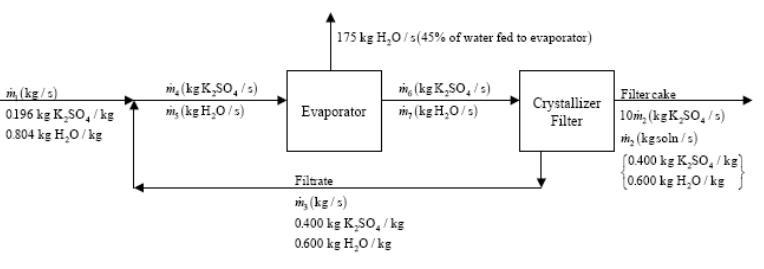
An evaporation–crystallization process of the type described in Example 4.5-2 is used to obtain solid potassium sulfate from an
timofeeve [1]

Answer:

feed = 220.77 kg/s; maximum production rate of solid crystal = 416 kg/s; the rate of supplying fresh feed to obtain the production rate = 1.6

Explanation:

Material or mass balance can be used to estimate the mass flow rates of all the streams in the diagram shown in the attached file.

Overall balance: M_{1} = 175 + 11M_{2}

Water: 0.804M_{1} = 175 + 0.6M_{2}

Using substitution method, we have:

M_{1} = 220.77 kg/s

M_{2}  = 4.16 kg/s

The maximum production rate of solid crystal is 10M_{2} = 10*4.16 = 416 kg/s

Around evaporator:

0.45M_{5} = 175

M_{5} = 175/0.45 = 389 kg/s

Around the mixing point:

M_{1} + M_{3} = M_{4} + M_{5}

Solid crystal: 0.196M_{1} + 0.4M_{3} = M_{4}

Using the last two equations, we can obtain:

0.804M_{1} + 0.6M_{3} = M_{5}

0.6M_{3} = 389 - 0.804*220.77 = 389 - 177.5 = 211.5

M_{3} = 211.5/0.6 = 352.5 kg/s

The rate of supplying fresh feed to obtain the production rate is:

\frac{M_{3}}{M_{1}} = 352.5/220.77 = 1.6

7 0
3 years ago
Other questions:
  • Addition of 6 M HCl to which substance will NOT result
    10·2 answers
  • Quinine, an antimalarial drug, is 8.63% nitrogen. There are two nitrogen atoms per molecule. What is the molecular weight of qui
    5·1 answer
  • On a trip to the natural history museum you find two minerals that are similar in color. You can see from their chemical formula
    6·1 answer
  • A 0.944 M solution of glucose, C6H12O6, in water has a density of 1.0624 g/mL at 20∘C. What is the concentration of this solutio
    10·1 answer
  • Element X is a radioactive isotope such that every 82 years, its mass decreases by half. Given that the initial mass of a sample
    14·1 answer
  • How many moles of CaC2 are needed to react completely with 45.0g H2O?
    14·1 answer
  • Which isoelectronic series is correctly arranged in order of increasing radius?
    6·1 answer
  • what is 31/50000 If the toxic quantity is 1.5 g of ethylene glycol per 1000 g of body mass, what percentage of ethylene glycol i
    8·1 answer
  • Aspirin synthesis involves the addition of an acetyl group to salicylic acid in a condensation reaction with an alcohol. The ace
    8·1 answer
  • How many moles of BCl3 are needed to produce 10.0 g of HCl(aq) in the following reaction? (HCl molar mass is 36.46 g/mol).
    14·1 answer
Add answer
Login
Not registered? Fast signup
Signup
Login Signup
Ask question!