answer.
Ask question
Login Signup
Ask question
All categories
  • English
  • Mathematics
  • Social Studies
  • Business
  • History
  • Health
  • Geography
  • Biology
  • Physics
  • Chemistry
  • Computers and Technology
  • Arts
  • World Languages
  • Spanish
  • French
  • German
  • Advanced Placement (AP)
  • SAT
  • Medicine
  • Law
  • Engineering
Flura [38]
3 years ago
14

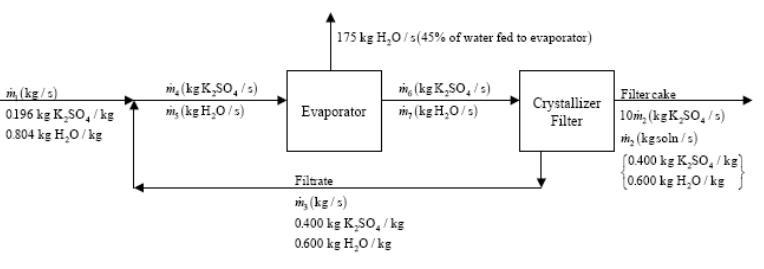
An evaporation–crystallization process of the type described in Example 4.5-2 is used to obtain solid potassium sulfate from an

aqueous solution of this salt. The fresh feed to the process contains 19.6 wt% K2SO4. The wet filter cake consists of solid K2SO4 crystals and a 40.0 wt% K2SO4 solution, in a ratio 10 kg crystals/kg solution. The filtrate, also a 40.0% solution, is recycled to join the fresh feed. Of the water fed to the evaporator, 45.0% is evaporated. The evaporator has a maximum capacity of 175 kg water evaporated/s.Calculate the maximum production rate of solid K2SO4, the rate at which fresh feed must be supplied to achieve this production rate.

Chemistry
1 answer:
timofeeve [1]3 years ago
7 0

Answer:

feed = 220.77 kg/s; maximum production rate of solid crystal = 416 kg/s; the rate of supplying fresh feed to obtain the production rate = 1.6

Explanation:

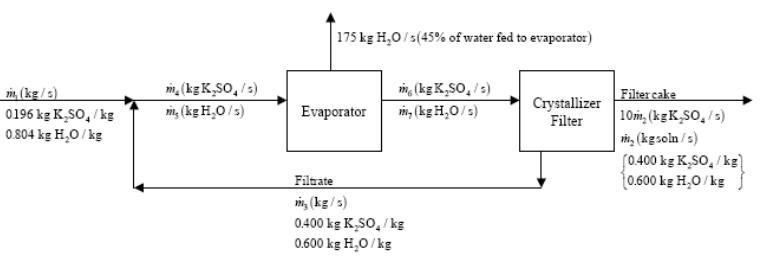
Material or mass balance can be used to estimate the mass flow rates of all the streams in the diagram shown in the attached file.

Overall balance: M_{1} = 175 + 11M_{2}

Water: 0.804M_{1} = 175 + 0.6M_{2}

Using substitution method, we have:

M_{1} = 220.77 kg/s

M_{2}  = 4.16 kg/s

The maximum production rate of solid crystal is 10M_{2} = 10*4.16 = 416 kg/s

Around evaporator:

0.45M_{5} = 175

M_{5} = 175/0.45 = 389 kg/s

Around the mixing point:

M_{1} + M_{3} = M_{4} + M_{5}

Solid crystal: 0.196M_{1} + 0.4M_{3} = M_{4}

Using the last two equations, we can obtain:

0.804M_{1} + 0.6M_{3} = M_{5}

0.6M_{3} = 389 - 0.804*220.77 = 389 - 177.5 = 211.5

M_{3} = 211.5/0.6 = 352.5 kg/s

The rate of supplying fresh feed to obtain the production rate is:

\frac{M_{3}}{M_{1}} = 352.5/220.77 = 1.6

You might be interested in
Suppose a group of volunteers is planning to build a park near a local lake. The lake is known to contain low levels of arsenic
Kisachek [45]

Answer:

A) 10.75 is the concentration of arsenic in the sample in parts per billion .

B) 7,633.66 kg the total mass of arsenic in the lake that the company have to remove.

C) It will take 1.37 years to remove all of the arsenic from the lake.

Explanation:

A) Mass of arsenic in lake water sample = 164.5 ng

The ppb is the amount of solute (in micrograms) present in kilogram of a solvent. It is also known as parts-per million.

To calculate the ppm of oxygen in sea water, we use the equation:

\text{ppb}=\frac{\text{Mass of solute}}{\text{Mass of solution}}\times 10^9

Both the masses are in grams.

We are given:

Mass of arsenic = 164.5 ng = 164.5\times 10^{-9} g

1 ng=10^{-9} g

Volume of the sample = V = 15.3 cm^3

Density of the lake water sample ,d= 1.00 g/cm^3

Mass of sample =  M = d\times V=1.0 g/cm^3\times 15.3 cm^3=15.3 g

ppb=\frac{164.5\times 10^{-9} g}{15.3 g}\times 10^9=10.75

10.75 is the concentration of arsenic in the sample in parts per billion.

B)

Mass of arsenic in 1 cm^3  of lake water = \frac{164.5\times 10^{-9} g}{15.3}=1.075\times 10^{-8} g

Mass of arsenic in 0.710 km^3 lake water be m.

1 km^3=10^{15} cm^3

Mass of arsenic in 0.710\times 10^{15} cm^3 lake water :

m=0.710\times 10^{15}\times 1.075\times 10^{-8} g=7,633,660.130 g

1 g = 0.001 kg

7,633,660.130 g = 7,633,660.130 × 0.001 kg=7,633.660130 kg ≈ 7,633.66 kg

7,633.66 kg the total mass of arsenic in the lake that the company have to remove.

C)

Company claims that it takes 2.74 days to remove 41.90 kilogram of arsenic from lake water.

Days required to remove 1 kilogram of arsenic from the lake water :

\frac{2.74}{41.90} days

Then days required to remove 7,633.66 kg of arsenic from the lake water :

=7,633.66\times \frac{2.74}{41.90} days=499.19 days

1 year = 365 days

499.19 days = \frac{499.19}{365} years = 1.367 years\approx 1.37 years

It will take 1.37 years to remove all of the arsenic from the lake.
3 0
2 years ago
Explain why neither the oil nor the glass fiber interferes with the diffraction pattern of the crystal.
SVEN [57.7K]
<span>It's because The oil and the glass fibers do not interfere with X-ray crystallographic measurements because only one is crystalline.
</span><span>Glass fibers have a low absorbance for </span>X-rays<span> and is </span><span>not crystalline. Because of this, glass fibers will not interfere with X-Ray patterns. Oil, on the other hand, could be considered as crytalline.</span>
8 0
2 years ago
A container holds 15.0 g of phosphorous gas at a pressure of 2.0 atm and a temperature of 20.0 Celsius. What is the density of t
erik [133]
<span>Density is a value for mass, such as kg, divided by a value for volume, such as m3. Density is a physical property of a substance that represents the mass of that substance per unit volume. We calculate as follows:

PV = nRT
PV = mRT/ Molar mass
m/V = P(molar mass)/RT
Density = P(molar mass)/RT 
Density = 2.0 ( 30.97 ) / 0.08206 ( 20 + 273.15) = 2.57 g/L <----First option</span>
5 0
2 years ago
Read 2 more answers
You are writing a safety contract for your class. List 10 things you would include in the contract.
andre [41]

1.always listen to teacher

2 no eating in class

3 always have attentive listening

4 always have proper safety material

5 wear eyeglasses when needed

6 let others be able to listen

 sorry I could only think of 6

7 0
2 years ago
Read 2 more answers
a 0.5674 g piece of copper is added to 10.00 ml; of 16 M HNO3, producing 0.8024 g of copper (ii) nitrate. What is the precent yi
uysha [10]
Idk there just making me answer it
5 0
2 years ago
Read 2 more answers
Other questions:
  • As ice transforms into steam, A)new molecules are formed. B)the types of atoms are changed. C)energy is absorbed by the molecule
    9·2 answers
  • How does the written lewis structure for potassium chloride differ from that of hydrogen chloride?
    9·1 answer
  • Select all of the correct statements pertaining to the first and second ionization energies of different elements. check all tha
    12·2 answers
  • What is the volume of 43.7 g of helium at stp?
    15·2 answers
  • Calculate the moles of camphor dissolved in 1.32 L of phenol. The molar mass of camphor is 152 g/mol and the molarity of phenol
    11·1 answer
  • The element thallium is 70% thallium-205 and 30% thallium-203. Calculate its relative atomic mass to 1 decimal place.
    14·1 answer
  • Sodium is a soft metal with a relatively low work function. Light corresponding to 476 kJmol−1 was shone on the sodium metal, an
    6·1 answer
  • What it the oxidation number for bromine in the molecule H2Br2O6?
    5·1 answer
  • The combustion of ethyne, shown below unbalance, produces heat which can be used to weld metals:
    8·1 answer
  • If the oxygen isotope 20O has a half-life of 15 seconds, what fraction of a sample of pure 20O remains after 1.0 minute?
    12·1 answer
Add answer
Login
Not registered? Fast signup
Signup
Login Signup
Ask question!