answer.
Ask question
Login Signup
Ask question
All categories
  • English
  • Mathematics
  • Social Studies
  • Business
  • History
  • Health
  • Geography
  • Biology
  • Physics
  • Chemistry
  • Computers and Technology
  • Arts
  • World Languages
  • Spanish
  • French
  • German
  • Advanced Placement (AP)
  • SAT
  • Medicine
  • Law
  • Engineering
zhenek [66]
2 years ago
9

How does the written lewis structure for potassium chloride differ from that of hydrogen chloride?

Chemistry
1 answer:
labwork [276]2 years ago
5 0
<span>Lewis structure of both is similar:

H : CI (hydrogen chloride)
</span>
<span>K : CI (potassium chloride)</span>
You might be interested in
How many moles of Cobalt are in 27.4 grams of cobalt
xeze [42]
0.4649331785818406 is what 27.4 grams is converted to! You're welcome!! :) 
5 0
2 years ago
Read 2 more answers
Suppose that magnesium would react exactly the same as copper in this experiment. how many grams of magnesium would have been us
Vikentia [17]

The solution for this problem would be:

We are looking for the grams of magnesium that would have been used in the reaction if one gram of silver were created. The computation would be:

1 g Ag (1 mol Mg) (24.31 g/mol) / (2mol Ag)(107.87g/mol) = 0.1127 grams of Magnesium

6 0
2 years ago
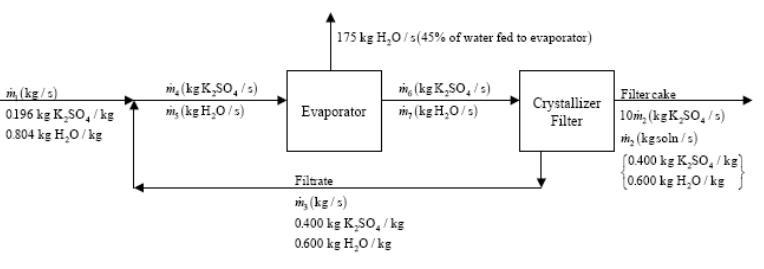
An evaporation–crystallization process of the type described in Example 4.5-2 is used to obtain solid potassium sulfate from an
timofeeve [1]

Answer:

feed = 220.77 kg/s; maximum production rate of solid crystal = 416 kg/s; the rate of supplying fresh feed to obtain the production rate = 1.6

Explanation:

Material or mass balance can be used to estimate the mass flow rates of all the streams in the diagram shown in the attached file.

Overall balance: M_{1} = 175 + 11M_{2}

Water: 0.804M_{1} = 175 + 0.6M_{2}

Using substitution method, we have:

M_{1} = 220.77 kg/s

M_{2}  = 4.16 kg/s

The maximum production rate of solid crystal is 10M_{2} = 10*4.16 = 416 kg/s

Around evaporator:

0.45M_{5} = 175

M_{5} = 175/0.45 = 389 kg/s

Around the mixing point:

M_{1} + M_{3} = M_{4} + M_{5}

Solid crystal: 0.196M_{1} + 0.4M_{3} = M_{4}

Using the last two equations, we can obtain:

0.804M_{1} + 0.6M_{3} = M_{5}

0.6M_{3} = 389 - 0.804*220.77 = 389 - 177.5 = 211.5

M_{3} = 211.5/0.6 = 352.5 kg/s

The rate of supplying fresh feed to obtain the production rate is:

\frac{M_{3}}{M_{1}} = 352.5/220.77 = 1.6

7 0
3 years ago
What is the volume (in ml) of a 12.9 g piece of metal with a density of 7.25 g/cm3?
Leto [7]
Hey there:

1 cm³ = 1 mL

D = m  / V

7.25 = 12.9 / V

V = 12.9 / 7.25

V = 1.779 cm³
6 0
2 years ago
Read 2 more answers
Use the following half-reactions to construct a voltaic cell:
velikii [3]

<u>Answer:</u> The correct answer is 3Ag^+(aq.)+Cr(s)\rightarrow 3Ag(s)+Cr^{3+}(aq.);E^o_{cell}=+1.53V

<u>Explanation:</u>

We are given:

Cr^{3+}(aq.)+3e^-\rightarrow Cr(s);E^o=-0.73V\\\\Ag^+(aq.)+e^-\rightarrow Ag(s);E^o=+0.80V

The substance having highest positive E^o potential will always get reduced and will undergo reduction reaction. Here, silver will always undergo reduction reaction will get reduced.

Chromium will undergo oxidation reaction and will get oxidized.

The half reactions for the above cell is:

Oxidation half reaction: Cr(s)\rightarrow Cr^{3+}+3e^-;E^o_{Cr^{3+}/Cr}=-0.73V

Reduction half reaction: Ag^{+}+e^-\rightarrow Ag(s);E^o_{Ag^{+}/Ag}=0.80V       ( × 3)

Net equation:  3Ag^+(aq.)+Cr(s)\rightarrow 3Ag(s)+Cr^{3+}(aq.)

Oxidation reaction occurs at anode and reduction reaction occurs at cathode.

To calculate the E^o_{cell} of the reaction, we use the equation:

E^o_{cell}=E^o_{cathode}-E^o_{anode}

Putting values in above equation, we get:

E^o_{cell}=0.80-(-0.73)=1.53V

Hence, the correct answer is 3Ag^+(aq.)+Cr(s)\rightarrow 3Ag(s)+Cr^{3+}(aq.);E^o_{cell}=+1.53V

4 0
2 years ago
Other questions:
  • In which orbitals would the valence electrons for carbon <br> c. be placed?
    8·2 answers
  • Examine the sets of bonds given in the choices. which one arranges the bonds in order of increasing (shortest to longest) bond l
    11·1 answer
  • Type the correct answer in the box. Express the answer to three significant figures.
    8·1 answer
  • 10mL of 1M silver nitrate is combined with 25mL of 0.1M sodium chromate. What is the concentration of sodium ion after the two s
    11·1 answer
  • At 80 ∘C, Kc=1.87×10^−3 for the reaction PH3BCl3(s)⇌PH3(g)+BCl3(g)
    11·1 answer
  • The reaction A + B → 2 C has the rate law rate = k[A][B]³. By what factor does the rate of reaction increase when [A] remains co
    6·1 answer
  • Suppose, in an experiment to determine the amount of sodium hypochlorite in bleach, you titrated a 26.34 mL sample of 0.0100 M K
    12·1 answer
  • You mix 500.0 mL of 0.250 M iron(III) chloride solution with 425.0 mL of 0.350 M barium chloride solution. Assuming the volumes
    13·1 answer
  • What are the answers to these questions
    11·1 answer
  • Was Democritus' atomic theory correct?
    9·1 answer
Add answer
Login
Not registered? Fast signup
Signup
Login Signup
Ask question!