answer.
Ask question
Login Signup
Ask question
All categories
  • English
  • Mathematics
  • Social Studies
  • Business
  • History
  • Health
  • Geography
  • Biology
  • Physics
  • Chemistry
  • Computers and Technology
  • Arts
  • World Languages
  • Spanish
  • French
  • German
  • Advanced Placement (AP)
  • SAT
  • Medicine
  • Law
  • Engineering
gregori [183]
2 years ago
8

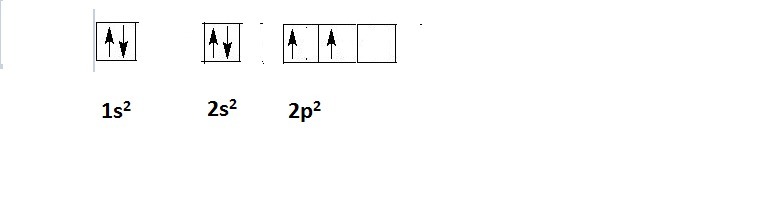
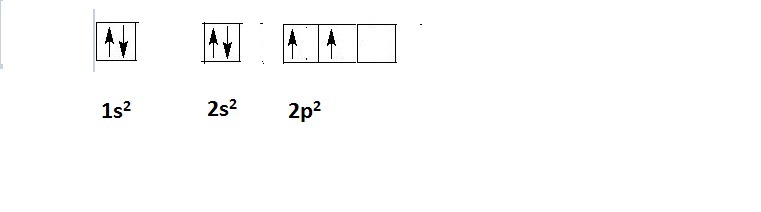
In which orbitals would the valence electrons for carbon c. be placed?

Chemistry
2 answers:
katrin2010 [14]2 years ago
8 0

Answer: 2s and 2p

Explanation: Carbon is an element with atomic number of 6 and thus contains 6 electrons. The electrons are filled in order of increasing energies and follows Afbau's rule.The electrons are singly filled first in each orbital having same spin, then only pairing occurs. This rule was known as Hund's Rule.

The valence electrons are the electrons which are present in last shell. Thus valence electrons are 4, two in s and 2 in p orbitals.

C: 6:1s^22s^22p_x^12p_y^1


telo118 [61]2 years ago
3 0

The answer is: 2s and 2p orbitals.

Carbon (C) is a chemical element with atomic number 6. It has 6 protons and 6 electrons.

Electron configuration for carbon: ₆C 1s² 2s² 2p².

Valence electrons are in 2s and 2p orbitals.

There is one pair of electrons in 2s orbital and two lone electrons in 2p orbital with the same electron spin.

Carbon is in group 14 of periodic table group.


You might be interested in
A student described two properties of a substance shown below which of the following is true about the two properties described
mel-nik [20]

Answer:

B

Explanation:

catches fire easily, there is a chemical in the substance that reacts to the flame, and a key to it being a chemical property is when exposed to other substances, there is a chemical in the other substances that makes it chemically react

7 0
2 years ago
Read 2 more answers
Determine ΔH for the reaction CaCO3 → CaO + CO2 given these data: 2 Ca + 2 C + 3 O2 → 2 CaCO3 ΔH = −2,414 kJ C + O2 → CO2 ΔH = −
kicyunya [14]

Answer:

The ΔH for the reaction is -456.5 KJ

Explanation:

Here we want to determine ΔH for the reaction;

Mathematically;

ΔH = ΔH(product) - ΔH(reactant)

In the case of the first reaction;

ΔH = ΔH(CaO) + ΔH(CO2) - ΔH(CaCO3)  ...........................(*)

From the other reactions, we can get the respective ΔH for the individual molecule in the reaction

In second reaction;

Kindly note that for elements, molecule of gases, ΔH = 0

What this means is that throughout the solution;

ΔH(Ca)  = 0 KJ

ΔH(O2) = 0 KJ

ΔH(C) = 0 KJ

Thus, in writing the equation for the subsequent chemical reactions, we shall need to write and equate the overall ΔH for the reaction to that of the product alone

So in the second reaction

ΔH = 2ΔH(CaCO3)

Thus;

-2414/2 = ΔH(CaCO3)

ΔH(CaCO3) = -1,207  KJ

Moving to the third reaction, we have;

ΔH = ΔH(CO2)

Hence ΔH(CO2) = -393.5 KJ

For the last reaction;

ΔH = ΔH(CaO)

Hence ΔH(CaO) = -1270 KJ

Going back to equation *

ΔH = ΔH(CaO) + ΔH(CO2) - ΔH(CaCO3)

Using the values of the ΔH  of the respective molecules given above,

ΔH  = -1270 + (-393.5) - (-1207)

ΔH  = -456.5 KJ
8 0
2 years ago
After going through a guided tutorial by selecting Run Grams Demonstration, you can create your own experiment by clicking the R
Step2247 [10]

Answer: Thus 24.0 g of SO_2 would be needed.

Explanation:

To calculate the moles :

\text{Moles of solute}=\frac{\text{given mass}}{\text{Molar Mass}}      

\text{Moles of} O_2=\frac{6.00g}{32g/mol}=0.1875moles

2SO_2(g)+O_2(g)\rightarrow 2SO_3(l)  

According to stoichiometry :

1 mole of O_2 require = 2 moles of SO_2

Thus 0.1875 moles of O_2 will require=\frac{2}{1}\times 0.1875=0.375moles  of SO_2  

Mass of SO_2=moles\times {\text {Molar mass}}=0.375moles\times 64g/mol=24.0g

Thus 24.0 g of SO_2 would be needed to completely react with 6.00 g of O_2 such that all reactants could be consumed.

5 0
2 years ago
A load of bauxite has a density of 3.11 . If the mass of the load is 220. metric tons, how many dump trucks, each with a capacit
kicyunya [14]

Answer : The number of dump trucks required are, 8

Explanation : Given,

Density of load of bauxite = 3.11g/cm^3

Mass of load = 220 metric tons = 220\times 10^6g

conversions used : 1 metric ton = 1000000 g

First w have to calculate the volume of load of bauxite.

Volume=\frac{Mass}{Density}

Volume=\frac{220\times 10^6g}{3.11g/cm^3}=7.07\times 10^7cm^3

Convert cubic centimeter to cubic yard:

1cm^3=1.30795\times 10^{-6}yards^3

So,

Volume of load = \frac{1.30795\times 10^{-6}yards^3}{1cm^3}\times (7.07\times 10^7cm^3)

Volume of load = 92.47 cubic yards

Now we have to calculate the number of dump trucks.

Capacity of a dump truck = 11 cubic yard

Number of trump trucks required = \frac{92.47\text{ cubic yard}}{11\text {cubic yard}}=8.406\approx 8

Thus, the number of dump trucks required are, 8

7 0
2 years ago
Glycolysis is the process by which energy is harvested from glucose by living things. Several of the reactions of glycolysis are
mote1985 [20]

Answer:

Unfavorable reactions: Reaction A and Reaction B.

Coupled reactions favorable: Reactions B and C and Reactions A and C.

Net change:

Reactions B and C : -14.2kJ/mol

Reactions A and B : 30.1kJ/mol

Reactions A and C: -16.7kJ/mol

Explanation:

A reaction is thermodynamically favorable (spontaneous) if ΔG < 0. Thus, the unfavorable reactions -ΔG > 0- are:

Reaction A and reaction B.

When reaction C is coupled with reaction B and reaction A the chemical equation is:

ATP + fructose-1,6-phosphate ⟶ ADP + fructose-1,6-bisphosphate

ΔG = 16.3 - 30.5 = -14.2 kJ/mol

ATP + glucose ⟶ ADP + glucose-6-phosphate

ΔG = 13.8 - 30.5 = -16.7 kJ/mol

The coupled reaction of A and B has a change in free energy of:

ΔG = 13.8 + 16.3 = 30.1 kJ/mol

4 0
2 years ago
Other questions:
  • The ionization energy for a hydrogen atom is 1.31×10⁶ J/mol. What is the ionization energy for He+?
    5·2 answers
  • How many kilojoules are required to melt 15g of ice at 0c and raise the temperature of the liquid that forms to 85c?
    12·2 answers
  • Consider the reaction cacn2 3 h2o → caco3 2 nh3 . how much nh3 is produced if 187 g of caco3 are produced?
    9·1 answer
  • A chemist is working on a reaction represented by this chemical equation:
    12·2 answers
  • What mass of sodium chloride (NaCl) forms when 7.5 g of sodium carbonate (Na2CO3) reacts with a dilute solution of hydrochloric
    11·2 answers
  • a student adds 15 g of baking soda to 10 g of acetic acid in a beaker. a chemical reaction occurs and a gas is given off. after
    10·1 answer
  • Choose ALL TRUE statements about calorimetry from the choices below:
    10·1 answer
  • If the gas in the piston above has a volume of 20.0 L at a temperature of 25 C what is the volume of that gas when it is heated
    11·2 answers
  • A titration is performed to determine the amount of sulfuric acid, H2SO4, in a 6.5 mL sample taken from car battery. About 50 mL
    10·1 answer
  • The diagram below represents a beaker of water being heated by a flame. The arrows represent heat
    14·1 answer
Add answer
Login
Not registered? Fast signup
Signup
Login Signup
Ask question!