answer.
Ask question
Login Signup
Ask question
All categories
  • English
  • Mathematics
  • Social Studies
  • Business
  • History
  • Health
  • Geography
  • Biology
  • Physics
  • Chemistry
  • Computers and Technology
  • Arts
  • World Languages
  • Spanish
  • French
  • German
  • Advanced Placement (AP)
  • SAT
  • Medicine
  • Law
  • Engineering
Bond [772]
2 years ago
11

If the gas in the piston above has a volume of 20.0 L at a temperature of 25 C what is the volume of that gas when it is heated

to 100 C if the pressure remains constant

Chemistry
2 answers:
dexar [7]2 years ago
8 0

Answer:

15.98 L

Explanation:

First, you need to find T1, T2, V1 and V2.

T1 = 25 C = 298.15 K (25C + 273.15K)

T2 = 100 C = 373.15 K (100C + 273.15K)

V1 = 20. L

V2 = ? (we are trying to find)

Next, rearrange to fit the formula

V2 = V1 x T1 / T2

Next, fill in with our numbers

V2 = 20. L x 298.15 K / 373.15 K

Do the math and you should get...

15.98 L

- If you need more help or futher explanation please let me know. I would be glad to help!

Otrada [13]2 years ago
7 0

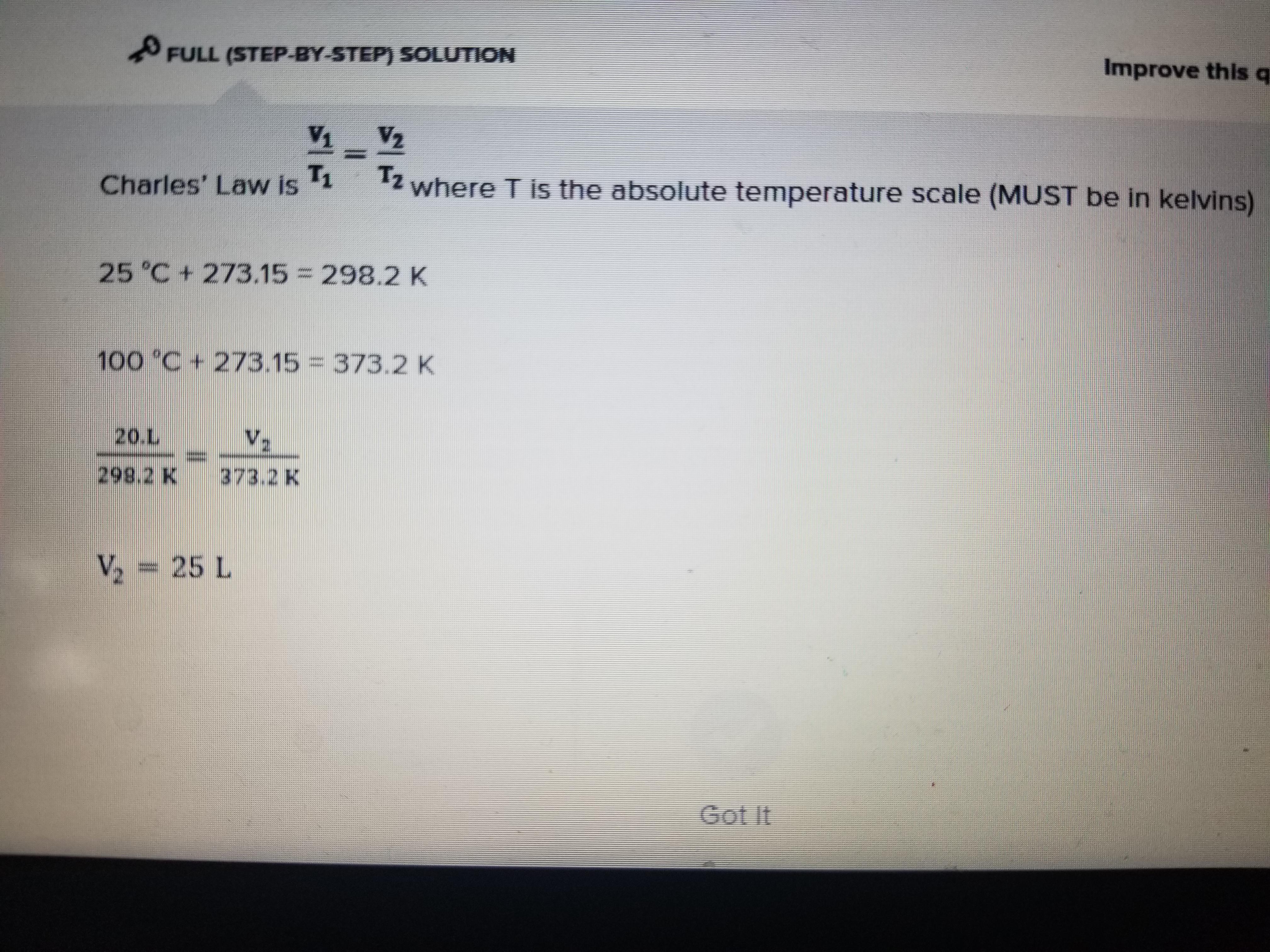
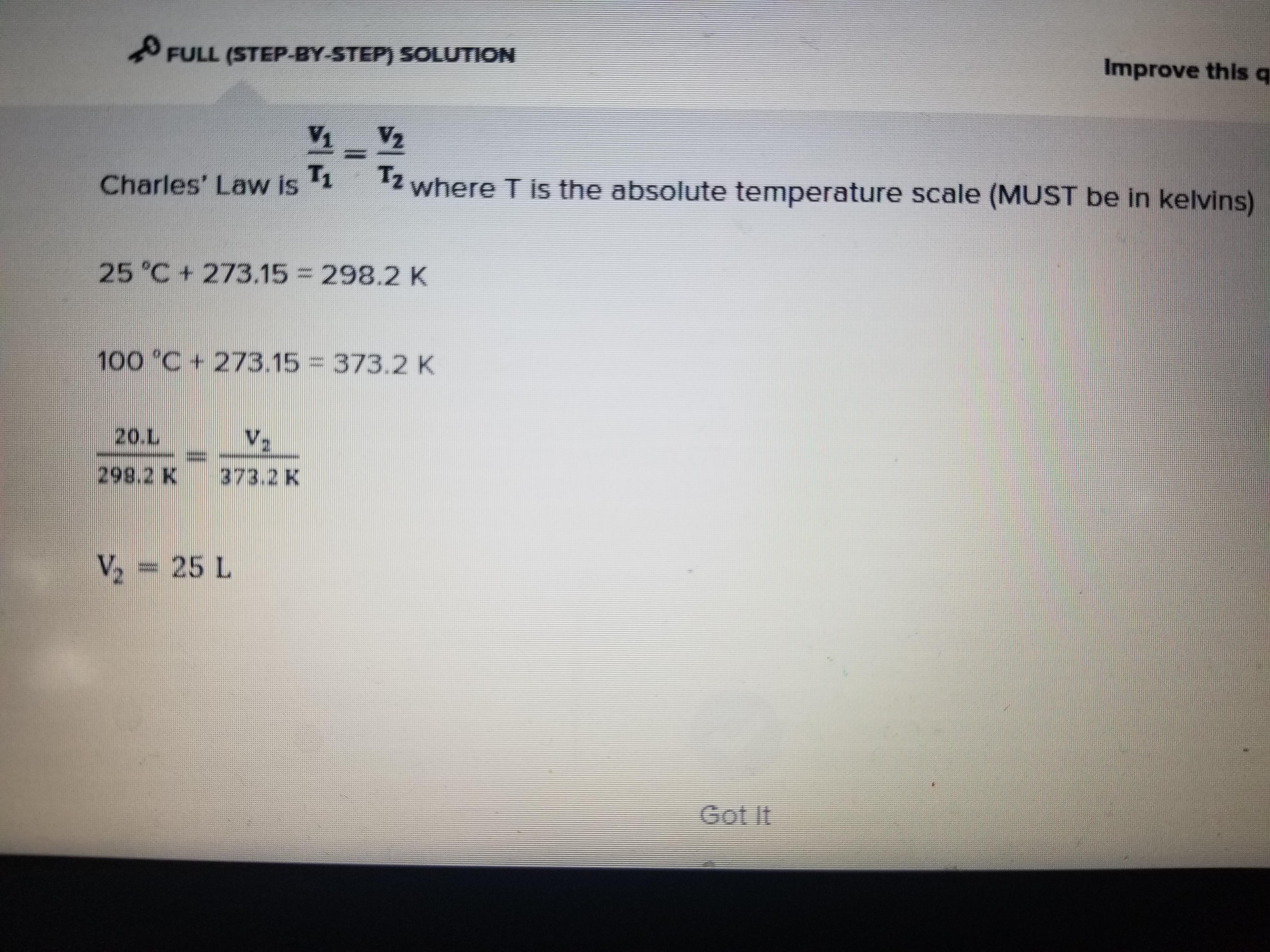
Answer: 25L

Explanation:

You might be interested in
A 75.00 g sample of a substance is analyzed and found to consist of 32.73 g phosphorus and 42.27 g oxygen. calculate the percent
andre [41]
32.73 g phosphorus

42.27 g oxygen.
= 74 .99 substance
3 0
2 years ago
Estimate the increase in the molar entropy of O2(g) when the temperature is increased at constant pressure from 298 K to 348 K,
Tamiku [17]

Explanation:

It is known that relation between entropy, heat energy and temperature is as follows.

        dS = \frac{Q}{T}

        \int dS = \int \frac{Q}{T}

Also we know that at constant pressure, Q = \Delta H = C_{p} - dT

     \int_{S_{1}}^{S_{2}} dS = \int_{T_{1}}^{T_{2}} C_{p} \frac{dT}{T}

     \Delta S = C_{p} \int_{T_{1}}^{T_{2}} \frac{dT}{T}

As the given data is as follows.

        T_{1} = 298 K,          T_{2} = 348 K

         C_{p} = 29.355 J/K mol

Now, putting the given values into the above formula as follows.

          \Delta S = C_{p} ln {T_{1}}^{T_{2}} \frac{dT}{T}

                  = 29.355 [ln (348) - ln (298)]

                  = 29.355 [5.85 - 5.69]

                  = 4.48 J/k mol

Thus, we can conclude that the increase in the molar entropy of given oxygen gas is 4.48 J/k mol.

6 0
2 years ago
A 5 mole sample of liquid acetone is converted to a gas at 75.0°C. If 628 J are required to raise the temperature of the liquid
Shkiper50 [21]
The total energy can be found by adding the different energies:
628 + 15,600 + 712
= 16.94 kJ
4 0
2 years ago
Which procedure cannot be performed on a hot plate, requiring a Bunsen burner instead
ankoles [38]

Answer: Heating a crucible to remove water from a hydrate.

Explanation:

The options are:

a. Heating a solvent to help a solute dissolve.

b. Heating an isolated solid to dry it.

c. Heating water to boiling for a water bath.

d. Heating a crucible to remove water from a hydrate.

The procedure that can be performed on a hot plate are:

a. Heating a solvent to help a solute dissolve.

b. Heating an isolated solid to dry it.

c. Heating water to boiling for a water bath.

It should be noted that the hot plate cannot be used for heating of crucible in order to remove water from a hydrate. It is not advisable for someone to heat any silica or ceramic objects on a hot plate.

Therefore, heating a crucible to remove water from a hydrate is the correct option.

4 0
2 years ago
Be sure to answer all parts. For each reaction, find the value of ΔSo. Report the value with the appropriate sign. (a) 3 NO2(g)
Liono4ka [1.6K]

Answer:

a. -268.13 J/K

b. -279.95 J/K

c. + 972.59 J/K

Explanation:

The value of the change in entropy (ΔS°) can be calculated by:

ΔS° = ∑n*S° products - ∑n*S° reactants, where n is the stoichiometric number of moles.

The values of S° for each substance can be found on a thermodynamic table.

a. 3NO2(g) + H2O(l) → 2HNO3(l) + NO(g)

S°, NO2(g) = 240.06 J/mol.K

S°, H2O(l) = 69.91 J/mol.K

S°, HNO3(l) = 155.60 J/mol.K

S°, NO(g) = 210.76 J/mol.K

ΔS° = (210.76 + 2*155.60) - (3*240.06 + 69.91)

ΔS° = -268.13 J/K

b. N2(g) + 3F2(g) → 2NF3(g)

S°, N2(g) = 191.61 J/mol.K

S°, F2(g) = 202.78 J/mol.K

S°, NF3(g) = 260.0 J/mol.K

ΔS° = (2*260.0 ) - (191.61 + 3*202.78)

ΔS° = -279.95 J/K

c. C6H12O6(s) + 6O2(g) → 6CO2(g) + 6H2O(g)

S°, C6H12O6(s) = 212 J/mol.K

S°, O2(g) = 205.138 J/mol.K

S°, CO2(g) = 213.74 J/mol.K

S°, H2O(g) = 188.83 J/mol.K

ΔS° = (6*213.74 + 6*188.83) - (212 + 6*205.138)

ΔS° = +972.59 J/K
3 0
2 years ago
Other questions:
  • If 155 grams of potassium (K) reacts with 122 grams of potassium nitrate (KNO3), what is the limiting reagent?
    11·1 answer
  • What do pH and conductivity have in common?
    6·2 answers
  • A 10.0-ml sample of 0.200 m hydrocyanic acid (hcn) is titrated with 0.0998 m naoh. what is the ph at the equivalence point? for
    7·1 answer
  • How many free ions are there on the products side of the total ionic equations that results from the reaction between bismuth 3
    10·1 answer
  • A 0.0200 M NaCl solution was formed when 38.0 grams of NaCl was dissolved in enough water. What was the total volume of the solu
    8·2 answers
  • What is the name of the following ionic compound?: MoAs
    9·1 answer
  • When a 3.25 g sample of solid sodium hydroxide was dissolved in a calorimeter in 100.0 g of water, the temperature rose from 23.
    11·1 answer
  • A student wants to form 2‑hexanol using acidic hydration. He finds four alkenes in the inventory cabinet that could be possible
    12·1 answer
  • What is the simplest formula of a compound if a sample of the compound contains 0.221 mol X, 0.442 mol Y, and 0.884 mol Z? chemP
    9·2 answers
  • Catherine has some seawater. She wants to separate pure water from the seawater.
    8·2 answers
Add answer
Login
Not registered? Fast signup
Signup
Login Signup
Ask question!